Decide Whether to Blend or Stir a Cocoa and Banana Milk Drink for a Single Serving
A ripe banana and unsweetened cocoa powder can be combined with cold milk in two different ways, and the method you choose changes the texture, preparation time, and equipment you need to wash afterwards. Stirring is faster and suits a very ripe banana, while blending handles a firmer banana and produces a smoother, more uniform drink. Understanding what each method actually delivers helps you make the right call before you start rather than adjusting halfway through.
Read the note ↓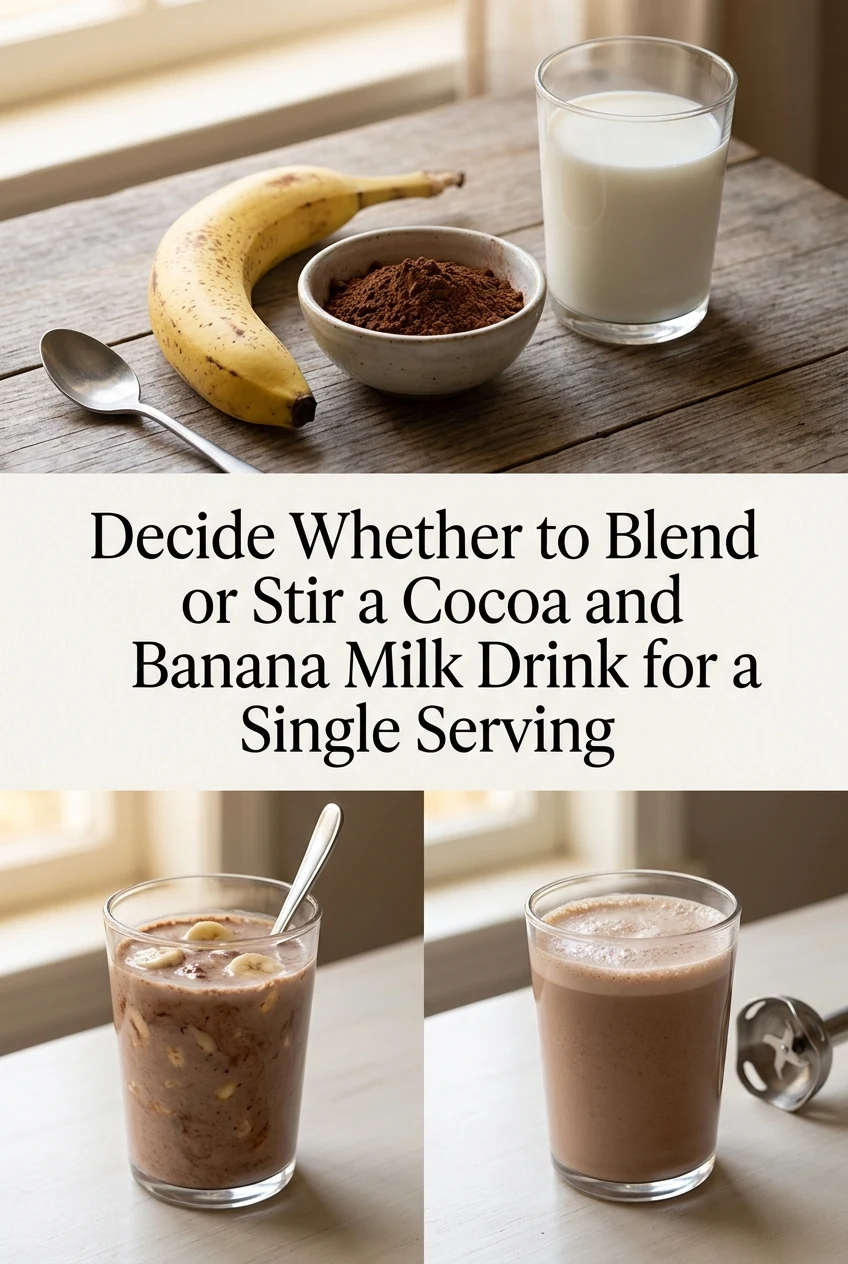
AI-generated editorial concept created for this article. The image is not a technical diagram or a tested result.
Assess the Banana Before Choosing a Method
A banana with a fully yellow skin and soft flesh mashes easily with a fork to a near-liquid paste in about 30 seconds. A banana that is still slightly firm at the centre, with a mostly yellow skin and only a few brown spots, resists fork mashing and leaves visible lumps in a stirred drink. If your banana falls into the first category, stirring is a practical choice. If it is in the second category, blending will produce a noticeably better result without requiring extra effort to compensate for the firmer texture.
The Stir Method: Steps and Realistic Outcome
Mash one very ripe banana thoroughly in a tall glass or deep bowl using a fork. Add 1 tablespoon of unsweetened cocoa powder and 1 teaspoon of sugar or honey, then mash and stir everything together into a rough paste before adding any liquid. Pour in 250 millilitres of cold pasteurised milk gradually, stirring continuously. The drink will be slightly textured with small banana flecks visible. This is normal and not a flaw. It takes about 3 minutes and requires only a fork and a glass to clean.
The Blend Method: Steps and Realistic Outcome
Break one banana, ripe or moderately firm, into 3 or 4 pieces and place them in a blender jar. Add 1 tablespoon of unsweetened cocoa powder, 1 teaspoon of sugar or honey, and 250 millilitres of cold pasteurised milk. Blend on medium speed for 20 to 30 seconds until fully smooth. Pour into a 350 to 400 millilitre glass immediately. The result is uniform, with no visible texture. The trade-off is a blender jar, lid, and blade assembly to wash. For a single serving, this is a meaningful consideration.
Glass Size Affects Which Method Works Comfortably
The stir method requires enough depth in the vessel to mash and stir without splashing. A standard 350 millilitre glass is too narrow for comfortable mashing; a wide bowl or a 500 millilitre jug works better for the mashing stage, after which you pour the finished drink into your serving glass. The blend method has no such constraint since the blender jar handles the mixing. If you only have a narrow glass available and no wide bowl, blending is the more practical choice regardless of banana ripeness.
Cocoa Powder Behaviour Differs Between the Two Methods
Unsweetened cocoa powder does not dissolve easily in cold milk. In the stir method, mixing it into the mashed banana paste first, before any milk is added, coats the cocoa particles in banana and helps them distribute more evenly once the milk is poured in. Skipping this step and adding cocoa directly to cold milk results in floating clumps. In the blend method, the mechanical action disperses the cocoa fully regardless of order. This distinction matters most if you are stirring; the paste step is not optional for a smooth result.
A little more
to know.
Can this drink be served warm instead of cold?
Yes for the stir method: make the banana and cocoa paste first, then stir in warm milk heated to just below simmering. Do not blend hot liquids in a standard blender jar unless the manufacturer's instructions specifically permit it.
Does the type of cocoa powder matter for either method?
Natural unsweetened cocoa and Dutch-process cocoa both work, but Dutch-process has a milder, less sharp flavour and disperses slightly more smoothly. Either type should be sifted if it appears clumped before you begin, regardless of which method you choose.
Original editorial guidance and recipe formulations, not independently kitchen-tested. Times are estimates and depend on equipment and product directions. Cooked bases need additional cooling and refrigeration before cold serving. Images are AI-generated illustrations; appearance and yield may vary. Check actual ingredient labels, allergens, and any certification you require. We do not certify products. Read our approach.
Save to Pinterest ↗ANOTHER IDEA FOR THE COUNTER