Compare a Bamboo Whisk and a Handheld Frother for Matcha
Two tools that home matcha drinkers reach for most often are the traditional bamboo whisk and the battery-powered handheld frother, and they produce noticeably different results in the cup. The choice affects not only the foam texture but also how evenly the powder disperses and what kind of vessel you need to use effectively. Understanding what each tool actually does helps you match it to the drink you want to make rather than guessing between them.
Read the note ↓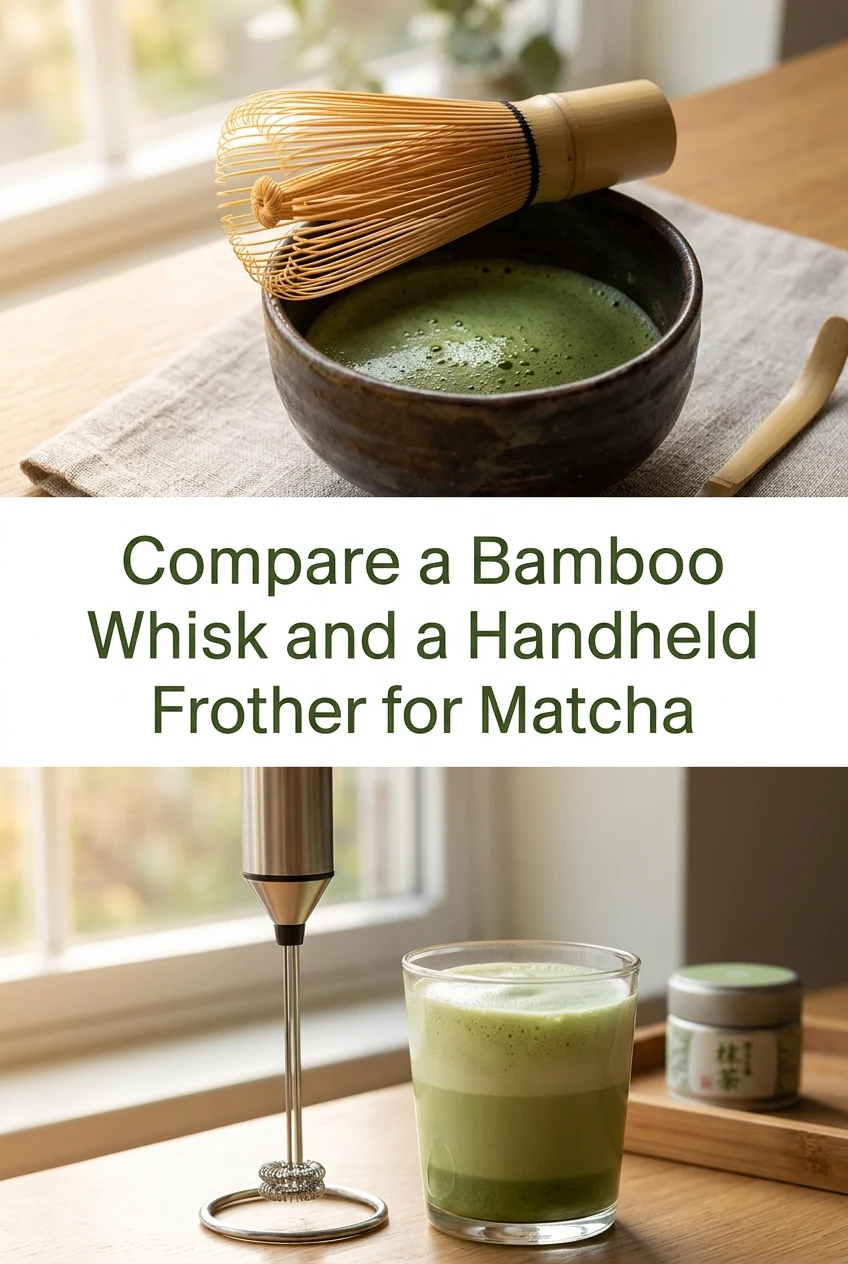
AI-generated editorial concept created for this article. The image is not a technical diagram or a tested result.
How the Bamboo Whisk Moves Through Liquid
A bamboo whisk, called a chasen, works through a rapid W or M shaped wrist motion across the bottom and sides of a wide bowl. The many fine tines create friction that breaks up clumps and incorporates air gradually. Because the motion is lateral rather than vertical, the foam that forms is fine-bubbled and relatively stable. The wide, shallow matcha bowl shape is important here; a tall narrow cup restricts the tine spread and reduces the whisk's effectiveness significantly.
How the Handheld Frother Moves Through Liquid
A battery frother spins a small coil at high speed, pulling liquid upward and folding air in quickly. It works in a taller, narrower vessel because the coil only needs a few centimetres of clearance. The foam it produces tends to be larger-bubbled and lighter than chasen foam, and it dissipates more quickly in the cup. For a matcha latte with steamed or heated milk poured over, the frother can produce a visible foam layer, though it may settle within a minute or two.
Powder Dispersion and Clump Reduction
Matcha powder clumps easily when it contacts water. Both tools address this, but in different ways. Sifting roughly one to two grams of matcha powder through a small fine sieve before adding water reduces clumps before either tool begins working. The chasen then disperses remaining particles through repeated tine contact with the bowl surface. The frother disperses through centrifugal force. In practice, the chasen tends to produce a smoother, more uniform suspension when the powder has been sifted first.
Water Temperature and Volume for Each Method
Both tools work best with water that is hot but not boiling, typically around 70 to 80 degrees Celsius, to avoid a bitter or dull result. For a chasen preparation, 60 to 80 millilitres of water in a wide bowl gives the tines room to work before milk is added. For a frother preparation, the same water volume in a taller cup or jug is sufficient. These are practical starting ranges, not universal standards, and your preferred strength will affect how much water you use.
Cleaning and Practical Upkeep
A bamboo whisk should be rinsed with warm water immediately after use and allowed to air dry on a whisk holder or upright so the tines keep their shape. It should not be submerged or scrubbed with soap. A handheld frother coil can be rinsed under running water or briefly run in a cup of clean water to clear residue. The frother requires battery or charge management that the chasen does not, making the chasen simpler to maintain for daily use.
A little more
to know.
Can I use a regular kitchen whisk instead of a chasen?
A standard kitchen whisk can break up clumps but its tines are too widely spaced to create the fine foam a chasen produces. The result is typically less smooth and the foam, if any forms, is coarser and collapses quickly.
Does the frother work directly in cold milk for an iced matcha latte?
A frother can mix matcha into a small amount of warm water first, which you then pour over cold milk and ice. Whisking matcha powder directly into cold liquid without pre-dissolving it usually leaves visible unmixed clumps in the finished drink.
Original editorial guidance and recipe formulations, not independently kitchen-tested. Times are estimates and depend on equipment and product directions. Cooked bases need additional cooling and refrigeration before cold serving. Images are AI-generated illustrations; appearance and yield may vary. Check actual ingredient labels, allergens, and any certification you require. We do not certify products. Read our approach.
Save to Pinterest ↗ANOTHER IDEA FOR THE COUNTER