Choose Between a Wide Shallow Dish and a Deep Ramekin for Setting a Small Cocoa Pudding
Container shape changes how heat leaves a cocoa pudding during setting and how cleanly it releases at the table. A wide shallow dish spreads the mixture thin, while a deep ramekin keeps it tall and dense. Neither is universally better; the right choice depends on your preferred texture, whether you plan to unmould the pudding, and how many portions you are making from a single batch.
Read the note ↓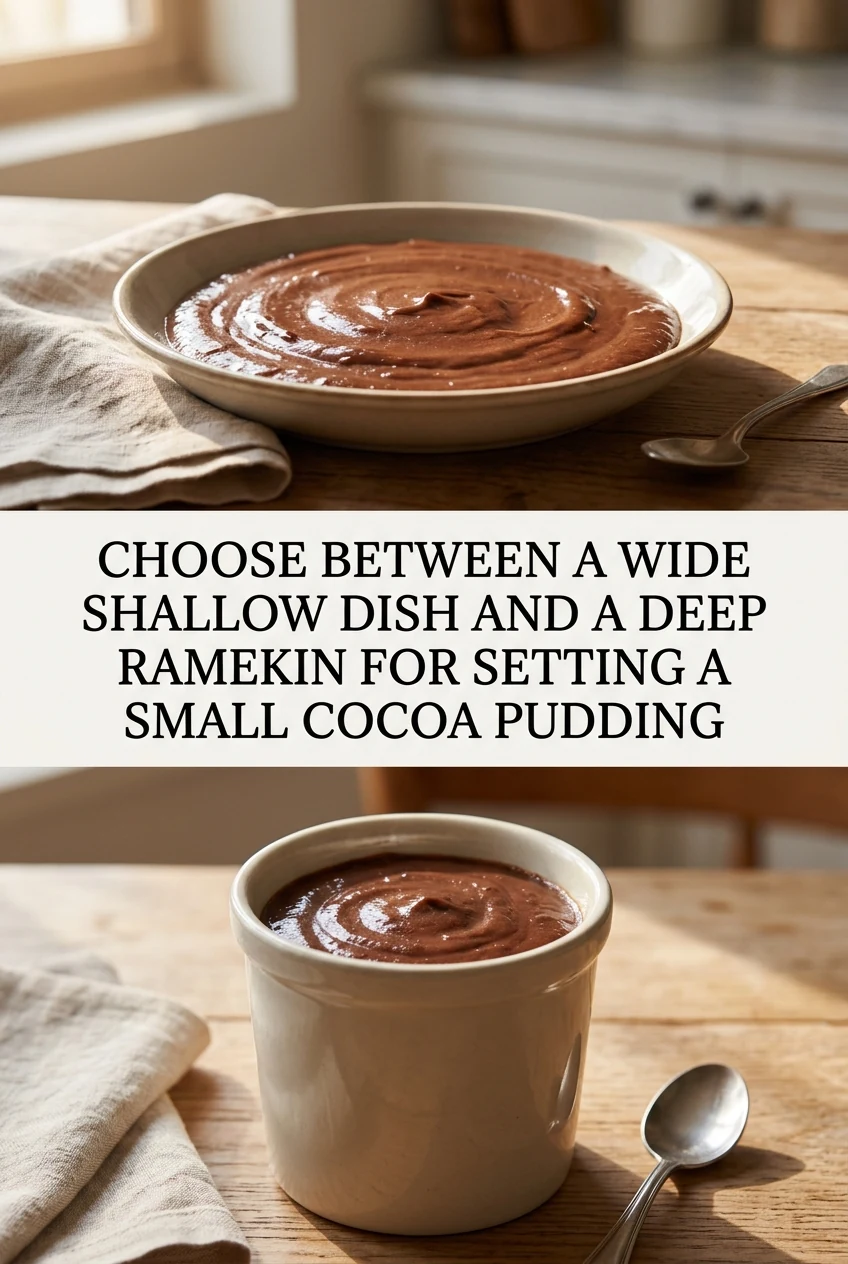
AI-generated editorial concept created for this article. The image is not a technical diagram or a tested result.
How Depth Affects Setting Time
A shallow dish roughly 12 cm wide and 3 cm deep exposes more surface area to ambient temperature, so the pudding firms from the top and sides simultaneously. A standard 6 cm deep ramekin holds heat longer at its centre, meaning the middle sets last. For a cornstarch-thickened cocoa pudding poured hot from the stove, the shallow dish typically reaches a firm set throughout in noticeably less refrigerator time than the ramekin, though exact times depend on your refrigerator and batch size.
Texture Differences You Will Actually Notice
The shallow dish produces a pudding that is relatively uniform in firmness from edge to centre because the thin layer cools evenly. The deep ramekin often yields a slightly softer, creamier core surrounded by a firmer outer layer. If you enjoy a spoonable pudding with a consistent set, the shallow dish suits that goal. If you prefer a denser, almost mousse-like centre with a clean outer skin, the ramekin delivers that contrast without any recipe change.
Unmoulding Feasibility
A shallow dish is rarely unmoulded; the pudding is simply spooned out, which means presentation is informal. A straight-sided ceramic ramekin, lightly brushed with a neutral oil before pouring, can be unmoulded onto a small plate by running a thin spatula around the edge and inverting briefly. This only works reliably once the pudding is fully set and cold. Attempting to unmould a warm or partially set pudding from either vessel will collapse the structure regardless of container choice.
Portion Size and Batch Planning
A worked example: a recipe yielding 500 ml of cocoa pudding mixture fills roughly two standard 250 ml ramekins or one 500 ml wide shallow dish. If you are serving two people individually, two ramekins keep portions separate and refrigerate neatly stacked with cling film. One shallow dish suits a shared dessert served at the table. This is an illustrative calculation based on volume, not a verified yield, since mixture density varies by recipe.
Practical Storage Considerations
Both vessels must be covered with cling film pressed directly onto the pudding surface to prevent a skin from forming, then refrigerated promptly. Move the filled containers to the refrigerator within two hours of cooking, or within one hour if your kitchen is above 32 C. Shallow dishes stack awkwardly in a crowded refrigerator; ramekins are easier to arrange. Use pasteurised dairy in the pudding mixture and keep it refrigerated until serving.
A little more
to know.
Can I use a glass dish instead of ceramic for either shape?
Yes. Oven-safe glass works for both shapes and lets you see the set from the side. Glass conducts heat differently from ceramic, so check the centre of the pudding before assuming it is fully set based on the edges alone.
Does the cocoa percentage in the recipe change which vessel works better?
Higher cocoa content can make the mixture slightly thicker before pouring, which matters more in a deep ramekin where the centre sets last. A thicker mixture in a deep vessel may leave a denser, less smooth core compared with the same mixture spread in a shallow dish.
Original editorial guidance and recipe formulations, not independently kitchen-tested. Times are estimates and depend on equipment and product directions. Cooked bases need additional cooling and refrigeration before cold serving. Images are AI-generated illustrations; appearance and yield may vary. Check actual ingredient labels, allergens, and any certification you require. We do not certify products. Read our approach.
Save to Pinterest ↗ANOTHER IDEA FOR THE COUNTER