Choose a Serving Knife That Fits a Small Loaf Board
A small loaf board is a practical surface for a home-cafe syrup station, letting you slice garnishes, portion soft cheeses, or cut small breads alongside a jar of freshly made syrup. The challenge is choosing a serving knife whose blade length actually suits the board dimensions so you have room to cut cleanly without the tip hanging over the edge or the handle bumping the drink preparation area. This article walks through a straightforward way to compare blade length and board space before you commit to a knife, illustrated with one worked example. The steps here describe a planning approach, not a laboratory-tested outcome.
Read the note ↓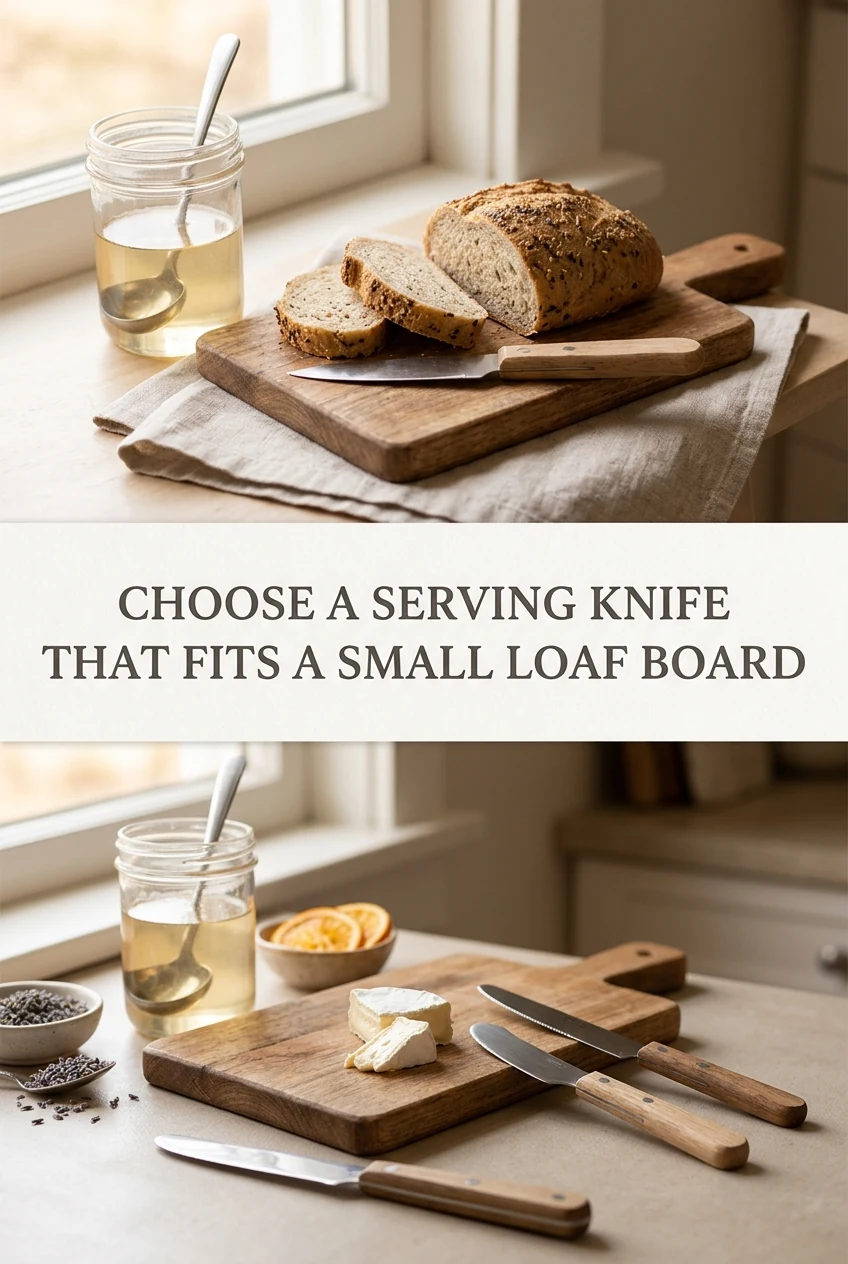
AI-generated editorial concept created for this article. The image is not a technical diagram or a tested result.
Understand Your Board Dimensions First
Before looking at any knife, measure your loaf board carefully. A typical small loaf board sold for home use runs between 25 cm and 35 cm long and 12 cm to 18 cm wide. Write down both measurements. The length matters because it sets the maximum useful blade length, and the width matters because it tells you how much lateral room you have when the knife rests across the board between cuts. If your board sits on a counter that also holds a kettle, a syrup bottle, or a small pitcher, measure the gap between the board edge and those items. That gap is your preparation buffer, and you want the knife handle to stay inside the board footprint so it never reaches into the drink preparation zone.
Match Blade Length to Board Length With Simple Arithmetic
When selecting a knife, start by evaluating the usable cutting length against your board. A blade needs enough clear run to slice through small breads or citrus garnishes without running off the ends of the board during a cutting stroke. However, blade length cannot be evaluated in isolation from the rest of the knife. If a knife blade takes up too much of the board length, the handle attached to it will inevitably extend past the board edge when the tool is set down. For a 30 cm board, selecting a knife with a blade around 12 cm to 14 cm provides adequate cutting edge for garnishes while leaving space for the handle. For a shorter 25 cm board, a compact utility or paring knife with a blade of 9 cm to 11 cm keeps the blade proportionate to the cutting area. Measuring the blade alongside the board gives you a practical baseline before factoring in the handle.
Check Handle Clearance and Board Stability
Once you have a blade length target, think about the handle. Handles on serving knives range from about 10 cm to 14 cm. Add your chosen blade length to the handle length to get the total knife length. That total should be shorter than the board length, ideally by at least 4 to 5 cm, so the handle does not project beyond the board when you set the knife down. Board stability is equally important. A loaf board without rubber feet or a damp cloth underneath can slide when you apply cutting pressure. Place a folded damp cloth beneath the board before use to keep it from shifting. This is a standard kitchen practice and does not require any special equipment.
A Worked Example: 30 cm Board and a Rosemary Syrup Garnish Session
Imagine you have made a small batch of rosemary syrup using water, sugar, and fresh rosemary, following the proportions on a reliable recipe. The syrup is cooled and refrigerated promptly after straining. You plan to serve it with sparkling water and want to cut thin lemon slices and small bread rounds as accompaniments on a 30 cm loaf board. If you consider an 18 cm utility knife with a 12 cm handle, the combined length reaches 30 cm, which spans the entire board from edge to edge with no buffer. Swapping to a 13 cm utility knife with an 11 cm handle gives an overall length of 24 cm. Resting this knife on the 30 cm board leaves a 6 cm margin, ensuring neither the tip nor the handle extends over the edges. You position the board so its far edge sits at least 15 cm from the syrup bottle and glasses, keeping the cutting surface clearly separated from the drink preparation edge. This is an illustrative plan based on the measurements described, not a result from a controlled test.
Syrup Ingredients and Prompt Refrigeration
When the syrup itself is part of the home-cafe setup, ingredient choices matter. Use only alcohol-free vanilla flavoring if vanilla is part of the recipe, and confirm the label states it contains no alcohol. Any gelatin used in related preparations should be labeled halal. Fresh herb syrups made with water and sugar are perishable and should be refrigerated as soon as they reach room temperature. Follow the storage guidance from the specific recipe you are using rather than assuming a general shelf life, since conditions vary. Keep the syrup jar away from the cutting surface on the loaf board to avoid cross-contamination from knife work.
A little more
to know.
Can I use a bread knife on a small loaf board?
A serrated bread knife can work on a small loaf board if its overall length, including the handle, fits comfortably within the board dimensions with margin to spare. Many standard bread knives have blades of 20 cm or longer with 12 cm handles, giving total lengths that exceed small boards. For a compact board, look for a shorter serrated utility knife so both the blade and handle stay within the board edges when resting.
How do I keep the loaf board from sliding during use?
Place a folded damp cloth flat on the counter beneath the board before you begin. The damp cloth grips both the counter and the underside of the board, helping to keep the board steady when you apply cutting pressure. Make sure the cloth is spread flat with no bunched folds that could tilt the board.
Original editorial guidance and recipe formulations, not independently kitchen-tested. Times are estimates and depend on equipment and product directions. Cooked bases need additional cooling and refrigeration before cold serving. Images are AI-generated illustrations; appearance and yield may vary. Check actual ingredient labels, allergens, and any certification you require. We do not certify products. Read our approach.
Save to Pinterest ↗ANOTHER IDEA FOR THE COUNTER