Check Whether a Lid Belongs to the Container Before Storing It
A still-fruit bar produces a steady stream of glass jars, plastic pitchers, and blender cups, each paired with its own lid. Grabbing the nearest lid and pressing it onto the nearest container is a habit that leads to leaks, cracked seals, and wasted batches. Before anything goes into the refrigerator, take thirty seconds to confirm that the lid you are holding was actually designed for the container in your other hand. This article walks through a practical home-cafe approach for making that confirmation a reliable part of your workflow.
Read the note ↓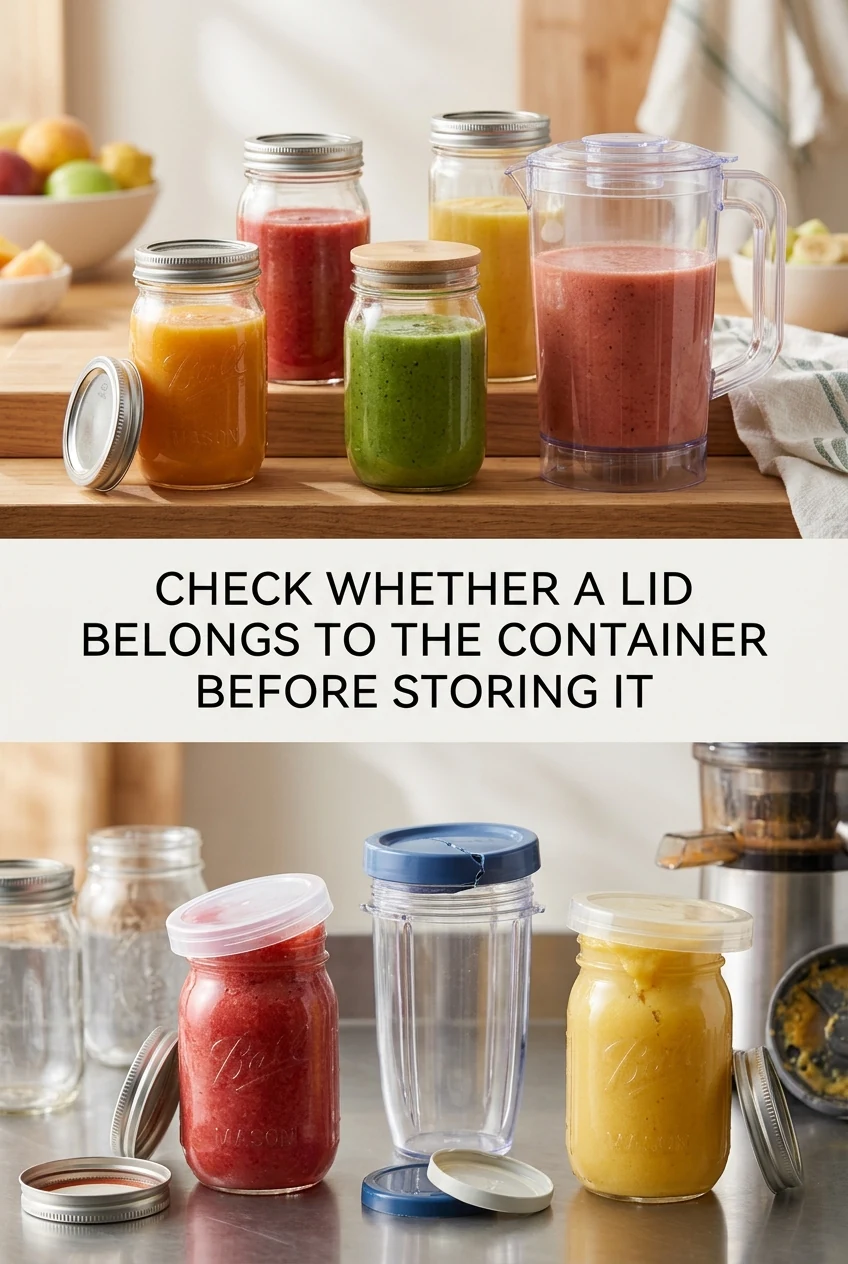
AI-generated editorial concept created for this article. The image is not a technical diagram or a tested result.
Why Lid-to-Container Matching Matters at a Still-Fruit Bar
A still-fruit bar typically keeps several container types in rotation at once: wide-mouth mason jars for infused waters, narrow-mouth glass bottles for cold-pressed juices, plastic blender cups for smoothie bases, and lidded pitchers for fruit syrups. Each of these has a lid engineered to a specific thread count, diameter, or bayonet pattern. A lid from a 500 ml wide-mouth jar will sit loosely on a 500 ml narrow-mouth jar even though both hold the same volume, because the opening diameters differ. That loose fit allows air in, accelerates spoilage of perishable fruit preparations, and can cause a full container to spill when moved. Confirming the match before storage is not a minor detail; it is the step that keeps your refrigerated batches safe and your workspace organized.
Reading Model and Size Markings on Lids and Containers
Most reputable container manufacturers mold or print identifying information directly onto their products. On glass mason jars you will often find the mouth diameter embossed on the base or shoulder, such as 70 mm or 86 mm. The matching lid will carry the same figure on its underside or on the band. Blender cup lids frequently display a model code that corresponds to the cup series listed in the manufacturer's documentation. Plastic pitcher lids may show a part number on the interior rim. Before your still-fruit bar session begins, spend a moment grouping lids with their containers and cross-referencing any visible markings against the original packaging or the maker's printed instructions. If markings have worn away, keep the original box or photograph the label when the product is new.
A Worked Example: Matching Lids for a Hibiscus and Berry Infusion Session
Imagine you are preparing a batch of hibiscus and mixed-berry infused water to refrigerate overnight. You have steeped dried halal-sourced hibiscus flowers and fresh berries in filtered water, allowed the mixture to cool to room temperature, and are now ready to portion it into three 1-litre wide-mouth glass jars. You also have on the counter two narrow-mouth 1-litre bottles left over from a previous juice session, along with their lids. All five lids look similar at a glance. Here is an illustrative plan, not a tested result, for how matching could proceed. First, check the embossed diameter on the base of each jar and bottle. The wide-mouth jars read 86 mm; the narrow-mouth bottles read 70 mm. Next, check the underside of each lid for the same figure. Sort the lids into two groups accordingly. Seat each wide-mouth lid onto a wide-mouth jar by hand, turning until you feel the thread engage smoothly without forcing. Do the same for the narrow-mouth lids. If any lid requires unusual pressure or sits at an angle, stop, remove it, and recheck the markings. Only lids that seat and close with normal hand pressure belong on those containers. Refrigerate the sealed jars promptly, as the fruit infusion is perishable.
Handling Blender Lids and Pitcher Lids Separately
Blender cups and their lids deserve special attention because forcing a mismatched lid onto a blender cup can damage the sealing ring or the cup threads, and a damaged seal may not be visible until liquid escapes. Always follow the blender manufacturer's instructions for which lid model pairs with which cup model. Do not attempt to fit a lid from one brand onto a cup from another brand, even if the outer diameter appears close. For lidded pitchers used to store fruit syrups, confirm that the lid's interior gasket sits flush against the pitcher rim all the way around before placing the pitcher in the refrigerator. A gasket that bunches or gaps on one side indicates a mismatch. Fruit syrups made with fresh juice and sugar are perishable and must be refrigerated promptly; a poorly fitting lid does not extend their usable period.
Building a Simple Lid-Matching Habit Into Your Workflow
Consistency is easier when the habit has a fixed place in your routine. Consider designating a small tray or section of your prep counter as the matching station. After washing containers and lids, place them on this tray in pairs before any filling begins. If a lid has no obvious partner on the tray, set it aside rather than guessing. Label storage bins with the container type and mouth size so lids are returned to the correct bin after washing. When you acquire new containers, note the model markings immediately and store the documentation. Over time, this approach reduces the chance of a mismatched lid reaching a filled container, which means fewer spills, fewer wasted batches, and a more organized still-fruit bar.
A little more
to know.
Can I use a lid that fits snugly but is not the manufacturer's intended match for my container?
It is best not to. A lid that feels snug but does not carry the matching model or diameter marking may not seal correctly under the pressure changes that occur when a cold container warms slightly or when liquid shifts. Follow the manufacturer's intended pairing to avoid leaks and to keep the container's threads undamaged.
How do I store lids so they stay matched to the right containers between uses?
One practical approach is to keep each lid loosely placed on its container during storage, or to store lids in labeled bins that correspond to the container type and mouth size. Grouping by the embossed diameter or model code printed on the lid makes it straightforward to pick the correct lid at the start of each still-fruit bar session without searching through a mixed pile.
Original editorial guidance and recipe formulations, not independently kitchen-tested. Times are estimates and depend on equipment and product directions. Cooked bases need additional cooling and refrigeration before cold serving. Images are AI-generated illustrations; appearance and yield may vary. Check actual ingredient labels, allergens, and any certification you require. We do not certify products. Read our approach.
Save to Pinterest ↗ANOTHER IDEA FOR THE COUNTER