Assemble a Savory Cream Cheese and Smoked Salmon Bagel for a Café Plate
A composed smoked salmon bagel plate can look polished or haphazard depending almost entirely on the order and care of assembly. The challenge for home café cooks is not sourcing the ingredients but controlling how each layer sits so the finished plate reads as intentional rather than thrown together. This guide walks through splitting, toasting, spreading, and layering as a coherent sequence, using one illustrative worked example to show how the components relate to each other in size, coverage, and placement. No specific results are guaranteed, as outcomes vary with equipment and ingredient brands.
Read the note ↓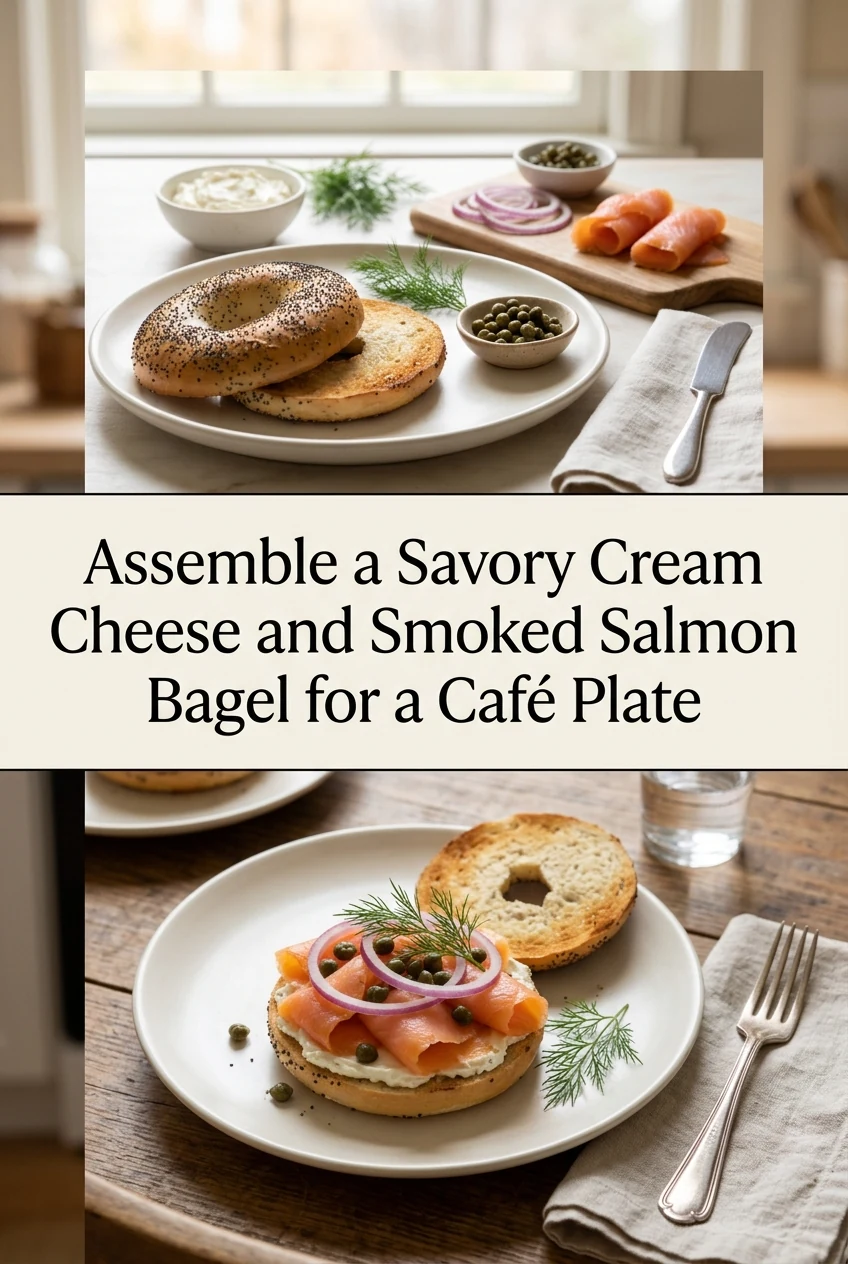
AI-generated editorial concept created for this article. The image is not a technical diagram or a tested result.
Choose and Split the Bagel
Select a plain or everything-seasoned bagel with a relatively flat crumb rather than a very open, airy one. A dense crumb gives the cream cheese something firm to grip and prevents the spread from sinking into large holes unevenly. Place the bagel on a stable cutting board and hold it flat with your palm resting lightly on top. Using a serrated bread knife, cut horizontally through the middle with a single steady sawing motion rather than pressing down. Aim for two halves of roughly equal thickness. If one half is noticeably thicker, it will toast unevenly and the thinner half may over-brown before the thicker one is ready. Once split, inspect the cut faces: they should be relatively smooth and parallel so both halves sit flat in the toaster slots.
Toast to a Consistent Color
Toast both halves cut-side up in a toaster or toaster oven set to a medium setting on your specific appliance. Because toaster browning varies by model and bagel moisture content, watch the first batch closely and adjust the setting for subsequent rounds rather than assuming one setting works universally. The target is a surface that is firm and lightly golden so it can support a spread without immediately softening, but not so dark that the flavor becomes bitter. Remove the halves and allow them to rest on a wire rack or plate for about one minute before spreading. Spreading onto a very hot surface can cause cream cheese to melt and slide rather than hold its shape.
Spread Cream Cheese Evenly to the Edge
Use full-fat block-style cream cheese that has been left at room temperature for around fifteen to twenty minutes so it is soft enough to spread without tearing the bagel surface. For each half of a standard bagel measuring roughly ten centimeters across, a layer approximately four to five millimeters thick is a workable starting point in this illustrative plan. Place a generous spoonful in the center and use an offset spatula or the back of a spoon to push the spread outward in short strokes toward the rim. The goal is an even layer that reaches close to the edge without spilling over, so every bite includes cream cheese. Uneven coverage leaves dry patches under the salmon and makes the plate look unfinished. Season the cream cheese lightly with a small pinch of fine sea salt and cracked black pepper before or after spreading, depending on your preference.
Layer Smoked Salmon, Capers, and Cucumber
Drape thin slices of cold-smoked salmon across the cream cheese in loose, slightly overlapping folds rather than pressing them flat. Folded salmon shows texture and depth, which contributes to the café appearance. For one bagel half, two to three thin slices arranged to cover most of the surface without completely hiding the cream cheese edge is a reasonable illustrative quantity. Next, scatter a small number of capers, perhaps six to eight per half, distributing them so they appear at intervals rather than clustered in one spot. Finally, add four to six very thin rounds of cucumber, cut on a mandoline or with a sharp knife to a thickness of roughly two millimeters. Lay them slightly overlapping along one side of the bagel so they remain visible as a distinct component rather than disappearing under the salmon.
Plate for a Finished Café Presentation
Place both assembled halves on a wide, flat plate with the cut sides facing up and the halves positioned at a slight angle to each other rather than parallel, which creates a more dynamic composition. Add a small cluster of dressed salad leaves or a few thin lemon slices to one corner of the plate to introduce color contrast without overcrowding the bagel itself. Keep the plate surface clean by wiping any cream cheese smears with a folded paper towel before serving. The assembled plate should show at least three distinct visual layers: the toasted bagel rim, the white cream cheese edge, and the pink salmon with the green cucumber rounds visible alongside. This layered visibility is what distinguishes a composed café plate from a simple assembled sandwich.
A little more
to know.
Can the bagel halves be assembled ahead of time and held before serving?
Assembling too far in advance is not recommended because the toasted surface softens as it absorbs moisture from the cream cheese and salmon. For best texture, toast and assemble each plate close to the time it will be served. If you need to prep components in advance, keep the cream cheese covered in the refrigerator, the salmon chilled and wrapped, and the cucumber slices in a small covered container, then assemble to order.
What type of smoked salmon works best for this assembly?
Cold-smoked salmon sliced thinly is the most practical choice for this style of plate because it drapes and folds easily without breaking apart. Hot-smoked salmon has a flakier texture and can be used, but it tends to sit in chunks rather than draping, which changes the visual layering. Either style is suitable as long as it is labeled as ready to eat and has been stored according to the producer's packaging instructions.
Original editorial guidance and recipe formulations, not independently kitchen-tested. Times are estimates and depend on equipment and product directions. Cooked bases need additional cooling and refrigeration before cold serving. Images are AI-generated illustrations; appearance and yield may vary. Check actual ingredient labels, allergens, and any certification you require. We do not certify products. Read our approach.
Save to Pinterest ↗ANOTHER IDEA FOR THE COUNTER