Arrange a Self-Serve Matcha Station for Two People on One Small Counter
A self-serve matcha station for two people works best when every tool has a designated position and users follow an orderly workflow. On a counter roughly 60 centimeters wide, this is achievable with deliberate left-to-right sequencing that mirrors the preparation steps. The layout allows each person to move smoothly through the sequence from sifting to whisking and serving in turn, minimizing arm crossing and keeping shared tools organized. This guide addresses layout, not matcha technique itself.
Read the note ↓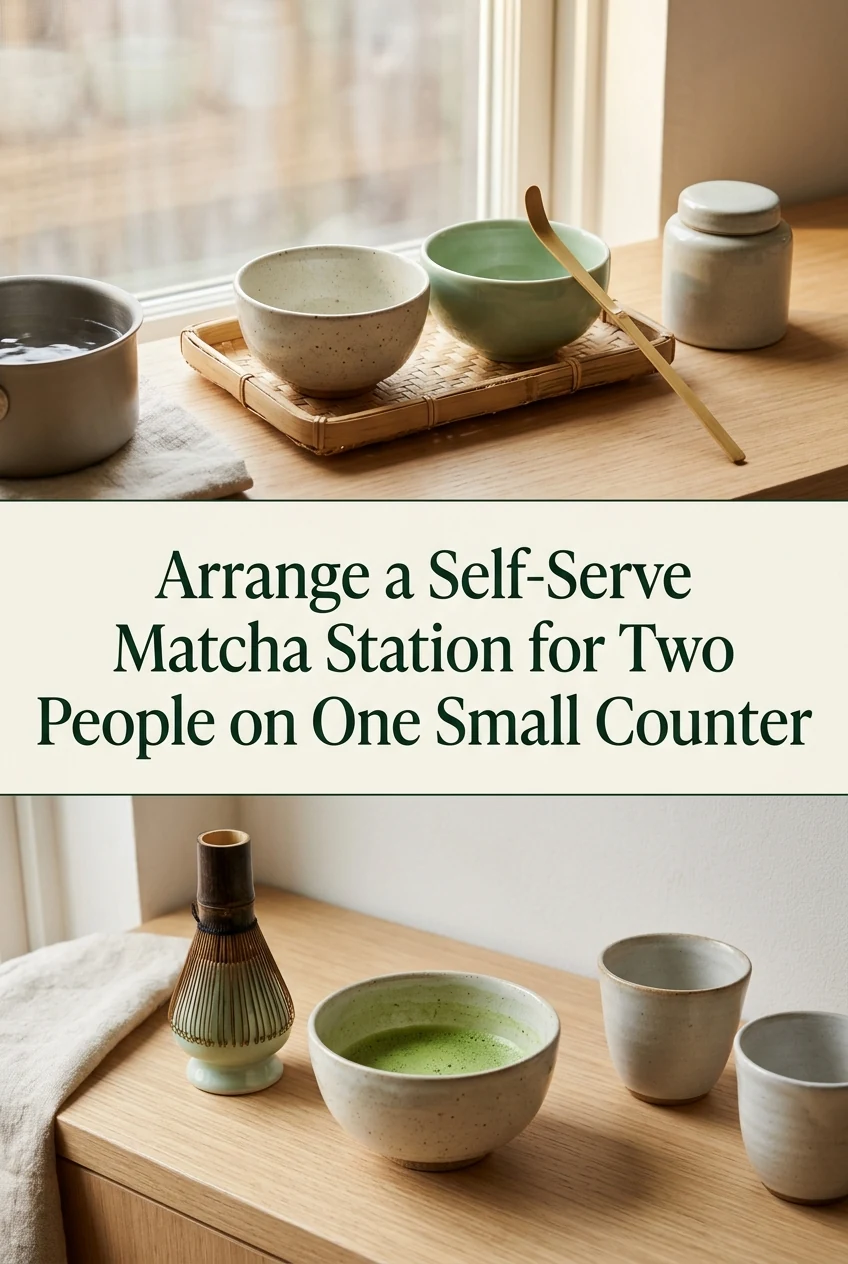
AI-generated editorial concept created for this article. The image is not a technical diagram or a tested result.
Map the Counter Before Placing Anything
Stand at the counter and divide it mentally into three zones: left for dry preparation, center for whisking, and right for finished cups. On a 60-centimeter counter, each zone is roughly 20 centimeters wide. This footprint is compact, so the front whisking area in the center must stay clear until a bowl is actively being prepared. Sketching the layout first helps prevent crowding during the whisking stage, which is where counter collisions are most likely.
Set Up the Dry Zone on the Left
Place the matcha tin, a small fine-mesh sifter, and a bamboo scoop in the left zone. The sifter should sit over a small catch bowl or directly over the whisk bowl when in use. Keep the tin lid off during a session so neither person fumbles with it mid-preparation. One scoop of matcha powder is typically one to two grams depending on the scoop size, so both people should use the same scoop to stay consistent with each other.
Position the Hot Water Vessel in the Center Back
Place the hot water vessel, whether a small kettle or a thermal carafe, at the back center of the counter. Back placement keeps the spout away from the front edge and reduces the risk of knocking it. Water for matcha is typically around 70 to 80 degrees Celsius rather than a full boil, so use a thermometer or a kettle with temperature control if available. Each person pours their own water into their whisk bowl in the center zone.
Assign One Whisk Bowl Position Per Person
Provide a dedicated whisk bowl and bamboo whisk (chasen) for each person, but stage the bowls sequentially rather than clustering them together. A 20-centimeter center zone cannot fit two whisk bowls side by side, nor does it allow two people to whisk at the same time without their arms colliding. Instead, stage the second bowl and whisk near the left prep area while the first person whisks in the center. Once the first drink is completed and moved to the right, the second person brings their prepared bowl into the central space to whisk. This gives each user full elbow room while keeping the tools organized.
Place the Serving Cups on the Right
Set the two serving cups on the right side of the counter before the session begins. Once a person has whisked their matcha, they pour or carry their bowl to the right and transfer the drink. This keeps the center zone clear for the second person immediately. If the matcha is being served in the whisk bowl itself, move the bowl to the right after whisking and place the empty cup there as a placeholder before the session starts.
A little more
to know.
What do we do with the chasen between uses during the same session?
Set the chasen upright on its flat handle base or place it on a ceramic whisk shaper (kusenaoshi) between uses. Do not rest it in water inside the whisk bowl, which softens the bamboo excessively and makes the bowl too damp for sifting dry powder. After the session, rinse the tines gently under warm running water without dish soap, then place the whisk onto a kusenaoshi so the tines maintain their flared shape while air-drying.
Is it necessary to sift matcha every time, or only for the first cup?
Sift each time. Matcha re-clumps quickly once the tin is opened, especially in humid conditions. Skipping the sift on a second cup often results in visible lumps that the whisk cannot fully break down.
Original editorial guidance and recipe formulations, not independently kitchen-tested. Times are estimates and depend on equipment and product directions. Cooked bases need additional cooling and refrigeration before cold serving. Images are AI-generated illustrations; appearance and yield may vary. Check actual ingredient labels, allergens, and any certification you require. We do not certify products. Read our approach.
Save to Pinterest ↗ANOTHER IDEA FOR THE COUNTER