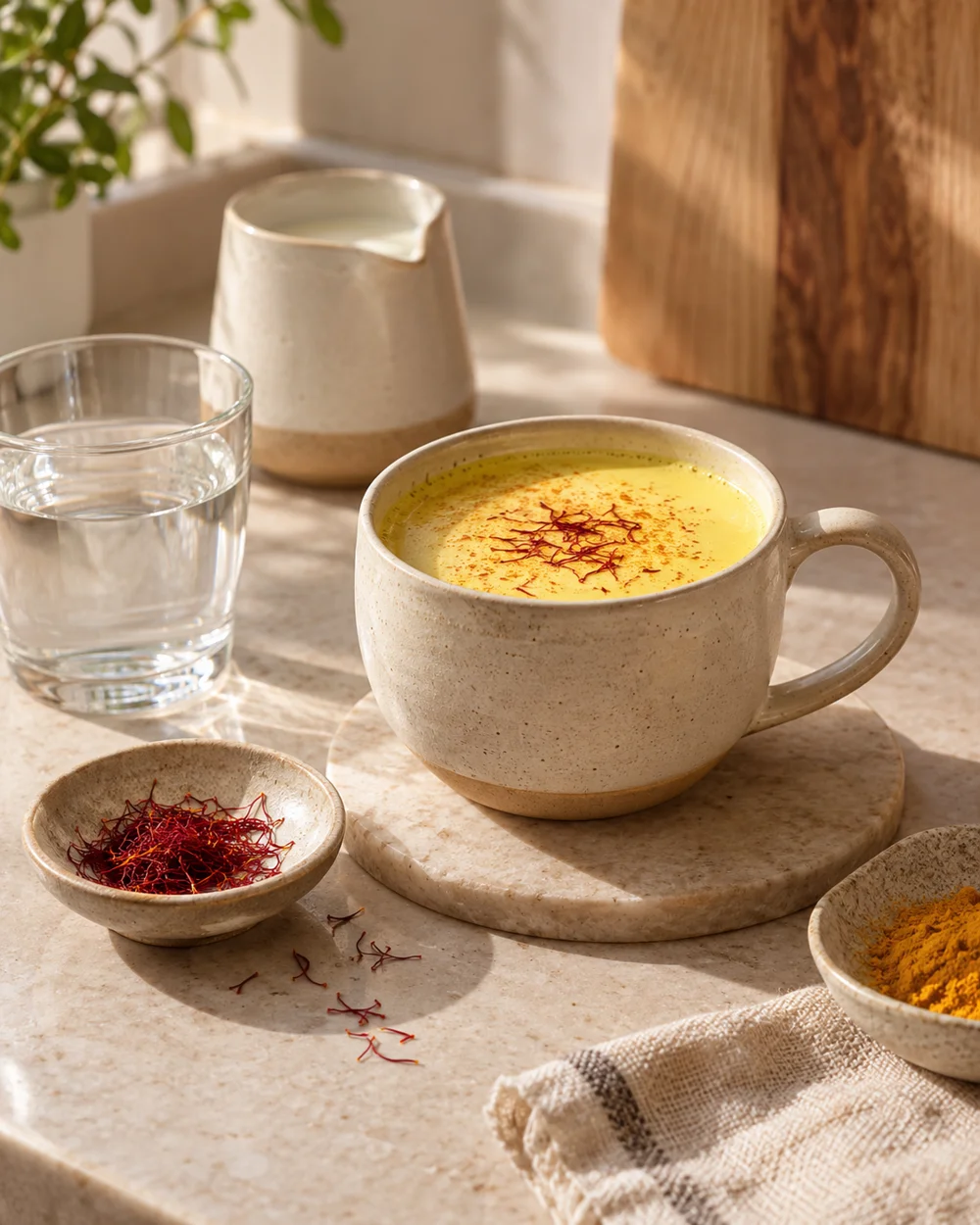
Warm Saffron and Honey Milk With No Grainy Residue
Dropping whole saffron threads directly into a cup of warm milk tends to leave two problems behind: patches of uneven golden colour where the threads clump, and the threads themselves sitting at the bottom as chewy strands. A short blooming step in a small amount of warm water before the milk ever enters the picture solves both issues in a straightforward way. This article walks through that process, explains why each stage matters, and finishes with a note on stirring in honey at the right moment so its flavour stays bright rather than cooked off.
Read the note ↓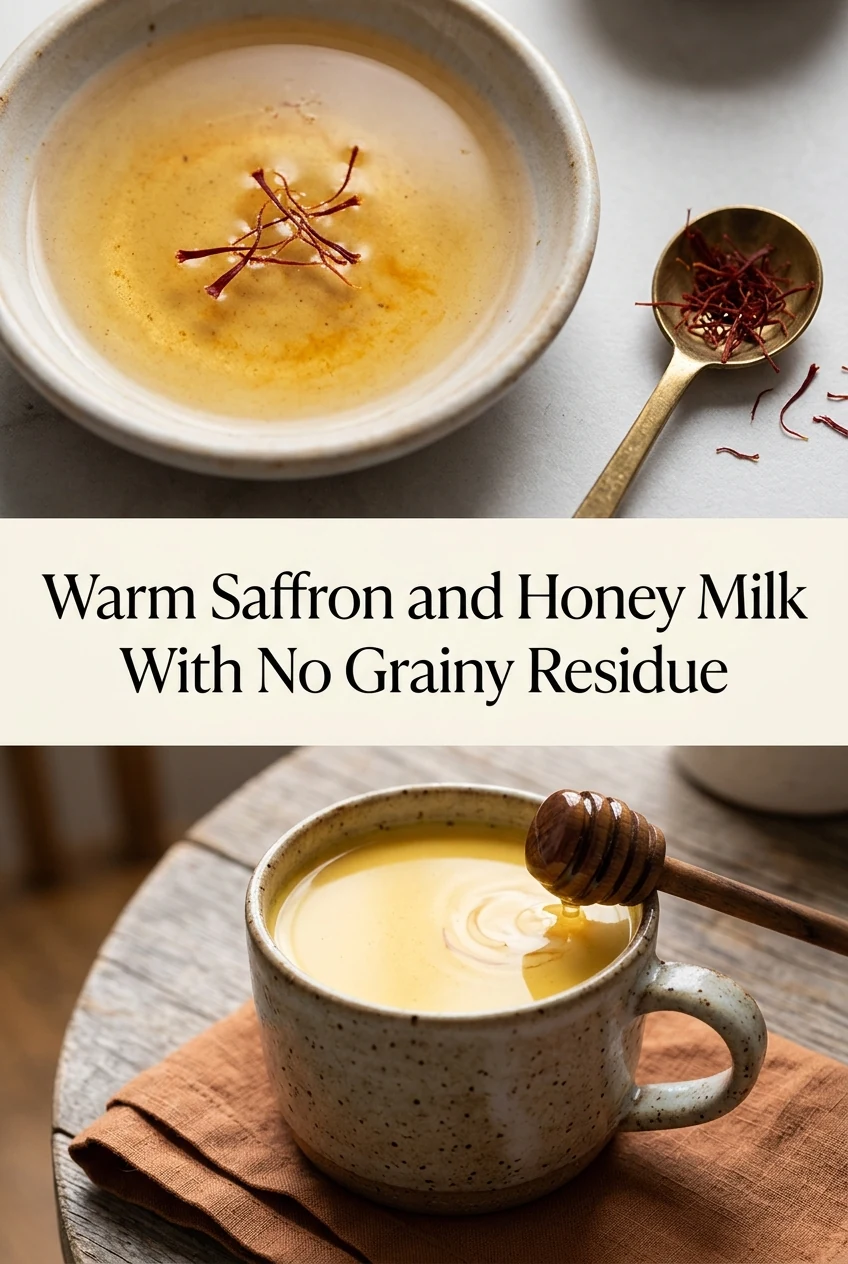
AI-generated editorial concept created for this article. The image is not a technical diagram or a tested result.
Why Whole Threads in Cold or Warm Milk Fall Short
Saffron releases its colour and flavour compounds into liquid gradually, and the process moves faster in warm water than in milk. Milk contains fat and protein that can slow that initial release further, so threads dropped straight into a cup often give up their colour unevenly, leaving some areas deeply golden and others almost white. The threads themselves do not dissolve; they remain as soft but noticeable strands that some people find unpleasant to drink. Addressing both issues means separating the blooming stage from the milk stage entirely, using water as the extraction liquid first and then combining the two.
Choosing and Measuring Your Saffron
A small pinch of saffron threads, roughly ten to fifteen threads, is enough for one standard mug of about two hundred and fifty millilitres of milk. Saffron varies in potency depending on origin and how recently it was packaged, so this range is an illustrative starting point rather than a fixed rule. Look for threads that are deep red with slightly orange tips; threads that are uniformly pale or that crumble to powder immediately may be older stock. Keep saffron in a sealed container away from direct light between uses, following whatever guidance the packaging provides on storage.
The Blooming Step in Warm Water
Measure one tablespoon of water into a small cup or ramekin and warm it until it is comfortably hot to the touch but not simmering, somewhere in the range that feels like a warm bath rather than boiling. Add your pinch of saffron threads to the water and leave them undisturbed for eight to ten minutes. During this time the water will take on a deep amber or golden hue and the threads will soften considerably. This concentrated liquid is what you will strain into the milk, leaving the spent threads behind. Using a very fine mesh strainer or a small piece of muslin held over the milk pan makes this transfer clean and complete.
Heating the Milk and Combining
Pour your two hundred and fifty millilitres of milk into a small saucepan and set it over low to medium-low heat. Warm it gently, stirring occasionally, until it is steaming and hot throughout but not boiling. Boiling milk can affect its texture and cause it to skin over quickly, so pulling it off the heat just before that point keeps things manageable. Once the milk is hot, strain the bloomed saffron water directly into the pan, stirring as you pour so the golden colour distributes evenly. The milk should shift to a uniform warm amber tone without any concentrated patches. Remove the pan from the heat completely before the next step.
Adding Honey and Serving
With the pan off the heat, stir in one teaspoon of honey, adjusting to your own preference for sweetness. Adding honey while the milk is still on a live flame can drive off some of its more delicate aromatic notes, so the off-heat moment is worth observing. Stir until the honey is fully dissolved and no streaks remain. Warm your serving mug by filling it with hot water for thirty seconds, then emptying it just before you pour. This keeps the drink at a pleasant temperature for longer without requiring any additional heating. Pour the finished milk into the warmed mug and serve immediately. As an illustrative plan, this sequence aims for an evenly coloured, smooth drink; individual results will vary depending on your specific saffron, milk, and equipment.
A little more
to know.
Can I use plant-based milk instead of dairy milk for this drink?
Plant-based milks such as oat or almond milk can be used in place of dairy milk following the same general steps. Keep in mind that different plant-based milks have different fat and protein compositions, which may affect how evenly the saffron colour distributes and how the finished drink tastes. Warming them gently and avoiding a full boil applies here as well, since some plant-based milks separate or develop an off flavour if overheated.
What if the colour still looks uneven after straining the bloomed water into the milk?
Uneven colour after combining usually means the two liquids were not stirred together thoroughly enough during the pour. Try stirring continuously in a circular motion as you strain the saffron water in, rather than adding it all at once and stirring afterward. If the milk has already cooled slightly and the colour is still patchy, a brief return to low heat while stirring can help the pigment distribute more evenly before you add the honey.
Original editorial guidance and recipe formulations, not independently kitchen-tested. Times are estimates and depend on equipment and product directions. Cooked bases need additional cooling and refrigeration before cold serving. Images are AI-generated illustrations; appearance and yield may vary. Check actual ingredient labels, allergens, and any certification you require. We do not certify products. Read our approach.
Save to Pinterest ↗ANOTHER IDEA FOR THE COUNTER