Store Opened Canned Coconut Milk Safely Between Two Cold Drink Sessions
A standard 400 ml can of coconut milk is often more than one cold drink session needs. Leaving the remainder in the open can on a counter invites spoilage and off flavours. Transferring it correctly to a sealed container and refrigerating it promptly keeps the milk safe and flavour-intact for your next session. This guide covers the transfer steps, container choice, temperature target, and the signs that tell you the milk is still good to use.
Read the note ↓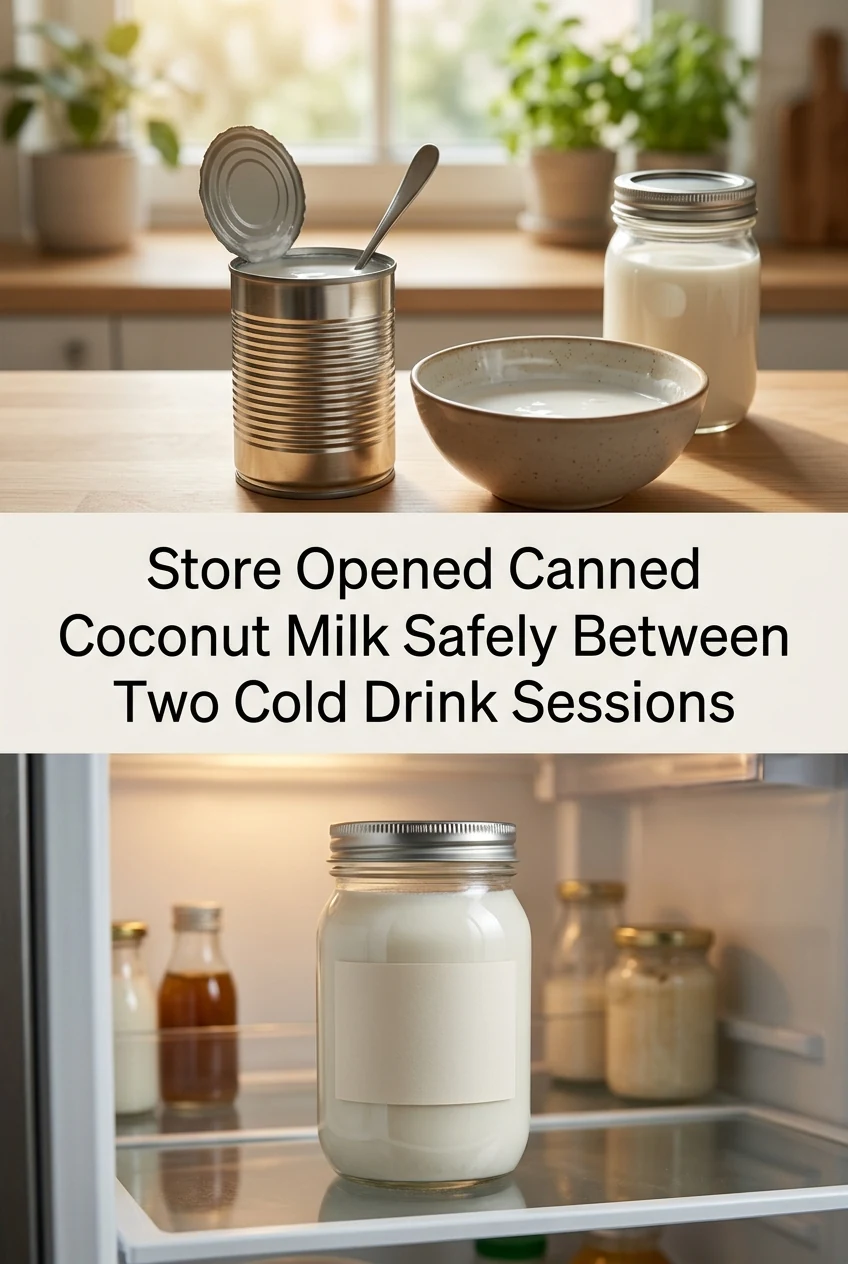
AI-generated editorial concept created for this article. The image is not a technical diagram or a tested result.
Why the Can Itself Is Not a Storage Container
Once a can is opened, the cut metal rim is difficult to seal airtight, and the exposed interior can transfer a faint metallic note to the milk over time. More practically, an unsealed can in a refrigerator absorbs surrounding odours. A clean glass jar or a food-grade plastic container with a tight-fitting lid eliminates both problems and makes it easy to see how much milk remains before you start your next drink.
Choosing and Preparing the Right Container
Select a container just large enough to hold the remaining volume with minimal headspace. For a leftover amount of roughly 200 to 250 ml, a 300 ml glass jar with a screw lid works well as an illustrative example, though any clean, food-safe, airtight container of similar size is suitable. Wash the container with hot soapy water, rinse it thoroughly, and dry it before use. Residual water can dilute the milk and encourage bacterial growth.
Transferring and Sealing Without Delay
Pour or spoon the coconut milk into the prepared container immediately after measuring out what you need for your current drink. Stir the can contents first if the cream has separated to the top, so the transferred portion is consistent. Wipe the jar rim clean, seal the lid firmly, and label the container with the date. Move it to the refrigerator within the two-hour window, or within one hour if your kitchen is above 32 degrees Celsius.
Temperature Target and Refrigerator Placement
The refrigerator should hold at or below 4 degrees Celsius. Place the sealed jar toward the back of a middle shelf rather than in the door, where temperatures fluctuate each time the door opens. A fridge thermometer is the most reliable way to confirm your appliance is holding the correct temperature. Coconut milk stored this way should be used within two days for best quality, though always assess it before use rather than relying solely on elapsed time.
Checking the Milk Before Your Next Session
Before adding refrigerated coconut milk to a drink, open the jar and check for any sour or rancid smell, unusual colour change beyond normal cream separation, or visible mould. Normal separation, where a white solid layer sits above a thinner liquid, is expected and not a spoilage sign. Stir or shake the jar to recombine before measuring. If anything seems off, discard the milk rather than tasting it to decide.
A little more
to know.
Can I freeze leftover coconut milk instead of refrigerating it?
Yes. Pour it into a freezer-safe container leaving a small gap for expansion, seal it, and freeze. The texture may become slightly grainy after thawing, which is generally fine for blended cold drinks but less ideal if a smooth consistency matters.
Does shaking the can before opening affect how I store the leftovers?
Shaking blends the cream and liquid before you open the can, so the poured remainder is already combined. This makes the stored portion more uniform and means you will not need to stir as vigorously before measuring it out at your next session.
Original editorial guidance and recipe formulations, not independently kitchen-tested. Times are estimates and depend on equipment and product directions. Cooked bases need additional cooling and refrigeration before cold serving. Images are AI-generated illustrations; appearance and yield may vary. Check actual ingredient labels, allergens, and any certification you require. We do not certify products. Read our approach.
Save to Pinterest ↗ANOTHER IDEA FOR THE COUNTER