Stop Bitter Over-Extraction in Coarse French Press Steeping
A long steep in an immersion brewer often delivers a muddy cup if fine coffee particles remain suspended during the pour. Even coarse ground coffee sheds smaller fragments during immersion. When these fines sit in contact with hot liquid and pass through or press against the metal mesh filter, they can add harsh, dry notes to the cup. Skimming off the floating foam and surface grinds before placing the lid helps the particles beneath settle naturally, leading to a cleaner cup with balanced body and less grit.
Read the note ↓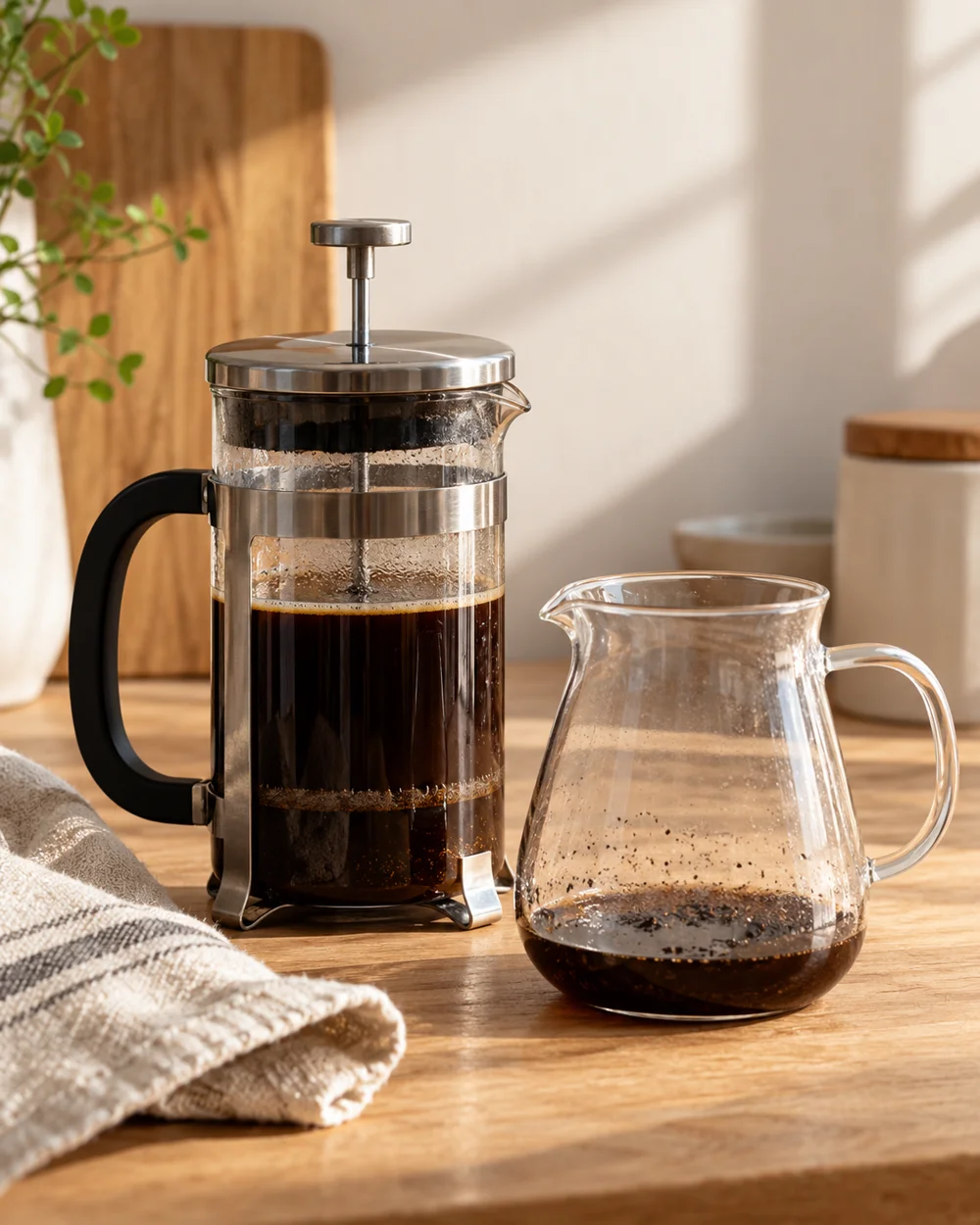
Representative category illustration reused from our editorial library; it does not depict this specific project or a tested result.
Crust Formation Dynamics
During the first few minutes of steeping, releasing gas carries coarse coffee grounds to the water surface, creating a floating crust. This top layer holds a mix of coarse particles and fine grounds right at the surface. If left undisturbed, these floating particles can easily stir back into the liquid during pouring or clog the metal filter mesh, contributing unwanted silt and astringency to the finished coffee.
Breaking The Surface Layer
At the four-minute mark of a steep, take an ordinary metal soup spoon and gently stir the surface crust three to four times. This disturbance releases trapped carbon dioxide bubbles, causing the majority of saturated coarse coffee pieces to lose buoyancy and drop smoothly to the glass beaker floor. The material left floating on the top surface after stirring consists primarily of pale foam, trapped lipids, and fine insoluble particles that dry out the palate if left in the finished cup.
Skimming Fines With Spoons
Take two spoons and gently skim the remaining light foam and floating grit off the liquid surface, discarding them into a bowl. Removing these floating remnants clears the surface and keeps fine particles from staying suspended near the pour spout. Because most brewing has already occurred by this point, clearing the surface helps minimize excess sediment without stripping away desirable coffee oils.
Settling Without Full Compression
After skimming, allow the uncovered brewer to sit undisturbed for another three to five minutes. This rest allows suspended particles to settle toward the bottom of the beaker. Set the lid assembly onto the rim so the mesh filter rests just at the surface of the liquid to act as a screen, rather than plunging the filter all the way to the floor. Pushing the plunger down into the settled bed stirs up fine sediment, which can escape past the edges of the filter and enter the cup.
Worked Pouring Protocol
For an illustrative example using 30 grams of coarse coffee and 500 grams of hot water, pour the water continuously, wait four minutes, break the crust, and skim the top layer clean. Let the slurry rest until the clock shows eight total minutes. Insert the plunger just 2 centimeters below the liquid line to act solely as a strainer. Decant the clarified coffee smoothly into a separate preheated carafe in a steady stream, leaving the final 30 milliliters behind with the sludge.
A little more
to know.
Why should the metal mesh plunger not be pushed to the bottom?
Pushing the screen all the way down disturbs the settled coffee bed, forcing fine grounds back up around the edges of the mesh. Resting the screen near the surface allows it to act as a pour strainer while keeping the settled bed undisturbed at the bottom.
Does skimming the surface foam reduce the overall body of the beverage?
Skimming removes surface foam and floating silt rather than dissolved coffee flavor. The brew keeps its characteristic immersion body and rounded mouthfeel, while finishing with less grittiness and a cleaner cup profile.
Original editorial guidance and recipe formulations, not independently kitchen-tested. Times are estimates and depend on equipment and product directions. Cooked bases need additional cooling and refrigeration before cold serving. Images are AI-generated illustrations; appearance and yield may vary. Check actual ingredient labels, allergens, and any certification you require. We do not certify products. Read our approach.
Save to Pinterest ↗ANOTHER IDEA FOR THE COUNTER