Small-Batch Mulberry and Lemon Syrup for Cold Drinks
Fresh mulberries release juice quickly under heat and sugar, but their fine seeds and fibrous skins must be strained out before the syrup is usable in cold drinks. Making a small, weighed batch lets you see exactly how much finished syrup a given weight of fruit actually yields after straining, which matters when you are scaling a recipe or planning how many drinks a single batch will cover.
Read the note ↓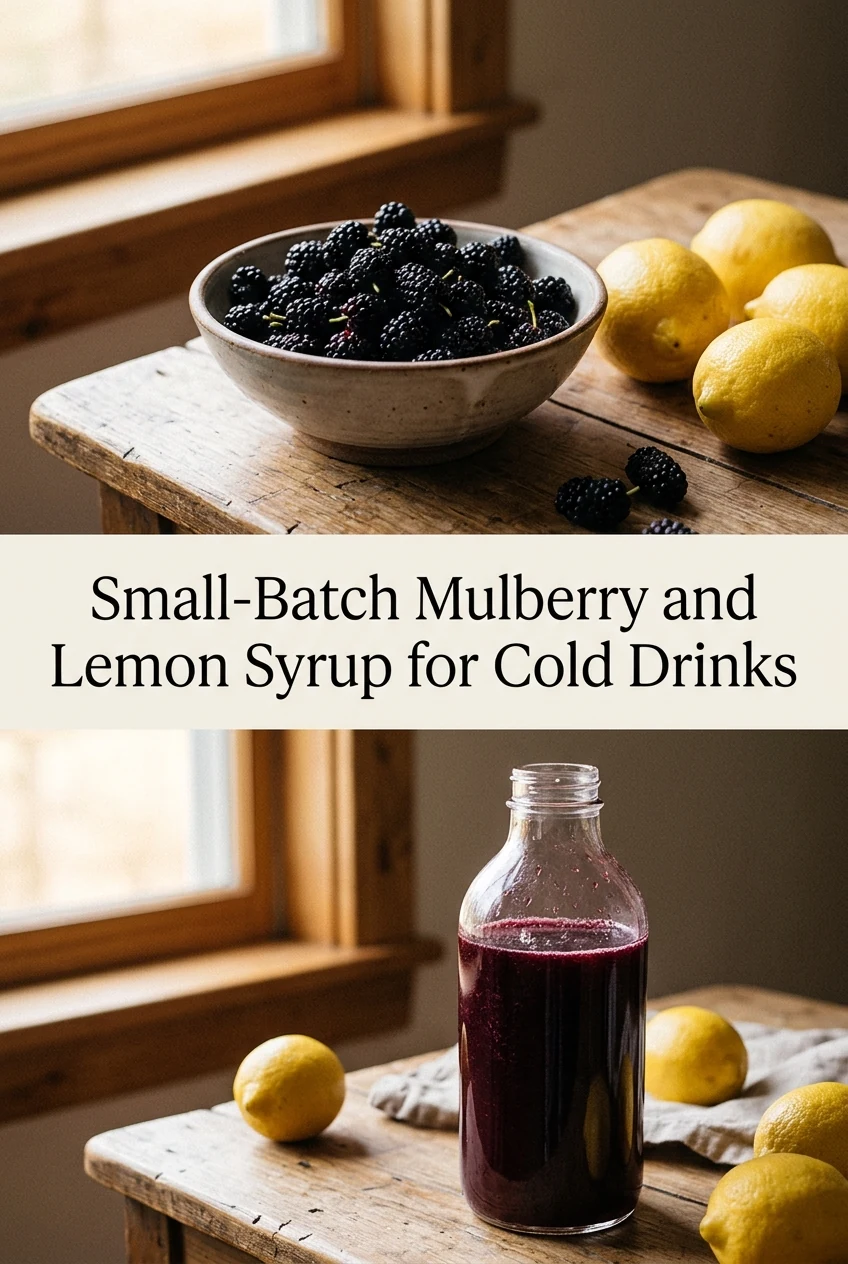
AI-generated editorial concept created for this article. The image is not a technical diagram or a tested result.
Weighing fruit before you start
Start with 300 grams of fresh mulberries, rinsed and picked over. This weight is a practical small-batch amount that fits a medium saucepan without crowding. Weigh the fruit on a kitchen scale rather than measuring by cup, because mulberries compress unpredictably and a cup measure can vary by 30 grams or more depending on how loosely the berries are packed. Record the starting weight so you can compare it against your strained yield later.
Cooking the fruit and sugar together
Combine the 300 grams of mulberries with 200 grams of white sugar and 120 millilitres of cold water in a saucepan. Stir over medium heat until the sugar dissolves, then let the mixture reach a gentle simmer. Cook uncovered for about 12 minutes, stirring occasionally. The berries will collapse and the liquid will deepen in colour. Do not boil hard, as this reduces the liquid faster than the seeds can be removed and makes straining more difficult.
Straining and measuring the yield
Pour the cooked mixture through a fine-mesh strainer set over a heatproof jug. Press the solids gently with a spoon to extract juice without forcing seeds through the mesh. Discard the solids. Measure the strained liquid. As an illustrative example, 300 grams of mulberries cooked with 200 grams of sugar and 120 millilitres of water typically yields roughly 280 to 320 millilitres of finished syrup, though actual results vary with fruit ripeness and moisture content.
Adding lemon and adjusting balance
While the syrup is still warm, stir in 25 millilitres of freshly squeezed lemon juice. The acid brightens the colour and balances the sweetness. Taste the syrup once it cools slightly. If it tastes flat, add lemon juice in 5-millilitre increments. If it is sharper than you want, the sharpness softens once the syrup is chilled and diluted in a drink. Avoid adding extra sugar at this stage, as the syrup will thicken slightly on cooling; assess the final balance after tasting it cold.
Storing and using the syrup
Transfer the cooled syrup to a clean glass jar or bottle and refrigerate at 4 degrees Celsius or below within two hours of making. Keep refrigerated and use promptly, inspecting for freshness before each pour. To serve in a cold drink, start with 30 millilitres of syrup over ice, then add still or sparkling water to taste. The syrup is also suitable for stirring into iced tea or drizzling over shaved ice. Always shake or stir before pouring, as some natural settling may occur.
A little more
to know.
Can frozen mulberries be used instead of fresh?
Yes. Thaw them fully and drain excess liquid before weighing, otherwise the added water throws off the sugar ratio. Expect the colour to be slightly deeper and the cook time to be a minute or two shorter because frozen fruit breaks down faster.
Why does the syrup sometimes look cloudy after refrigeration?
Fine particles that passed through the strainer can settle and cause cloudiness when cold. This is normal and does not indicate spoilage. Stir or gently swirl the jar before measuring a portion. A second pass through a coffee filter removes most remaining particles if clarity matters.
Original editorial guidance and recipe formulations, not independently kitchen-tested. Times are estimates and depend on equipment and product directions. Cooked bases need additional cooling and refrigeration before cold serving. Images are AI-generated illustrations; appearance and yield may vary. Check actual ingredient labels, allergens, and any certification you require. We do not certify products. Read our approach.
Save to Pinterest ↗ANOTHER IDEA FOR THE COUNTER