Set Up a Small Tray for Iced Tea Ingredients Before Brewing Starts
Iced tea preparation involves a short window between the hot steep and the cold pour where timing matters. Searching for a measuring jug, ice, or syrup after the steep has already finished causes the tea to over-extract or cool unevenly. Gathering everything onto one tray before the kettle boils removes that mid-session scramble and keeps the workflow moving in the right order without interruption.
Read the note ↓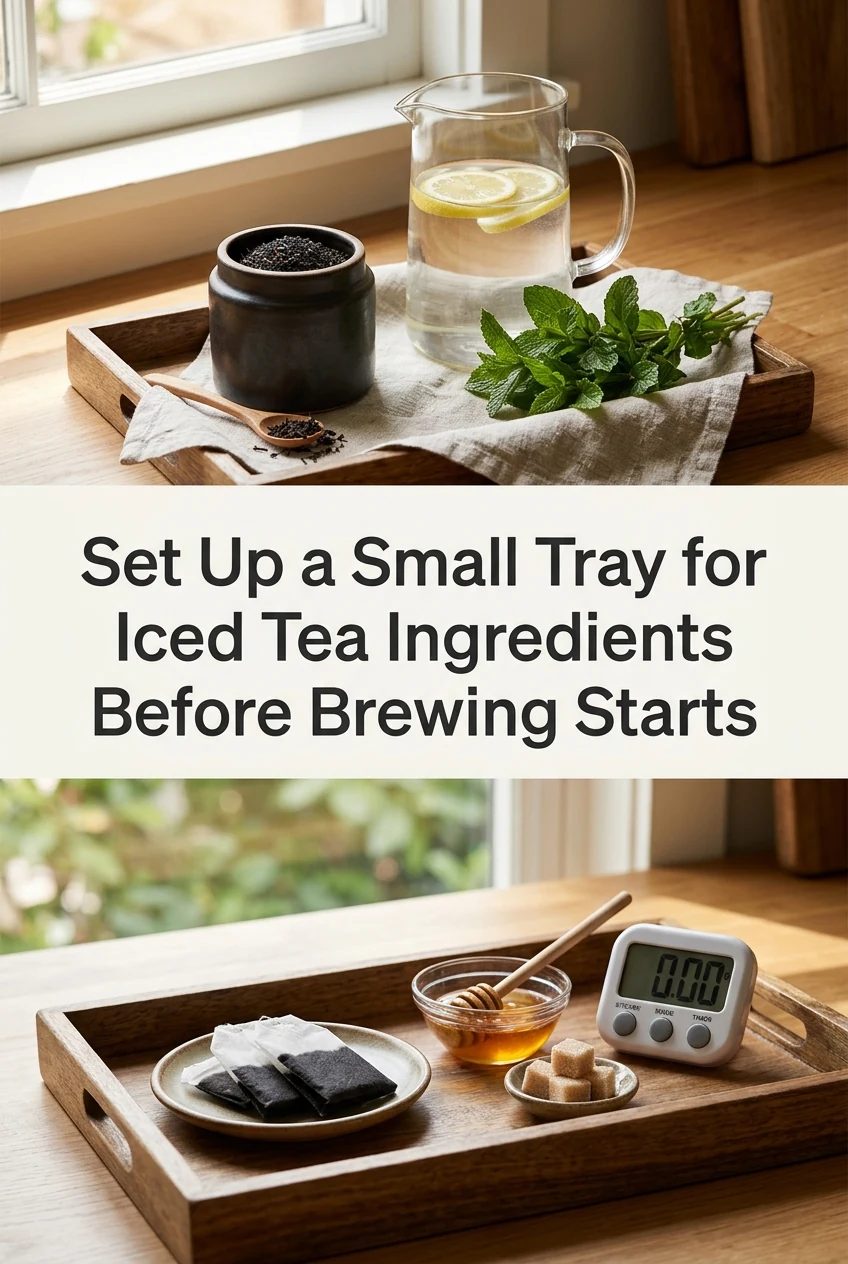
AI-generated editorial concept created for this article. The image is not a technical diagram or a tested result.
Identify what belongs on the tray before you start
A standard iced tea tray setup includes tea bags or a measured amount of loose leaf tea in an infuser, a timer, a heatproof measuring jug of at least 500 ml capacity, a fine mesh strainer if using loose leaf, a separate container of prepared syrup or sugar, a long spoon, and a filled ice tray or a bowl of ice. Laying these out in the order you will use them, left to right or front to back, makes the sequence visible before you begin.
Prepare the ice before the kettle goes on
Ice is the one component that cannot be retrieved quickly mid-session. Fill your ice container before starting the kettle. If you are using a 500 ml jug of hot tea that you intend to pour over ice to cool rapidly, you will need enough ice to fill a separate 750 ml pitcher or serving jug at least halfway. Preparing ice last, after the steep, means the tea sits waiting and continues extracting. Ice first removes that risk entirely.
Set the timer as soon as the water hits the tea
Place the timer on the tray so it is visible from where you are standing, not across the kitchen. The moment you pour hot water over the tea bags or infuser, start the timer. Steep time varies by tea type and personal preference, so this guide does not prescribe a universal duration, but having the timer on the tray means you are not estimating. When it sounds, you act immediately rather than finishing another task first.
Position the syrup within reach for the pour stage
Syrup added to hot tea before chilling distributes more evenly than syrup stirred into cold tea. Keep the syrup bottle or jar on the tray with a small measuring spoon or a 15 ml measure beside it. A practical starting point for a 500 ml batch is 30 ml of a simple or flavoured syrup, adjusted to taste in subsequent batches. Having the measure already on the tray means you add it during the pour without pausing to find it.
Clear the tray between batches to reset the workflow
After serving, remove used tea bags, rinse the jug, and return items to their tray positions before making a second batch. A cluttered tray from the first round causes the same searching problem you set out to avoid. Spent tea bags left near fresh ones create a small but real risk of reusing them by mistake, which produces a weak, flat result. Resetting takes under two minutes and keeps each batch starting from the same organised point.
A little more
to know.
Does the order of adding syrup versus ice to the jug affect the final drink?
Adding syrup to the hot tea before pouring over ice helps it dissolve fully and distribute evenly. Syrup added directly to a cold, already-diluted glass tends to sink and requires more stirring to incorporate, which can disturb the ice and dilute the drink faster.
Is a 500 ml heatproof jug large enough for a two-person serving?
A 500 ml steep produces roughly two standard 250 ml servings before ice dilution. Once poured over ice, volume increases slightly as ice melts. For three or more people, steep in a 750 ml to 1 litre heatproof jug to avoid a second immediate batch.
Original editorial guidance and recipe formulations, not independently kitchen-tested. Times are estimates and depend on equipment and product directions. Cooked bases need additional cooling and refrigeration before cold serving. Images are AI-generated illustrations; appearance and yield may vary. Check actual ingredient labels, allergens, and any certification you require. We do not certify products. Read our approach.
Save to Pinterest ↗ANOTHER IDEA FOR THE COUNTER