Set Up a Shared Ingredient Area When Two People Are Making Different Drinks at Once
Two people making different drinks from the same counter at the same time is a common home cafe situation during a small gathering, and it creates a specific set of friction points: reaching across each other for the same syrup bottle, unclear ownership of the milk jug and uncertain ice access. A simple spatial arrangement resolves most of these problems before they happen, without requiring extra equipment or a large counter surface.
Read the note ↓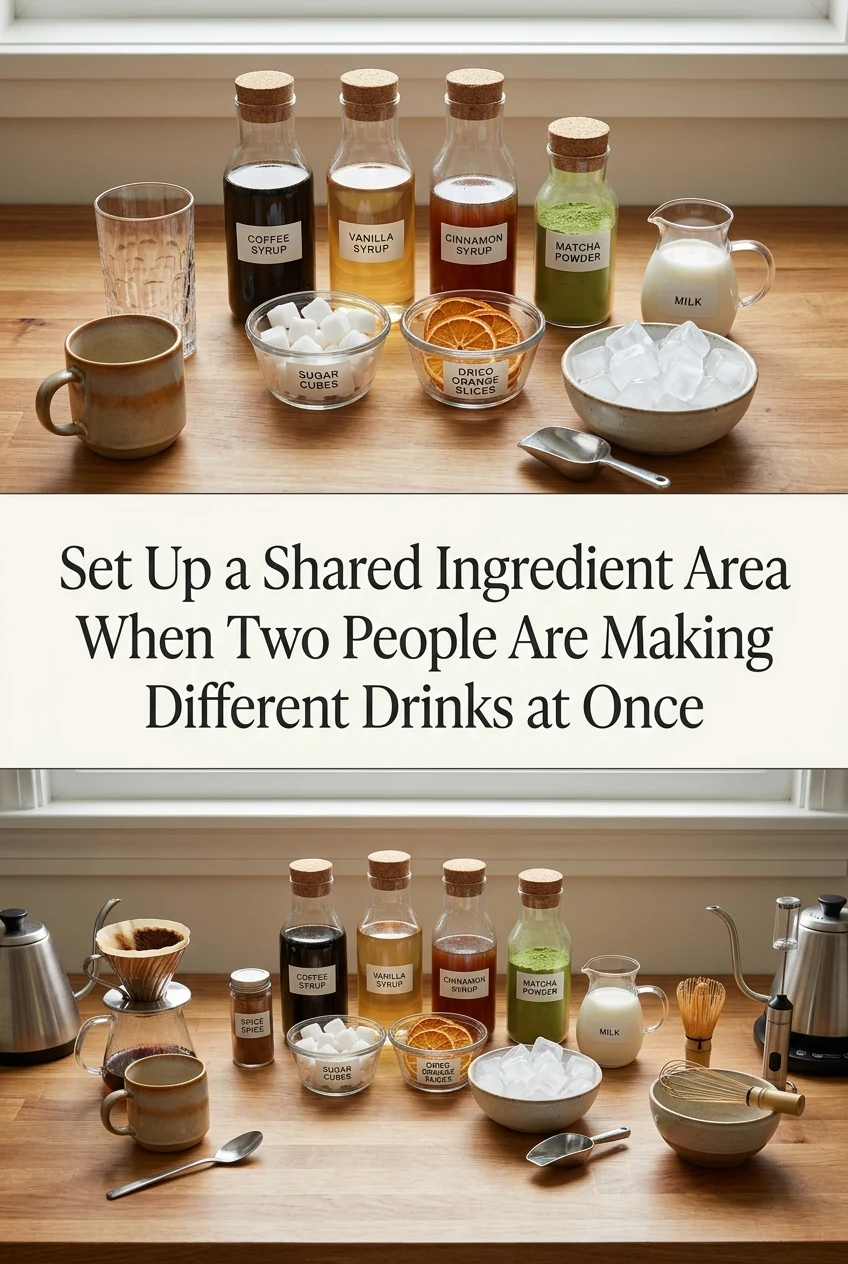
AI-generated editorial concept created for this article. The image is not a technical diagram or a tested result.
Define a central shared zone and two personal prep zones
Mentally divide the counter into three areas. The centre strip, roughly 30 to 40 centimetres wide, holds everything both people need: the syrup bottles, the milk jug, the ice bucket and any shared measuring tools. Each person works in their own zone to the left or right of the centre. This arrangement means neither person needs to reach into the other's space to access shared ingredients, and each person has a clear surface for their own glass, cup and tools.
Position shared ingredients in a consistent order
Place shared items in the central zone in a fixed left-to-right order that both people agree on before starting. For example: ice bucket at the far left, milk jug next, then syrup bottles, then any shared measuring spoons. Consistent placement means each person can reach for an item without looking, which reduces the hesitation and double-reaching that causes spills. Labelling syrup bottles clearly also prevents one person from picking up the wrong bottle mid-pour.
Establish a brief handoff signal for the milk jug
Milk is the ingredient most likely to cause a collision because both people may need it at nearly the same moment. Agree on a simple verbal signal before you start, such as one person saying the word ready when they are about to pick up the jug. This is not elaborate; it is a one-second spoken cue that prevents two hands reaching for the same handle simultaneously. Return the jug to its fixed position in the central zone immediately after each use.
Keep measuring tools in the personal prep zone
Each person should have their own measuring spoon or small graduated cup in their personal zone rather than sharing one from the centre. Sharing a single measuring spoon creates a bottleneck where one person waits while the other finishes measuring. Two inexpensive measuring spoons eliminate this entirely. Scales, if used, can sit in the central zone and be used in turn, but for syrup and milk volumes a dedicated spoon per person is faster and avoids cross-contamination between drinks.
Manage ice access to avoid double-dipping
Place the ice bucket in the central zone with a single shared scoop resting on a small plate beside it. Only one person uses the scoop at a time and returns it to the plate rather than leaving it in the bucket. This prevents the scoop from being buried and also keeps the ice clean. If both people need ice at the same moment, one person scoops for both glasses in a single trip, which is faster than alternating and avoids two people leaning over the bucket simultaneously.
A little more
to know.
What if the counter is too narrow to create three distinct zones?
On a narrow counter, place shared ingredients at one end rather than in the middle. Each person works from the same end in turn for shared items and uses the remaining counter length as their personal prep space.
Should perishable ingredients like milk stay in the central zone throughout the session?
Return milk to the refrigerator if the session extends beyond the two-hour room-temperature limit, or one hour if the kitchen is above 32 degrees Celsius. Bring it out again only when the next drink is being assembled.
Original editorial guidance and recipe formulations, not independently kitchen-tested. Times are estimates and depend on equipment and product directions. Cooked bases need additional cooling and refrigeration before cold serving. Images are AI-generated illustrations; appearance and yield may vary. Check actual ingredient labels, allergens, and any certification you require. We do not certify products. Read our approach.
Save to Pinterest ↗ANOTHER IDEA FOR THE COUNTER