Separate a Bottle's Net Contents from Its Graduated Measuring Marks
A bottle of simple syrup, flavored milk, or cold brew concentrate often carries two different numbers: the net contents printed on the label and a series of graduated lines molded or printed onto the vessel itself. These two pieces of information serve completely different purposes, and confusing them can throw off a drink recipe before you even begin pouring. This article explains what each marking actually communicates, how to read them together without mixing them up, and how a home-cafe workflow can use both correctly. The approach described here is an illustrative planning method, not a kitchen-tested or laboratory-verified result.
Read the note ↓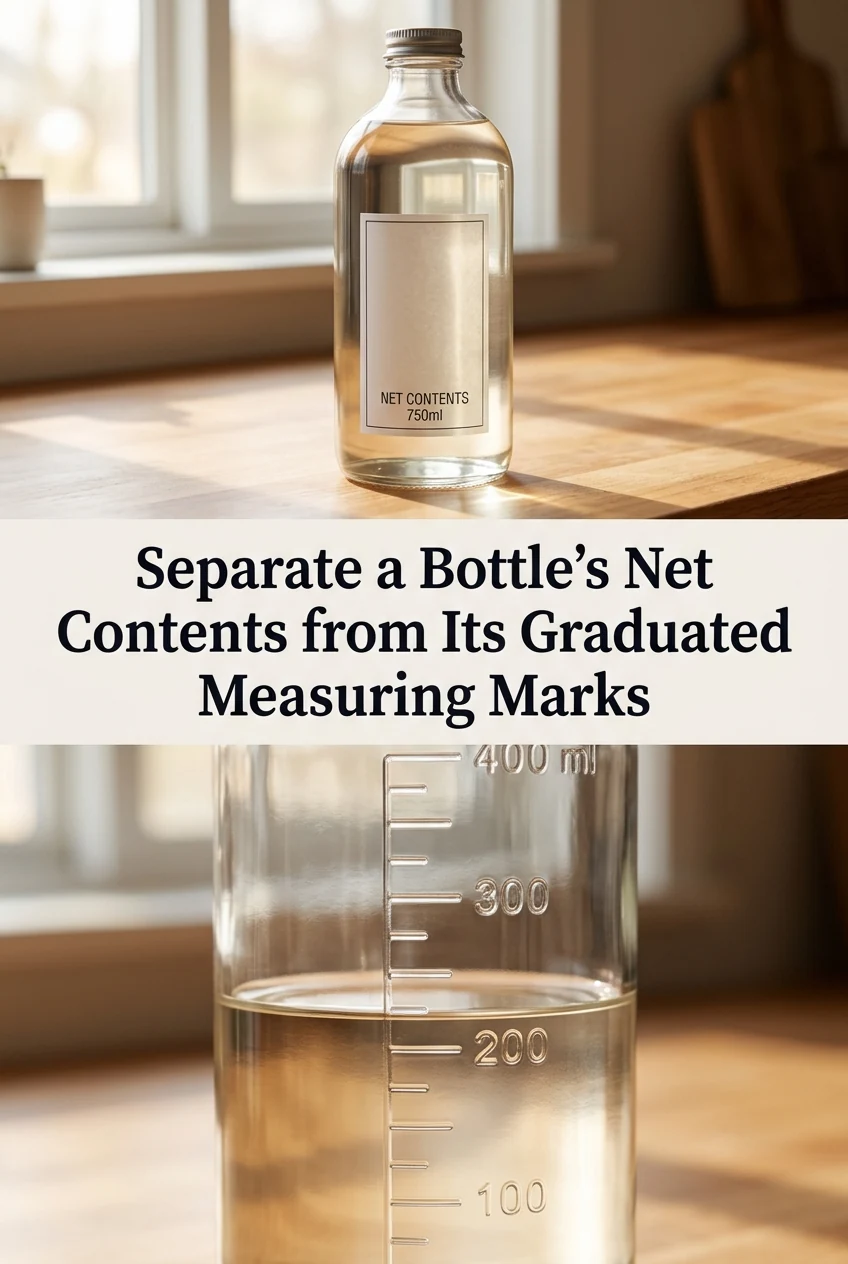
AI-generated editorial concept created for this article. The image is not a technical diagram or a tested result.
What the Net Contents Declaration Actually Means
The net contents figure printed on a product label — for example, '500 mL' or '16 fl oz' — is a legal declaration by the manufacturer stating how much product was placed inside the container at the time of filling. It tells you the total supplied quantity, not the current level in the bottle after any has been used, and it makes no claim about the accuracy of any graduation marks on the vessel. A bottle can carry a net contents statement and have no graduation marks at all, or it can carry marks that were added purely for general reference rather than precision measurement. Treating the net contents figure as a live readout of remaining volume is the most common source of confusion in a home-cafe setting.
What Graduated Marks on a Bottle Actually Represent
Molded or printed graduation lines on a bottle are a convenience feature. Their accuracy depends entirely on the manufacturer's design intent, the uniformity of the bottle's cross-section at each marked interval, and whether the bottle was designed to function as a measuring vessel. Many condiment and syrup bottles include approximate marks to help with rough portioning, but the manufacturer does not certify these as calibrated measurements unless the product is explicitly sold as a measuring container. Before relying on any bottle's graduation marks for a recipe, check the product's own label or packaging information to understand what those marks are intended to show.
A Worked Example: Planning Portions from a 750 mL Syrup Bottle
Suppose you purchase a 750 mL bottle of alcohol-free vanilla-flavored syrup — one whose label confirms the flavoring is alcohol-free — and the bottle has five horizontal lines spaced along its side. The net contents tell you the bottle holds 750 mL total when full. If each of the five intervals were perfectly equal, each would represent 150 mL, but the bottle's shoulder and base taper mean the top and bottom intervals may hold different volumes than the middle ones. As an illustrative plan: if your recipe calls for 30 mL per serving, a full 750 mL bottle could yield up to 25 servings at that rate. That arithmetic uses the label figure, not the graduation lines. The graduation lines might help you see roughly when you are approaching half a bottle, but they should not replace a dedicated measuring tool when the recipe requires a specific quantity.
Using a Separate Measuring Tool Alongside the Bottle
The practical home-cafe approach is to keep a dedicated measuring jug or set of measuring spoons separate from any decorative or storage bottle. When a recipe specifies 15 mL of a halal-certified simple syrup, pour from the storage bottle into the measuring tool, confirm the quantity there, and then add it to the drink. This keeps the storage bottle's graduation marks in their appropriate role — a rough visual guide to remaining stock — while the measuring tool handles portion accuracy. If you are working with a perishable ingredient such as a dairy-based flavored milk, transfer only what you need for immediate use and return the bottle to the refrigerator promptly, following the storage guidance printed on that product's label.
Keeping a Simple Inventory Note
Because the net contents figure reflects the original fill and not current volume, a straightforward way to track remaining stock is to note the date you opened the bottle and make a small tally of how many measured portions you have removed. Multiply the number of portions by the measured volume per portion and subtract from the original net contents to get an estimated remaining quantity. For the 750 mL example above, after pouring ten measured 30 mL servings you would estimate roughly 450 mL remaining. This is still an estimate because small measurement variations accumulate, but it is more reliable than reading the bottle's graduation lines as a precise gauge. Always follow the opened-product storage instructions on the label, and refrigerate any perishable bottle as directed.
A little more
to know.
Can I use the graduation lines on my syrup bottle instead of a measuring jug?
You can use them as a rough visual reference, but they are not a substitute for a dedicated measuring tool when a recipe specifies an exact quantity. The lines on most storage and condiment bottles are a convenience feature, not a calibrated scale, and the bottle's shape often means the intervals are not equal in volume from top to bottom. For consistent results, measure with a proper measuring jug or spoon and use the bottle's marks only to gauge approximately how much stock remains.
Does the net contents figure tell me how much syrup is left after I have used some?
No. The net contents declaration on the label states the volume the manufacturer placed in the bottle when it was filled and sealed. Once you have opened the bottle and used any of the contents, that figure no longer reflects the current volume. To track remaining quantity, keep a running tally of how much you have measured out and subtract it from the original net contents figure to get an estimate.
Original editorial guidance and recipe formulations, not independently kitchen-tested. Times are estimates and depend on equipment and product directions. Cooked bases need additional cooling and refrigeration before cold serving. Images are AI-generated illustrations; appearance and yield may vary. Check actual ingredient labels, allergens, and any certification you require. We do not certify products. Read our approach.
Save to Pinterest ↗ANOTHER IDEA FOR THE COUNTER