Scoop or Weigh: Comparing Volume and Mass Measures for Loose Leaf Tea in a Small Pot
Home brewers who alternate between a teaspoon scoop and a kitchen scale for loose leaf tea often notice the resulting brew strength varies even when the steep time and water temperature stay the same. The cause is almost always the difference between how much a given leaf type fills a spoon versus how much it actually weighs. Understanding that gap helps you choose a method that gives you consistent results from the same tea across multiple sessions.
Read the note ↓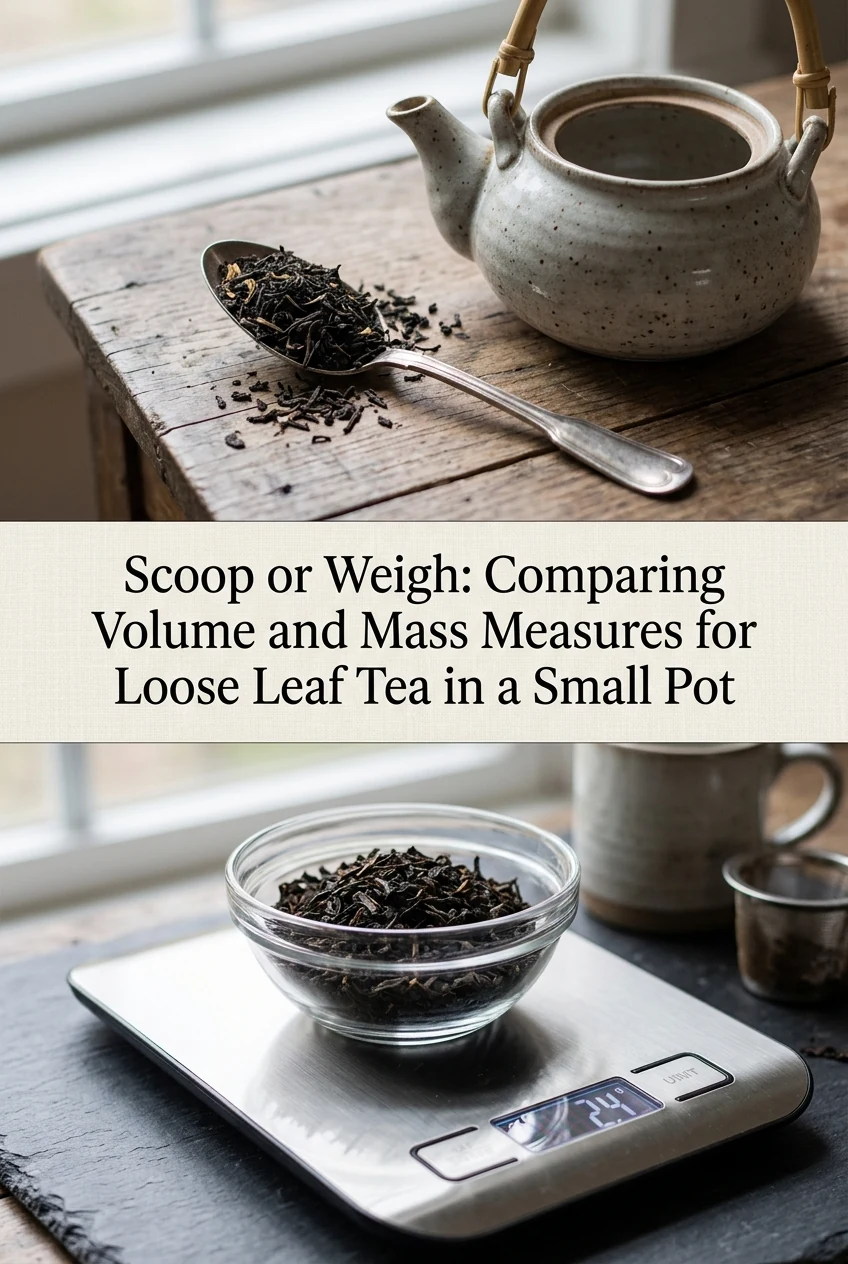
AI-generated editorial concept created for this article. The image is not a technical diagram or a tested result.
Why the Same Spoon Gives Different Results with Different Teas
A 5 ml teaspoon of tightly rolled oolong pellets weighs considerably more than a 5 ml teaspoon of large, open-cut white tea leaves because the pellets pack into the spoon volume more densely. The spoon measures space, not mass. When you switch tea types without adjusting the scoop count, you are changing the actual amount of leaf in the pot even if the spoon looks equally full. This is the core reason volume measures produce inconsistent strength across different leaf styles.
A Concrete Two-Cup Pot Example
Consider a 400 ml teapot. A common starting point for many loose leaf teas is roughly 2 to 3 grams of leaf per 200 ml of water, giving a range of 4 to 6 grams for this pot. This is an illustrative range, not a universal rule; your preferred strength and the specific tea will shift it. Weighing to 5 grams on a kitchen scale gives you the same input every time. Scooping by spoon for the same tea may yield anywhere from 3 to 7 grams depending on leaf size and how the spoon is filled.
When Scooping by Volume Is Practical Enough
If you brew the same tea repeatedly from the same batch and fill the spoon the same way each time, a volume scoop can be consistent enough for everyday use. The method works best with medium-cut leaves of uniform size that pack predictably into a spoon. It becomes less reliable when you switch between a fine broken-leaf tea and a whole-leaf variety, or when the same tea is purchased from a different supplier and arrives in a different cut size.
How to Calibrate Your Scoop Against a Scale Once
Weigh your usual scoop of a specific tea on a kitchen scale and note the result. If your standard two-teaspoon scoop of that tea weighs 4 grams, you now know the relationship for that tea and can use the spoon confidently without weighing every time. Repeat this calibration when you open a new tea or switch varieties. This one-time check takes under two minutes and removes the guesswork from volume scooping without requiring a scale at every brew session.
Choosing Based on Your Actual Brewing Habit
A kitchen scale gives repeatable results regardless of leaf type and is the better choice if you brew several different teas or are trying to dial in a new tea for the first time. A calibrated scoop is faster and sufficient if you brew one or two familiar teas regularly. Neither method controls for water temperature or steep time, which also affect strength. Fixing your measure method removes one variable, making it easier to adjust the others when the brew does not taste right.
A little more
to know.
Does the shape of the measuring spoon affect how much leaf it holds?
A deep, narrow spoon bowl packs irregular dry leaves differently than a wide, shallow bowl of the same rated volume, and leaves heap differently across the rim. Spoon geometry influences how dry tea settles into the scoop, which is why calibrating your specific spoon against a scale is more reliable than assuming all teaspoons scoop an identical mass.
If I always brew by weight, do I still need to adjust for a stronger or lighter cup?
Yes. Weight fixes the leaf input but steep time and water temperature still determine extraction. If a correctly weighed brew tastes too weak, extend the steep time slightly before adding more leaf, so you isolate which variable needs changing.
Original editorial guidance and recipe formulations, not independently kitchen-tested. Times are estimates and depend on equipment and product directions. Cooked bases need additional cooling and refrigeration before cold serving. Images are AI-generated illustrations; appearance and yield may vary. Check actual ingredient labels, allergens, and any certification you require. We do not certify products. Read our approach.
Save to Pinterest ↗ANOTHER IDEA FOR THE COUNTER