Scoop or Weigh: Comparing Volume and Mass Measures for Cocoa and Drinking Chocolate
Cocoa powder and drinking chocolate blends behave differently in a measuring spoon because their particle size, fat content and added sugar affect how loosely or densely they settle. A tablespoon of natural cocoa powder from one tin can weigh noticeably more or less than a tablespoon from another brand. Understanding when that difference matters, and when it does not, helps you decide whether a scale is worth adding to your drink-making routine.
Read the note ↓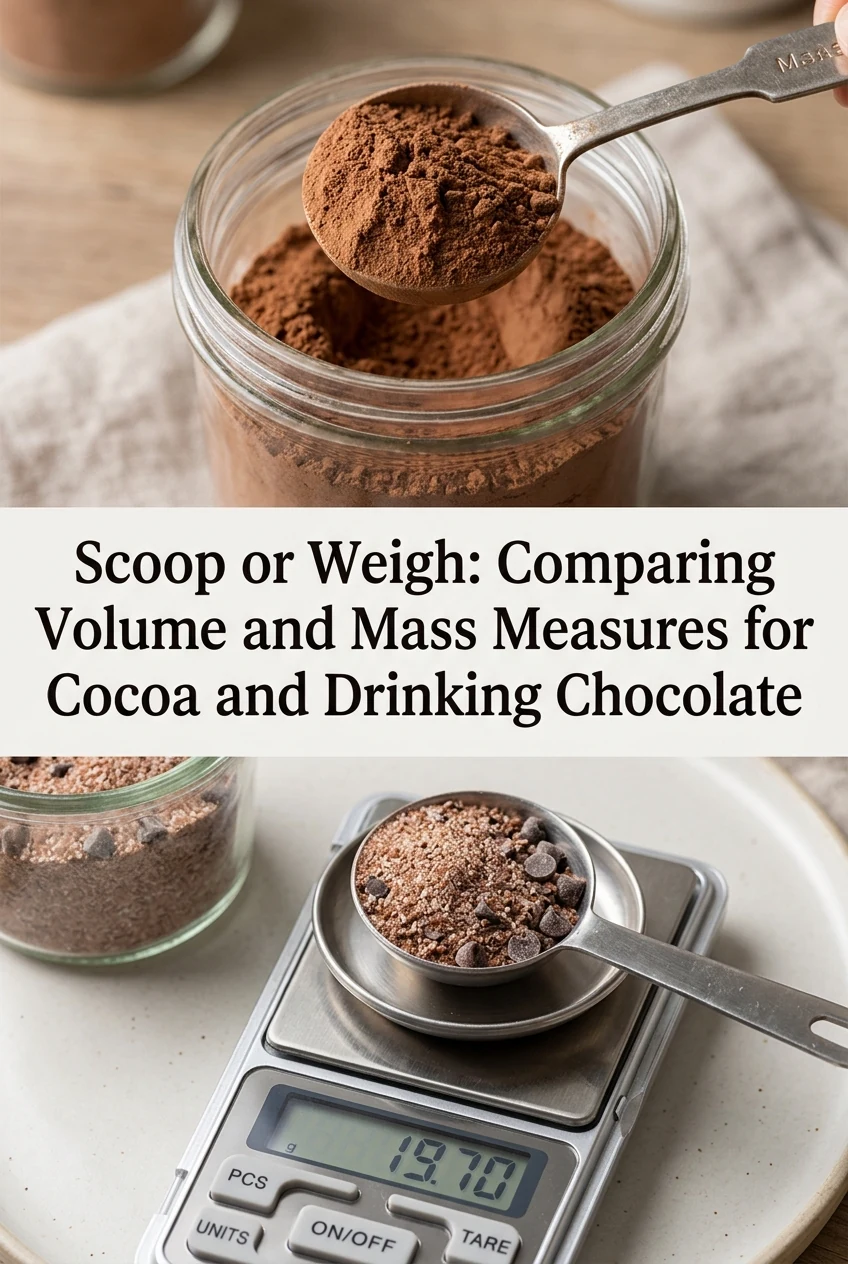
AI-generated editorial concept created for this article. The image is not a technical diagram or a tested result.
Why the Same Spoon Gives Different Results Across Tins
Natural cocoa powder is fine and tends to compact easily, so a scooped tablespoon can range from roughly 5 to 8 grams depending on whether you scooped directly from the tin or spooned powder loosely into the measure. Dutch-process cocoa often has a similar range. Drinking chocolate blends that include sugar and milk solids differ further in bulk density, often weighing noticeably more per level spoon because crystalline sugar is denser than aerated cocoa. Those differences add up across multiple drinks prepared in a session.
When Volume Measuring Is Sufficient
For a single casual drink where you are adjusting to personal taste anyway, a level tablespoon is a reasonable starting point. The variation across a few grams is unlikely to ruin a cup of hot cocoa. Volume measuring works well when you are using the same tin consistently, scooping with the same technique each time, and the drink is forgiving of small adjustments. It becomes less reliable when you switch between products or prepare drinks for several people at once.
When a Scale Improves Consistency
If you are preparing drinks for two or more people and want each cup to taste the same, weighing gives you a fixed reference point regardless of how the powder has settled in the tin. As an illustrative example, targeting 10 grams of cocoa per 200 millilitre cup removes the scooping variable entirely. A small kitchen scale that reads in one-gram increments is sufficient. Tare the scale with your mixing cup on it before adding powder.
Drinking Chocolate Blends Need Separate Calibration
Drinking chocolate products vary widely in their cocoa content and sugar ratio, and maker instructions often specify a number of heaped teaspoons rather than a gram weight. Follow the maker instructions on the tin as your baseline, then adjust from there. Do not apply a cocoa gram target to a drinking chocolate blend without checking, because the sugar content means the same gram weight will produce a much sweeter, less intense result than pure cocoa.
Building a Personal Reference for Your Usual Products
Weigh three level tablespoons of your usual cocoa powder separately and note each result. Average them. That number becomes your personal volume-to-mass reference for that specific tin. Write it on a piece of tape stuck to the tin. When you open a new tin of the same brand, repeat the check, as batches can vary slightly. This takes under two minutes and gives you the convenience of scooping with the accuracy of having verified the conversion yourself.
A little more
to know.
Does sifting cocoa before measuring change the weight significantly?
Sifting breaks up compacted clumps and aerates the powder, which can reduce the weight of a scooped tablespoon by one to two grams. If your recipe was developed with sifted cocoa, sift before measuring. If not, stay consistent with whichever method you use.
Is there a point where the difference between scooping and weighing stops mattering?
For drinks with strong added flavours like spiced syrups or strong brewed tea as a base, small cocoa variations are harder to detect. For a plain hot cocoa where cocoa is the primary flavour, a gram or two in either direction is more noticeable to most palates.
Original editorial guidance and recipe formulations, not independently kitchen-tested. Times are estimates and depend on equipment and product directions. Cooked bases need additional cooling and refrigeration before cold serving. Images are AI-generated illustrations; appearance and yield may vary. Check actual ingredient labels, allergens, and any certification you require. We do not certify products. Read our approach.
Save to Pinterest ↗ANOTHER IDEA FOR THE COUNTER