Read the Yield Line on a French Press Before Deciding How Many Cups to Brew
French press carafes indicate their brewing limit through a maximum fill line or graduated cup markings that define the practical volume for a clean pour. Filling a press to the brim without accounting for grounds displacement and the space required by the plunger assembly causes coffee to overflow through the spout during plunging and leads to excess sediment in the final cup. Checking the carafe's marked capacity before measuring water ensures you leave adequate headspace, preventing spills and keeping every brew consistent.
Read the note ↓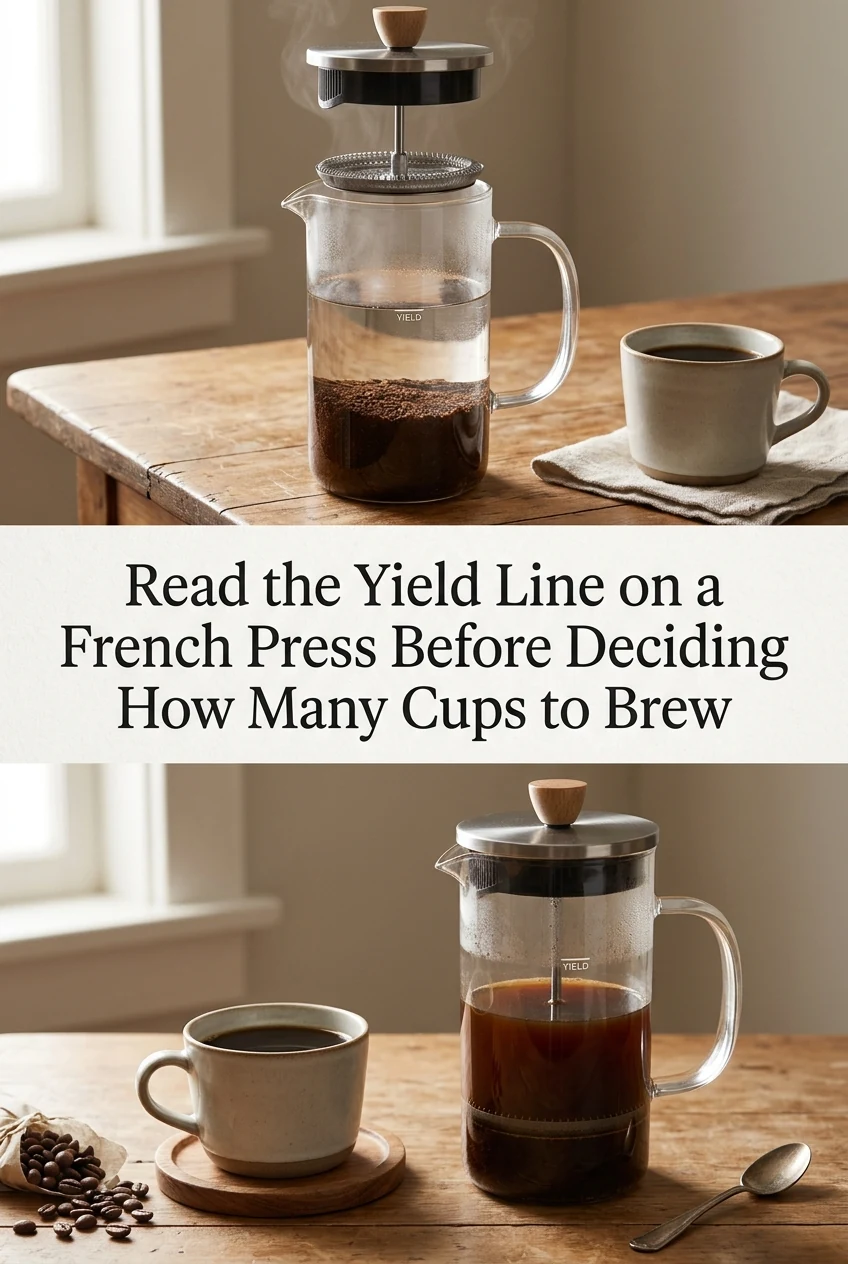
AI-generated editorial concept created for this article. The image is not a technical diagram or a tested result.
Understanding the Difference Between Maximum and Yield Lines
The total physical capacity of a carafe differs from its usable brewing volume. When a press features a fill line or cup markings, that indicator represents the practical brewing limit, leaving necessary headspace below the pour spout for coffee grounds, blooming foam, and the submerged filter assembly. Filling liquid past this line leaves no clearance when seating the plunger, which forces hot liquid out through the spout. Planning your water measurement around the carafe's intended usable capacity rather than total brim volume keeps the brew safe and clean.
How to Locate the Yield Line on Your Specific Press
Hold the carafe at eye level and check for graduated volume markings or a fill indicator positioned below the pour spout. On a common 350-milliliter press, the usable capacity is typically around 300 milliliters, while an 800-milliliter model accommodates roughly 650 to 700 milliliters of water. If your carafe has no printed lines, place the lid and plunger assembly onto the empty press to see how far the filter extends beneath the rim. As a reliable rule of thumb, leave at least 2 to 3 centimeters of clearance below the spout opening to allow room for the coffee bed and plunger without spillage.
Counting Cups Before Measuring Water
Decide how many cups you need before you measure anything. A standard serving cup in a home setting holds roughly 200 to 240 milliliters. If your press yields 600 milliliters, that is two to three cups depending on your cup size, not four. Counting first prevents the common mistake of measuring coffee for four servings and then discovering the press only yields enough water for three, leaving the coffee ratio off and one cup short.
Adjusting When the Yield Does Not Match Your Cup Count
If your press's usable capacity does not divide evenly into the number of cups you need, adjust down rather than up. Brewing less than the maximum capacity is always safe. Brewing above the fill line risks overflow and grounds in the pour. For an illustrative example, if you need two cups at 220 milliliters each and your press yields 650 milliliters, brew to 440 milliliters and leave the rest of the capacity unused. The ratio of coffee to water stays consistent regardless of how full the press is.
Pouring Without Disturbing the Grounds Layer
After plunging, decant the coffee immediately and steadily in a smooth motion. Pour gently rather than tipping the carafe abruptly, which can agitate the settled bed and force fine coffee silt past the mesh filter into your cup. Stop pouring as soon as the liquid stream turns noticeably cloudy or reaches the compressed grounds at the base, rather than attempting to drain every last drop. Leaving the bottom layer of muddy liquid behind ensures a cleaner cup. Rinse the carafe promptly after use to keep grounds from sticking to the glass.
A little more
to know.
Why does my last cup always taste more bitter than the first?
Coffee continues extracting while it sits in contact with the grounds even after plunging. Pouring all the brewed coffee into a separate preheated carafe or thermal jug immediately after pressing stops extraction and keeps the flavor consistent across every cup.
Does water temperature affect how much space the plunger needs?
Water temperature does not alter the physical space required by the plunger mechanism, nor does liquid expansion cause brewer overflow. Instead, hot water causes freshly ground coffee to rapidly release carbon dioxide, creating a frothy bloom that rises toward the rim. Leaving adequate clearance below the spout accommodates this foam and the displacement of the filter assembly, preventing spills when you seat the lid and press.
Original editorial guidance and recipe formulations, not independently kitchen-tested. Times are estimates and depend on equipment and product directions. Cooked bases need additional cooling and refrigeration before cold serving. Images are AI-generated illustrations; appearance and yield may vary. Check actual ingredient labels, allergens, and any certification you require. We do not certify products. Read our approach.
Save to Pinterest ↗ANOTHER IDEA FOR THE COUNTER