Read a Coffee Bag's Grind Description Before Choosing a Brewer
A bag of pre-ground coffee carries more useful information than most home brewers stop to read. The grind description printed or stamped on the packaging tells you which brewing method the roaster had in mind when they set the grinder. Matching that description to the brewer you actually own is one of the simplest ways to avoid a weak, bitter, or muddy cup without changing anything else about your routine.
Read the note ↓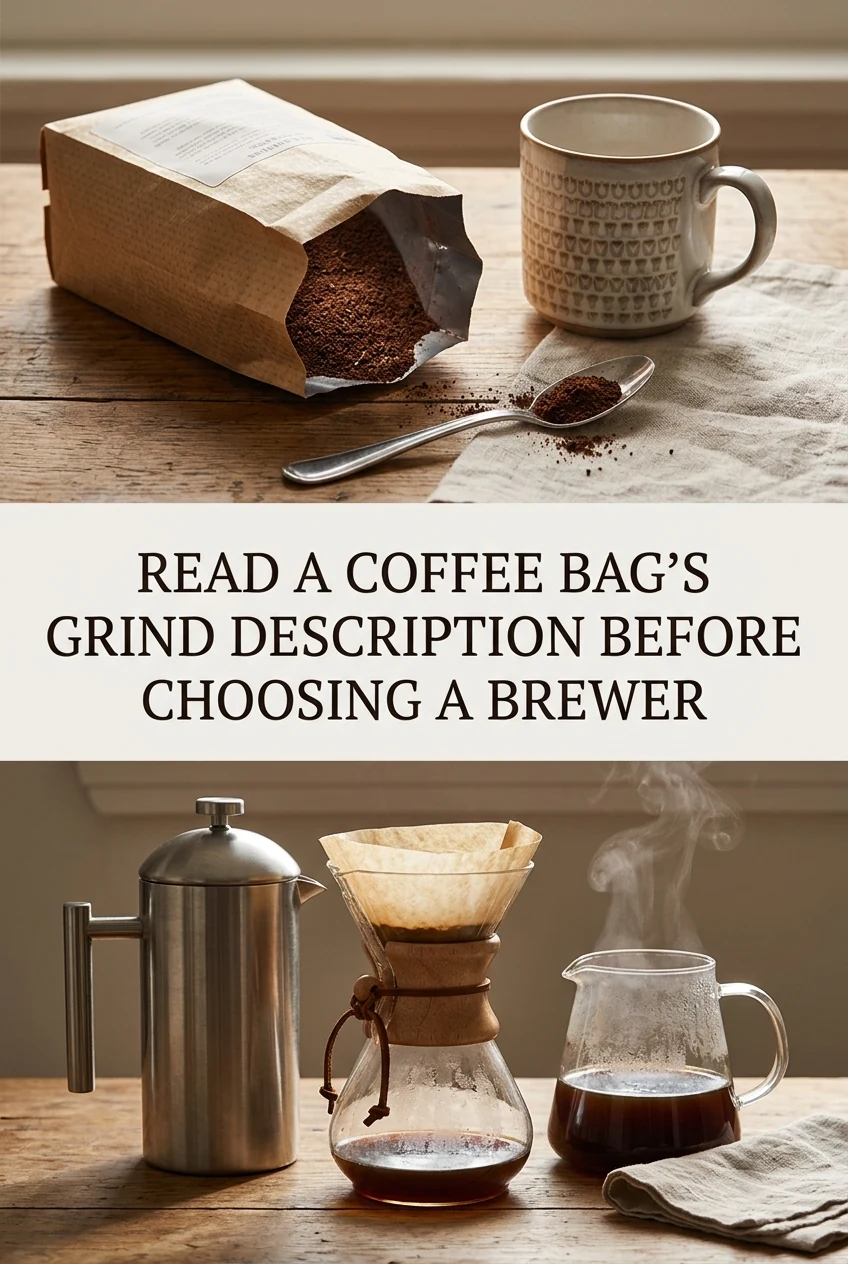
AI-generated editorial concept created for this article. The image is not a technical diagram or a tested result.
Why the Grind Description Exists
Roasters grind coffee to a specific particle size before sealing the bag because extraction depends heavily on how much surface area water contacts and for how long. A grind labeled for espresso is ground fine so that pressurized water moving through it in roughly 25 to 30 seconds meets enough resistance to extract properly. A grind labeled for drip or filter is coarser so that gravity-fed water draining through a paper filter over several minutes does not over-extract. When the label says 'espresso,' the roaster is not describing flavor intensity or roast darkness; they are describing the particle size they chose and the brew method it suits. Reading that label before you buy prevents a mismatch before it reaches your kitchen.
Common Label Terms and What They Signal
Labels vary by brand, but several terms appear consistently. 'Espresso grind' or 'fine grind' indicates coffee ground for a pump or stovetop espresso maker. 'Drip grind,' 'filter grind,' or 'medium grind' suits flat-bottom or cone drip brewers. 'Coarse grind' or 'French press grind' is intended for full-immersion brewers with a metal mesh plunger. 'Moka pot grind' sometimes appears separately and sits between espresso and drip. Some bags list multiple compatible methods, which is helpful. What the label does not tell you is a universal water temperature, a dose weight, or a brew time that applies to every machine of that type, because those variables differ between individual brewers and their maker instructions. Use the label to confirm method compatibility, then follow your specific brewer's manual for dose and timing.
A Worked Example: Matching a Bag to Two Brewers
Imagine you have two brewers at home: a stovetop moka pot and a flat-bottom electric drip machine. You pick up a bag labeled 'Moka Pot Grind, medium-fine.' This is an illustrative planning scenario, not a tested result. The moka pot is a strong match because the label names it directly. Your drip machine is a weaker match; medium-fine particles may slow drainage through a flat-bottom paper filter and produce a denser, more bitter cup than the same coffee ground to a true medium would. A second bag on the same shelf labeled 'Drip and Filter, medium grind' would suit the drip machine well and would likely under-extract in the moka pot because the coarser particles allow water to pass through the pressurized chamber too quickly. Buying the bag whose label matches your intended brewer avoids both problems before you spend money.
When a Bag Lists No Grind Description
Some specialty bags omit a grind description entirely, especially whole-bean offerings. In that case, look for a brew method recommendation elsewhere on the packaging, such as a small icon row or a text block on the back panel. If none appears, contact the roaster directly; many publish brewing guides on their packaging inserts or include a QR code linking to their recommendations. Do not infer grind suitability from roast color alone. A dark roast can be ground for drip, and a light roast can be ground for espresso. Roast level and grind size are separate decisions the roaster makes independently, and treating one as a proxy for the other leads to mismatched purchases.
Storing Pre-Ground Coffee After Opening
Once you have matched the bag to your brewer and opened it, storage affects how the coffee performs. Pre-ground coffee has more exposed surface area than whole beans and loses volatile compounds faster after the bag is opened. Seal the bag tightly using its built-in clip or valve, or transfer the coffee to an airtight container kept at room temperature away from direct light and heat sources. Do not refrigerate or freeze opened pre-ground coffee unless the roaster's own instructions specifically recommend it, because condensation from temperature changes can affect the grounds. Use the coffee within the window the roaster suggests on the packaging; if no window is printed, treat the grind description as one more reason to buy in smaller quantities that you can use promptly.
A little more
to know.
Can I use espresso-grind coffee in a drip machine if I have nothing else available?
You can attempt it, but the fine particles are likely to slow drainage significantly, and depending on your drip machine's filter basket design, you may end up with overflow or a very dense, bitter brew. It is a workable short-term workaround for some machines, but it is not what the roaster or the drip machine maker designed the product for. Check your drip machine's manual to see whether it mentions fine grinds at all before proceeding.
Does a bag labeled for multiple brew methods mean the grind works equally well in all of them?
Not necessarily equally well, but the roaster has judged the particle size to be compatible with each listed method. Multi-method labels often indicate a medium grind, which sits in a range broad enough to function in drip brewers, some pour-over setups, and occasionally a moka pot. Read the full list on the label and cross-reference it with your specific brewer's recommended grind range if the maker's instructions include one.
Original editorial guidance and recipe formulations, not independently kitchen-tested. Times are estimates and depend on equipment and product directions. Cooked bases need additional cooling and refrigeration before cold serving. Images are AI-generated illustrations; appearance and yield may vary. Check actual ingredient labels, allergens, and any certification you require. We do not certify products. Read our approach.
Save to Pinterest ↗ANOTHER IDEA FOR THE COUNTER