Prevent Cocoa Clumping in Cold Milk Drinks
Unsweetened cocoa powder contains natural fats and insoluble fibers that resist combining with cold liquids. Stirring dry cocoa directly into chilled milk creates hydrophobic dry pockets that float persistently on top. Because cocoa solids do not dissolve, producing a uniform cold drink requires creating a warm, fluid suspension first. Hydrating the powder with a measured volume of hot water softens natural cocoa butter and separates microscopic particles. This straightforward technique ensures your cold cocoa base remains evenly dispersed without requiring commercial syrups or high-speed blenders.
Read the note ↓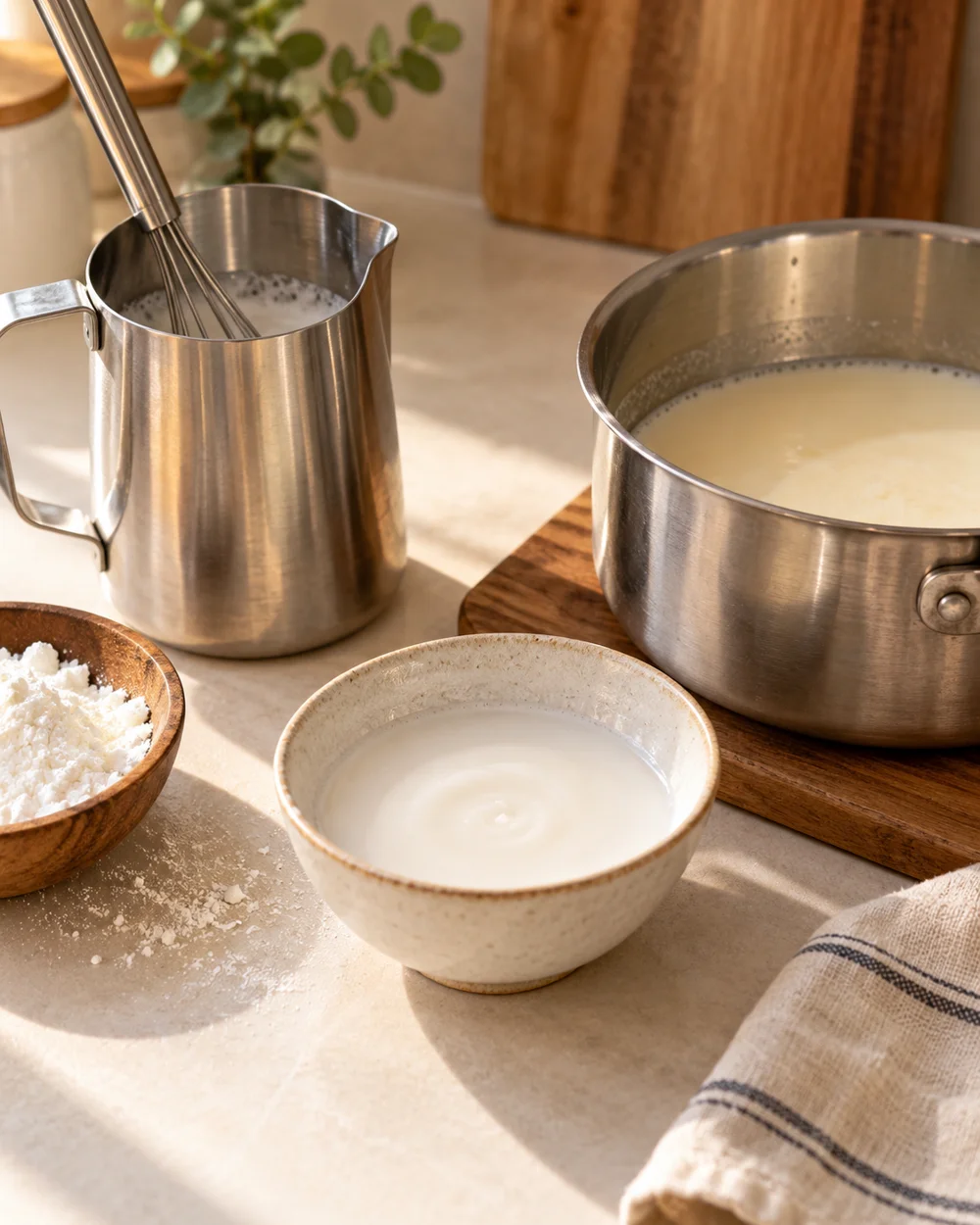
Representative category illustration reused from our editorial library; it does not depict this specific project or a tested result.
Understanding Cocoa Dispersion Mechanics
Cocoa powder is naturally hydrophobic because residual cocoa butter—typically 10 to 22 percent by weight—repels water-based fluids. When dry cocoa touches chilled milk, moisture hydrates only the outer edge, forming a sticky barrier around trapped dry powder. Cold dairy proteins coat these pellets, preventing dispersion. Cocoa solids do not dissolve into liquid; rather, their insoluble plant fibers form a suspended colloid. Introducing hot water melts cocoa butter and allows water to penetrate individual particles, ensuring they remain suspended when combined with cold milk.
Proper Liquid Ratios for the Initial Slurry
Achieving a smooth suspension requires an adequate liquid-to-powder ratio. Mixing equal parts by weight produces a stiff, unworkable dough that resists dilution. A reliable ratio uses two to two-and-a-half parts hot water to one part cocoa powder by weight. For 12 grams of cocoa powder, measure 30 milliliters of hot water heated to at least 75 degrees Celsius. Place the cocoa into a small heatproof bowl, add the hot water, and stir in tight circles using a small whisk or fork. Within thirty seconds, the mixture shifts into a glossy, pourable base.
Worked Beverage Proportions
To prepare a balanced 240-milliliter iced beverage, combine 12 grams of cocoa powder with 15 grams of granulated sugar in a heatproof cup. Pour 30 milliliters of hot water over the dry blend, whisking until smooth and lump-free. Let this concentrated slurry sit on the counter for two minutes to drop to a warm temperature. Pouring boiling liquid directly over ice melts excess water, thinning beverage texture. Once lukewarm, stir in 180 milliliters of chilled pasteurized milk, then pour the blended liquid over 50 grams of solid ice cubes in a glass.
Incorporating Chilled Dairy Gradually
Pouring a full volume of cold milk into warm cocoa paste at once can cause cocoa butter to firm abruptly into tiny specks. Use a progressive dilution method instead. Stir approximately 30 milliliters of cold milk into the lukewarm cocoa slurry first, whisking until the mixture forms an evenly thinned liquid. Once that preliminary blend is stable, pour in the remaining 150 milliliters of cold milk while stirring steadily. This two-stage addition prevents localized separation and keeps cocoa particles uniformly suspended throughout the dairy base.
Safe Handling and Batch Storage
When preparing cocoa base in advance for multiple drinks, store unused portions properly to prevent spoilage. Transfer the warm base into a clean, airtight glass jar. Place the jar in a refrigerator running at 4 degrees Celsius or lower within two hours of preparation, or within one hour if ambient room temperature exceeds 32 degrees Celsius. Refrigerated paste keeps safely for up to three days. Because cocoa butter firms when chilled, the paste thickens in storage; stir in a teaspoon of warm water to loosen it before assembling drinks.
A little more
to know.
Can I use cold water to create the initial cocoa paste?
Cold water cannot melt cocoa butter or penetrate packed dry clusters. Cocoa butter remains firm below 34 degrees Celsius, causing outer starches to form an impermeable gel shell around dry powder. Water heated above 75 degrees Celsius is necessary to yield a smooth suspension.
Why does dark sediment settle at the bottom of the glass after fifteen minutes?
Cocoa powder consists of insoluble plant fibers that do not dissolve into a chemical solution. Even with proper slurry preparation, gravity causes heavier suspended particulates to settle slowly over time. Stir the drink gently with a straw before sipping to redistribute the sediment.
Original editorial guidance and recipe formulations, not independently kitchen-tested. Times are estimates and depend on equipment and product directions. Cooked bases need additional cooling and refrigeration before cold serving. Images are AI-generated illustrations; appearance and yield may vary. Check actual ingredient labels, allergens, and any certification you require. We do not certify products. Read our approach.
Save to Pinterest ↗ANOTHER IDEA FOR THE COUNTER