Prepare a Small Cardamom Syrup Batch and Store It Correctly
A small batch of cardamom syrup gives you a measured, consistent sweetener for hot lattes, iced drinks and sparkling water without committing to a large quantity that may go unused. This guide covers the exact quantities for a 250 ml batch, how to crack and simmer whole pods, how to strain the syrup cleanly and how to bottle and refrigerate it promptly so it stays safe for use across the following week.
Read the note ↓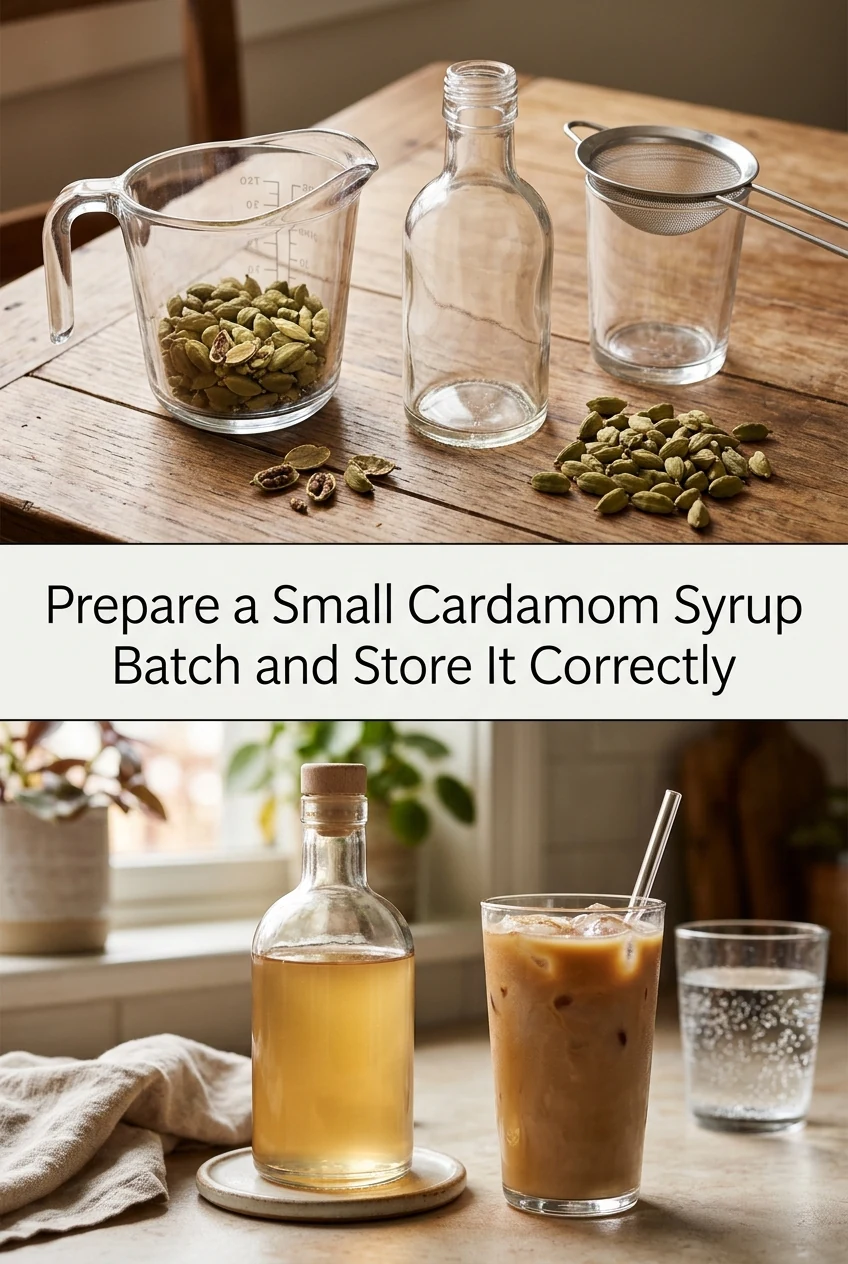
AI-generated editorial concept created for this article. The image is not a technical diagram or a tested result.
Gather Your Quantities Before You Start
For a 250 ml finished batch, measure 200 ml of cold water and 200 g of white granulated sugar into a small saucepan. Separately, count out 10 whole green cardamom pods. Lightly crack each pod using the flat side of a knife so the seeds are exposed but the pod remains in one piece. This cracking step is important because it releases the aromatic oils into the syrup during simmering without letting loose seeds scatter into the liquid and complicate straining later.
Simmer the Syrup and Watch the Timing
Place the saucepan over medium heat and stir gently until the sugar dissolves fully, which typically takes two to three minutes. Add the cracked pods, reduce the heat to low and let the mixture simmer uncovered for eight minutes. Do not boil vigorously, as rapid boiling can cause the syrup to reduce unevenly and alter the final volume. After eight minutes, remove the pan from the heat and allow the syrup to steep with the pods for a further ten minutes off the heat.
Strain the Syrup Without Leaving Residue
Set a fine mesh strainer over a heatproof jug. Pour the syrup slowly through the strainer, then press the pods gently with the back of a spoon to extract any remaining liquid. Discard the pods. If you notice any cloudiness or fine seed particles passing through, line the strainer with a single layer of cheesecloth and pour the syrup through a second time. This two-pass method is an illustrative approach rather than a guaranteed result, as strainer mesh sizes vary.
Bottle the Syrup and Refrigerate Promptly
Allow the strained syrup to cool at room temperature for no more than 30 minutes, then transfer it into a clean glass bottle or jar with a tight-fitting lid. Do not leave it at room temperature beyond two hours from when cooking finished. Seal the bottle and place it in the refrigerator at 4 degrees Celsius or below immediately. Label the bottle with the preparation date. Because this syrup contains no preservatives, use it within seven days and discard any remainder after that period.
Use the Syrup in Hot and Cold Drinks
For a hot drink, stir 15 ml of cardamom syrup directly into brewed coffee or tea before adding milk. For an iced drink, add the syrup to the glass before the ice so it distributes evenly without clumping at the bottom. A useful starting point is 10 to 20 ml per 250 ml drink, adjusted to your preference. Always use a clean spoon each time you measure from the bottle to avoid introducing moisture or residue that could shorten the syrup's refrigerator life.
A little more
to know.
Can I use pre-ground cardamom instead of whole pods?
Pre-ground cardamom does not dissolve in syrup, and its fine particulate matter is difficult to strain out with household mesh or cheesecloth, leaving a cloudy syrup with gritty sediment. Whole cracked pods are strongly preferable because they infuse their essential oils while filtering out cleanly.
Why does my syrup look slightly cloudy after refrigeration?
Slight cloudiness can develop as the syrup cools and is generally a cosmetic issue from fine particles. If the syrup smells sour or shows any visible growth, discard it immediately regardless of the date.
Original editorial guidance and recipe formulations, not independently kitchen-tested. Times are estimates and depend on equipment and product directions. Cooked bases need additional cooling and refrigeration before cold serving. Images are AI-generated illustrations; appearance and yield may vary. Check actual ingredient labels, allergens, and any certification you require. We do not certify products. Read our approach.
Save to Pinterest ↗ANOTHER IDEA FOR THE COUNTER