Prepare a Small Batch of Saffron and Honey Syrup for Cold Milk Drinks
Saffron does not release its colour and flavour instantly. It needs time in warm water before honey is introduced, and the water temperature during steeping matters more than most home cooks expect. Skipping or shortening the steep produces a pale, weakly flavoured syrup that underperforms in cold milk drinks where the flavour must compete with the milk's natural sweetness. This guide focuses on the steep and assembly sequence rather than on flavour variations.
Read the note ↓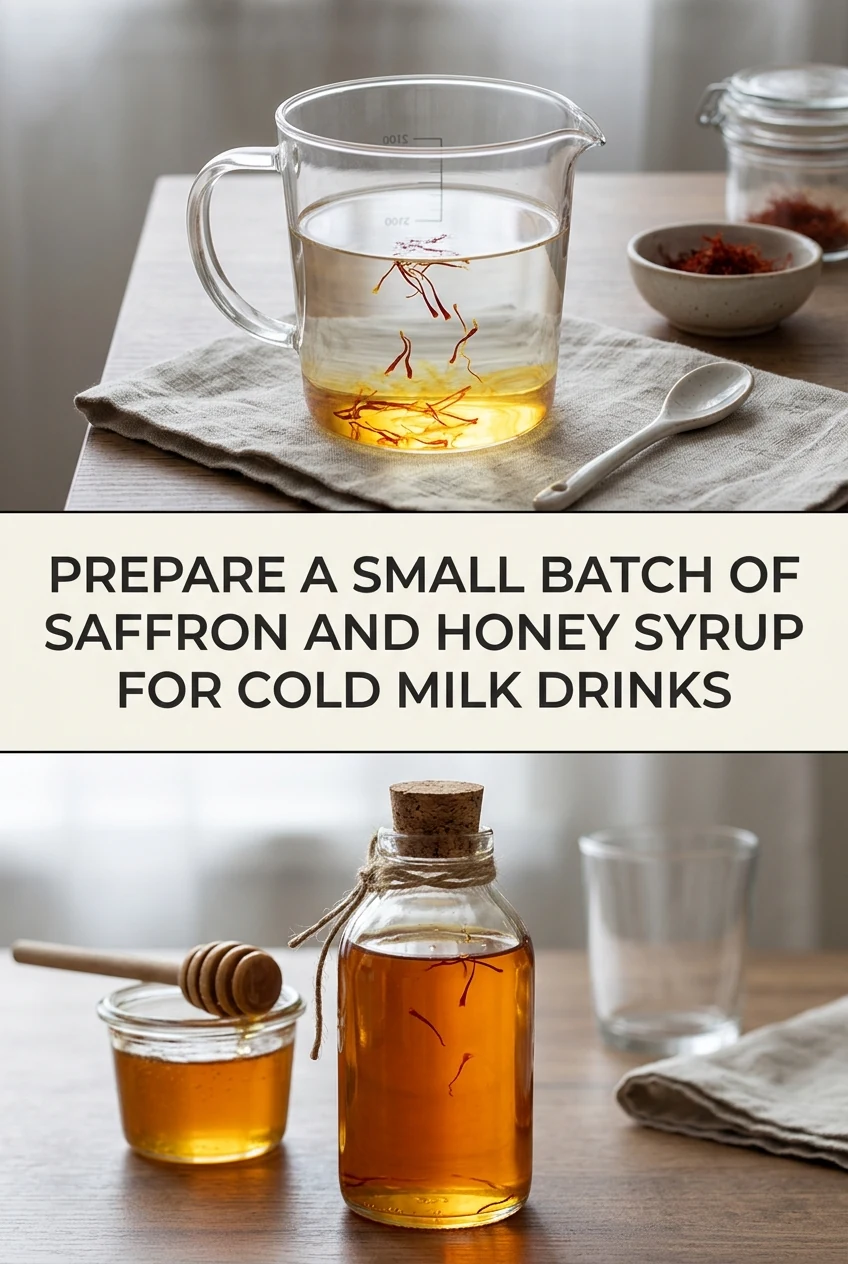
AI-generated editorial concept created for this article. The image is not a technical diagram or a tested result.
Measure Water Temperature Before Steeping
Bring a small amount of water to approximately 85 degrees Celsius, which is just below a full boil. Use a kitchen thermometer to confirm the temperature rather than estimating by appearance. Water that is too cool extracts colour and flavour slowly and unevenly. Water that is at a full rolling boil can degrade some of saffron's aromatic compounds. For a small batch, 60 ml of water at 85 degrees Celsius is a workable illustrative starting quantity, though your preferred batch size may differ.
Steep the Saffron for the Full Time
Add a small pinch of saffron threads, approximately 0.1 to 0.15 g, to the measured warm water in a heatproof cup or small bowl. Stir once and leave undisturbed for 15 minutes. The water will shift from pale yellow to a deeper golden orange as the crocin compounds in the threads dissolve. Do not shorten the steep to save time; a 5-minute steep produces noticeably less colour and a thinner flavour. Set a timer so the steep is consistent between batches.
Add Honey After Steeping, Not Before
Once the steep is complete, add honey directly to the warm saffron water. Liquid honey dissolves readily into warm liquid with gentle stirring, eliminating the need for additional cooking on the stove. For the illustrative 60 ml batch, 50 g of liquid honey stirs in smoothly. Adding honey after steeping rather than before ensures the saffron threads are fully exposed to water during extraction. Stir until completely blended and no honey streaks remain visible.
Cool Completely Before Adding to Cold Milk
Allow the syrup to reach room temperature before refrigerating, which typically takes 20 to 30 minutes in a small uncovered bowl. Do not add warm syrup directly to cold milk; the temperature difference causes the milk to partially warm, which shortens how long the assembled drink stays cold and can affect texture. Once the syrup is at room temperature, transfer it to a small sealed jar and refrigerate. Use within five days and discard if any off smell or visible change develops.
Assemble the Cold Milk Drink in the Right Order
Add ice to the glass first, then pour cold milk, then add the saffron honey syrup on top. Pouring syrup over milk rather than the reverse allows you to see how much colour disperses naturally before stirring, which is a useful visual check that the syrup is properly concentrated. Stir gently from the bottom before serving. Start with one to two teaspoons of syrup per 200 ml of cold milk and adjust to taste; the syrup is sweet and the flavour is distinct, so small additions are easier to manage.
A little more
to know.
Can I use powdered saffron instead of threads for this syrup?
Powdered saffron dissolves faster than threads but is harder to measure accurately at small quantities, and some commercial powders are adulterated with other ingredients. If using powder, start with a smaller amount than you think you need and taste the steep before adding honey, as the flavour can be more intense or inconsistent.
Does the type of honey affect the final flavour noticeably?
Yes. A strongly flavoured honey such as buckwheat will compete with the saffron rather than supporting it. A mild, lightly flavoured honey allows the saffron character to remain the dominant note in the finished cold milk drink, which is generally the intended outcome for this style of syrup.
Original editorial guidance and recipe formulations, not independently kitchen-tested. Times are estimates and depend on equipment and product directions. Cooked bases need additional cooling and refrigeration before cold serving. Images are AI-generated illustrations; appearance and yield may vary. Check actual ingredient labels, allergens, and any certification you require. We do not certify products. Read our approach.
Save to Pinterest ↗ANOTHER IDEA FOR THE COUNTER