Prepare a Small Batch of Lemon and Basil Syrup for Still and Sparkling Cold Drinks
Fresh basil turns dark and develops a bitter edge when exposed to heat, which makes it unsuitable for simmering directly in a hot syrup. The solution is a two-stage process: make a plain lemon syrup first, allow it to cool completely, and then steep the basil leaves in the cooled syrup for a short, controlled time before straining. This guide covers both stages in sequence, with quantities suited to a small home or cafe batch that yields enough syrup for approximately eight to ten drinks.
Read the note ↓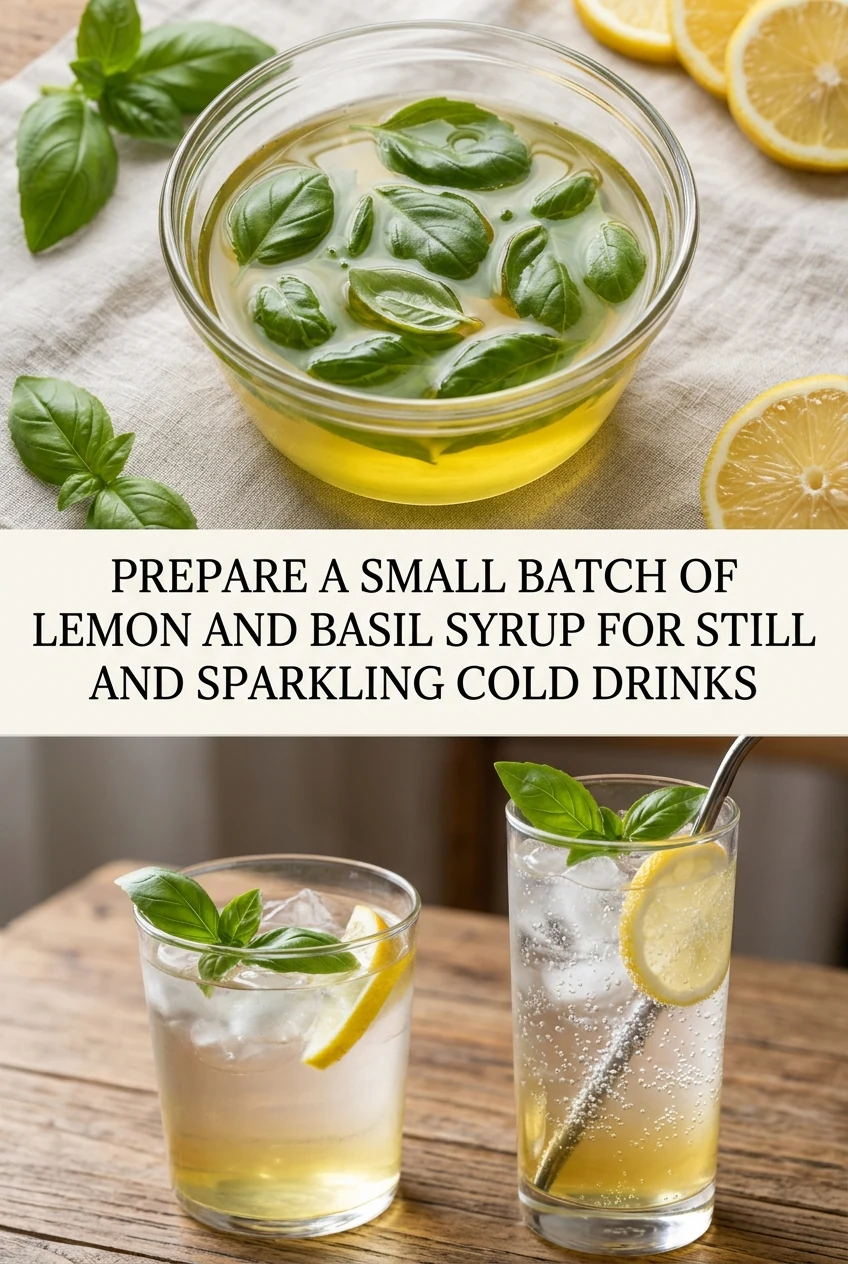
AI-generated editorial concept created for this article. The image is not a technical diagram or a tested result.
Making the plain lemon syrup base
Combine 200 grams of white granulated sugar with 200 millilitres of water in a small saucepan. Add the finely grated zest of one medium lemon and the juice of the same lemon, approximately 30 to 40 millilitres of juice. Stir over medium heat until the sugar dissolves completely, then bring to a brief simmer for three minutes. Remove from the heat immediately. Do not continue simmering after the sugar has dissolved and the three minutes are complete, as reducing the syrup further will make it too thick for cold drinks.
Cooling the syrup fully before adding basil
Pour the hot lemon syrup into a heatproof bowl or jug and leave it uncovered at room temperature until it reaches room temperature, which typically takes 30 to 40 minutes depending on ambient conditions. Do not add the basil while the syrup is still warm. Even residual warmth above approximately 40 degrees Celsius is enough to begin darkening the leaves and releasing the bitter compounds that make heat-steeped basil unpleasant. Test the temperature by touching the outside of the bowl; it should feel neutral, not warm.
Steeping the basil leaves
Once the syrup is fully cool, add 10 to 12 fresh basil leaves, roughly torn to expose more surface area without bruising them heavily. Stir gently once to submerge the leaves, then leave them to steep for 15 minutes. Check the colour at 15 minutes; the syrup should be pale green-yellow with a clean herbal scent. If you prefer a stronger basil note, steep for up to 20 minutes, but do not exceed this. Beyond 20 minutes the flavour can become grassy and the colour may begin to dull even in cold syrup.
Straining and bottling
Pour the steeped syrup through a fine mesh strainer into a clean, dry glass bottle or jar. Discard the basil leaves and any zest fragments. The finished syrup should be clear to very lightly tinted and smell of lemon with a distinct fresh basil note underneath. Seal the bottle immediately. This batch yields approximately 200 to 230 millilitres, which is enough for eight to ten drinks at a standard measure of 20 to 25 millilitres per serving. Actual yield varies with lemon juice content and simmer evaporation.
Serving in still and sparkling cold drinks
For a still cold drink, stir 20 to 25 millilitres of syrup into 250 millilitres of cold water over ice. For a sparkling version, add the syrup to the glass first, then pour sparkling water gently down the side of the glass to preserve carbonation. Refrigerate the sealed bottle at 4 degrees Celsius or below and use within four days. Discard any unused syrup after that period or if the colour darkens noticeably or the basil aroma fades, as these are signs the volatile compounds have degraded.
A little more
to know.
Can I use dried basil instead of fresh for this syrup?
Dried basil lacks the volatile aromatic compounds that give fresh basil its clean flavour. It produces a dull, slightly dusty taste in cold syrup and does not benefit from the cool-steep method. Fresh leaves are necessary for this recipe to work as intended.
Why does the syrup sometimes turn slightly brown even when cooled before steeping?
Basil leaves bruised during tearing or stirring release enzymes that cause oxidation. Handle the leaves gently, steep in a covered bowl to limit air exposure, and strain promptly at the 15 to 20 minute mark to minimise discolouration.
Original editorial guidance and recipe formulations, not independently kitchen-tested. Times are estimates and depend on equipment and product directions. Cooked bases need additional cooling and refrigeration before cold serving. Images are AI-generated illustrations; appearance and yield may vary. Check actual ingredient labels, allergens, and any certification you require. We do not certify products. Read our approach.
Save to Pinterest ↗ANOTHER IDEA FOR THE COUNTER