Prepare a Small Batch of Coconut and Lemongrass Syrup for Cold Drinks
Coconut and lemongrass syrup adds a clean, fragrant base to cold drinks without the heaviness of coconut cream. The key steps are bruising the lemongrass correctly so it releases flavor during steeping, using coconut milk rather than cream for a pourable consistency, and straining the finished syrup cleanly before jarring. This batch yields approximately 220 ml of syrup, suitable for eight to ten cold drinks, and keeps in the refrigerator for up to five days when stored correctly.
Read the note ↓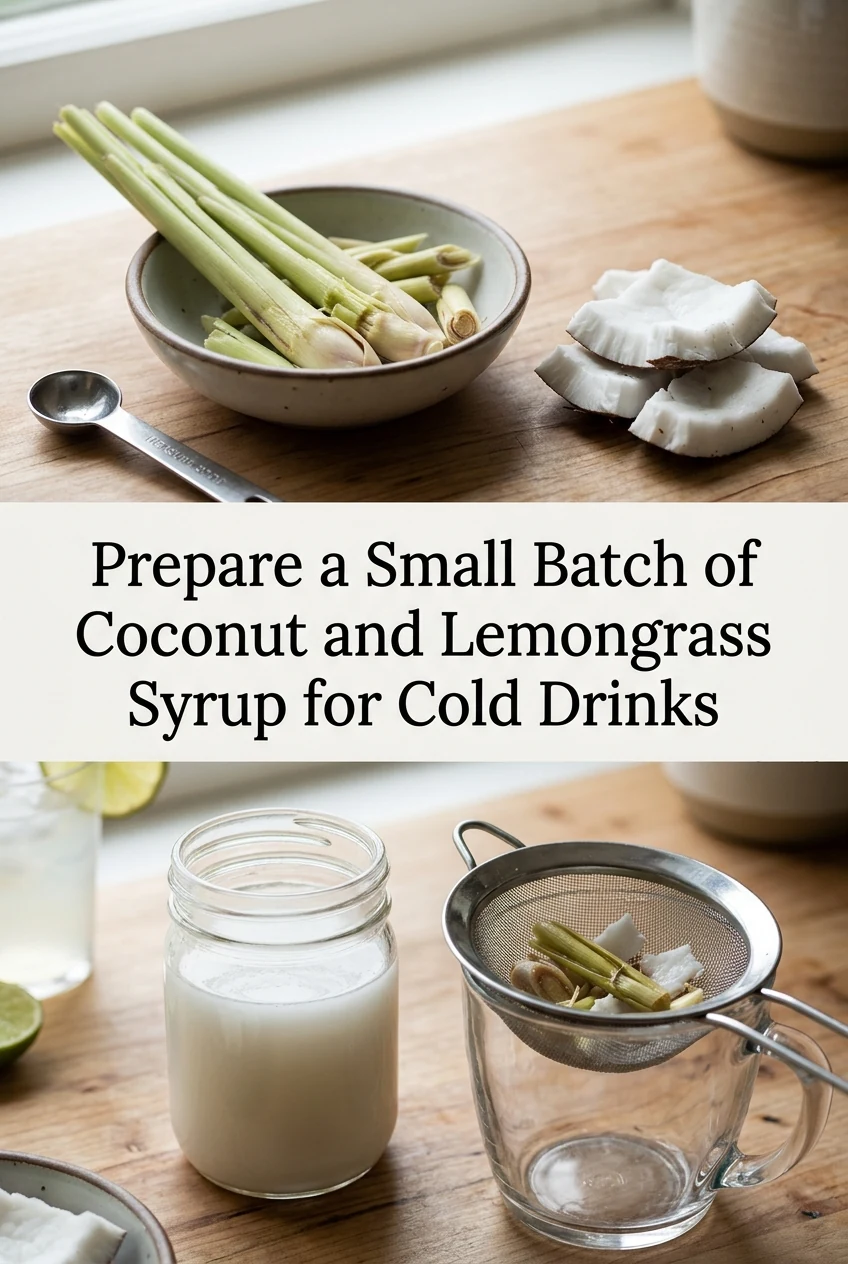
AI-generated editorial concept created for this article. The image is not a technical diagram or a tested result.
Prepare the Lemongrass for Steeping
Use two fresh lemongrass stalks, each approximately 25 to 30 cm long. Trim away the dry top third and the root base, leaving the pale lower section. Peel off the outermost layer, which is often tough and papery. Using the flat side of a heavy knife or a rolling pin, bruise the stalk firmly along its length in three or four places. This breaks the cell walls and allows the aromatic oils to release into the liquid during steeping. Cut each bruised stalk into three shorter pieces.
Steep in Sugar Syrup
Combine 150 ml of water and 130 g of white granulated sugar in a small saucepan. Stir over medium heat until the sugar fully dissolves, then add the lemongrass pieces. Bring to a gentle simmer, reduce heat to low, and steep uncovered for ten minutes. Do not boil hard, as this drives off the delicate citrus notes quickly. After ten minutes, remove from heat and allow the lemongrass to steep in the hot syrup for a further fifteen minutes off the heat before straining.
Add Coconut Milk and Strain
Remove the lemongrass pieces with tongs. Stir in 80 ml of full-fat canned coconut milk, whisking briefly to combine evenly. Return the pan to low heat for two minutes, stirring, just enough to fully incorporate the coconut milk without simmering. Pour the mixture through a fine-mesh sieve into a heatproof measuring jug to catch any fibrous lemongrass fragments. As an illustrative example, this quantity typically strains to roughly 200 to 230 ml of finished syrup, though yield varies with evaporation during steeping.
Cool, Jar, and Label for Refrigerator Storage
Allow the strained syrup to cool to room temperature before transferring to a clean glass jar with a tight-fitting lid. Coconut milk contains fat that can separate slightly on cooling; this is normal and the syrup will recombine with a brief stir before use. Write the preparation date on a label and attach it to the jar. Store in the refrigerator at 4 C or below and use within five days. Coconut milk shortens safe storage compared to a plain sugar syrup, so do not exceed this window.
Assemble a Cold Drink With the Syrup
Fill a 350 ml glass with ice. Add two tablespoons, approximately 30 ml, of coconut lemongrass syrup. Pour over 200 ml of cold still water or cold-brewed tea and stir well to combine. The syrup is sweet and concentrated, so start with two tablespoons and add a third only if you prefer a stronger flavor. Garnish with a thin slice of lime if available. Stir the jar of syrup with a clean dry spoon before each use if the coconut fat has separated during refrigeration.
A little more
to know.
Can I use dried lemongrass powder instead of fresh stalks?
Dried lemongrass powder disperses into the syrup and cannot be fully removed by straining, leaving a slightly cloudy result. If using powder, start with half a teaspoon, steep for five minutes only, and strain through muslin cloth to reduce cloudiness as much as possible.
Why does my syrup look grainy or curdled after refrigerating overnight?
Coconut fat solidifies at refrigerator temperature and can appear grainy or separated. This is a physical change, not spoilage. Allow the jar to sit at room temperature for five minutes, then stir firmly with a clean spoon until the texture looks smooth and uniform again before measuring.
Original editorial guidance and recipe formulations, not independently kitchen-tested. Times are estimates and depend on equipment and product directions. Cooked bases need additional cooling and refrigeration before cold serving. Images are AI-generated illustrations; appearance and yield may vary. Check actual ingredient labels, allergens, and any certification you require. We do not certify products. Read our approach.
Save to Pinterest ↗ANOTHER IDEA FOR THE COUNTER