Place a Damp Cloth Under a Cutting Board Before Preparing Fruit for Cold Drinks
A cutting board that slides during fruit preparation makes accurate knife work difficult. Citrus halves, mango cheeks, and melon slices all require downward pressure and directional cuts, and a shifting board redirects that force unpredictably. Placing a damp cloth underneath the board takes about three seconds and helps stabilize it against the counter surface. This single step helps keep fruit prep for cold drinks steady and controlled without requiring specialized non-slip mats or additional equipment.
Read the note ↓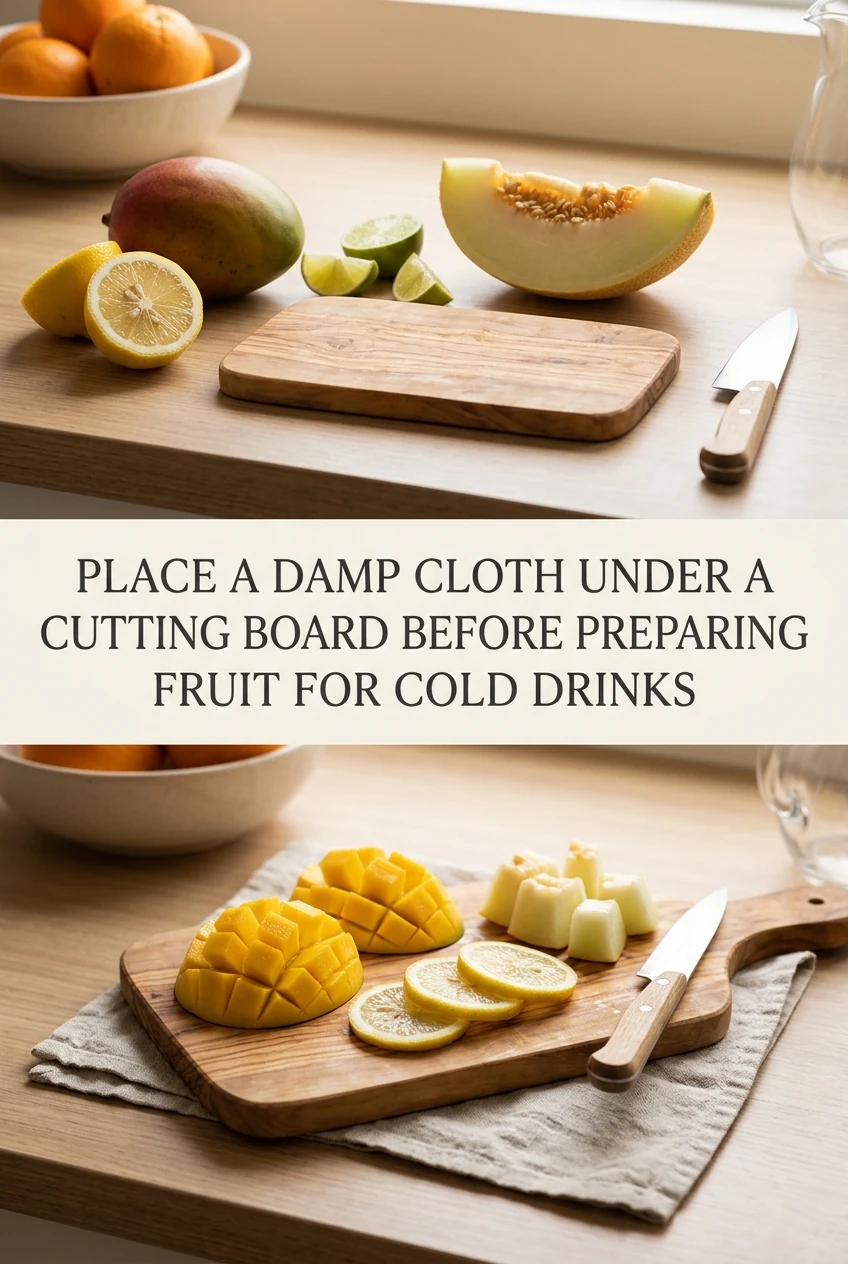
AI-generated editorial concept created for this article. The image is not a technical diagram or a tested result.
Why Boards Slide and Why Damp Cloth Works
Smooth cutting boards on smooth counters have little friction between them, especially when the counter surface is dry and clean. Fruit juice released during cutting can make the situation worse by acting as a lubricant under the board. A damp cloth increases friction because the moistened fabric softens and conforms to the micro-texture of both the board and the countertop, providing traction against lateral cutting forces. The cloth does not need to be soaking wet, just evenly damp across its surface.
Choosing and Preparing the Cloth
Use a clean, flat cloth without thick seams or folds that would create an uneven base. A standard kitchen towel folded once to match the board's footprint works well. Dampen it under the tap and wring it out so it is moist but not dripping. Lay it flat on the counter, smoothing out any air pockets or bunched fabric before placing the board on top. A cloth that is too wet can allow the board to shift on the water film rather than grip through it.
Applying This to Common Cold Drink Fruit
Citrus fruits like lemons and limes require firm halving cuts and then pressing, both of which push the board sideways. Mango cheeks need a controlled lengthwise cut close to the pit, where the knife can deflect if the board moves. Melon slices involve long strokes across a curved surface. In each case, the damp cloth keeps the board stationary so your cutting hand controls the knife path rather than compensating for board movement. This is especially relevant when preparing multiple portions in sequence.
Keeping the Setup Clean During Prep
Fruit juice will eventually reach the cloth during a longer prep session. Check the cloth periodically: if it becomes saturated with juice rather than water, it loses some of its gripping function and introduces a hygiene concern. Replace it with a fresh damp cloth if you notice significant juice absorption. The used cloth should go directly into a wash, not be reused for wiping surfaces. Keep a second cloth ready during busy prep periods so the swap takes only a moment.
Refrigerating Cut Fruit Promptly
Once fruit is cut for cold drinks, it enters a perishable window. Transfer cut citrus, mango, or melon to a covered container and refrigerate at 4 degrees Celsius or below within two hours of cutting, or within one hour if your kitchen is above 32 degrees Celsius. Do not leave cut fruit sitting at the prep station between service rushes. Prepare quantities that match expected demand within that window rather than cutting large amounts in advance that will sit at room temperature.
A little more
to know.
Does this method work for both plastic and wooden cutting boards?
Yes. The damp cloth grips the underside of both plastic and wooden boards effectively. Wooden boards are heavier and tend to slide less on their own, but the cloth still provides a meaningful improvement in stability, particularly during the lateral pressure of citrus halving.
Is there a counter surface where a damp cloth does not help?
On very porous or rough stone counters, the cloth may bunch slightly rather than lie flat, reducing its effectiveness. In that case, ensure the cloth is fully smoothed before placing the board, or use a slightly thicker folded towel to bridge minor surface irregularities.
Original editorial guidance and recipe formulations, not independently kitchen-tested. Times are estimates and depend on equipment and product directions. Cooked bases need additional cooling and refrigeration before cold serving. Images are AI-generated illustrations; appearance and yield may vary. Check actual ingredient labels, allergens, and any certification you require. We do not certify products. Read our approach.
Save to Pinterest ↗ANOTHER IDEA FOR THE COUNTER