Pick the Right Sweetener for a Cold Drink Base
Stirring granulated sugar into a cold drink and watching it sink to the bottom is a familiar frustration. The sweetener you choose for a cold base changes how quickly it dissolves, how much you need to reach the same perceived sweetness, and whether the finished drink feels thin or slightly viscous. This guide compares granulated sugar, simple syrup, and honey across three practical dimensions so you can make a deliberate choice rather than defaulting to whatever is nearest.
Read the note ↓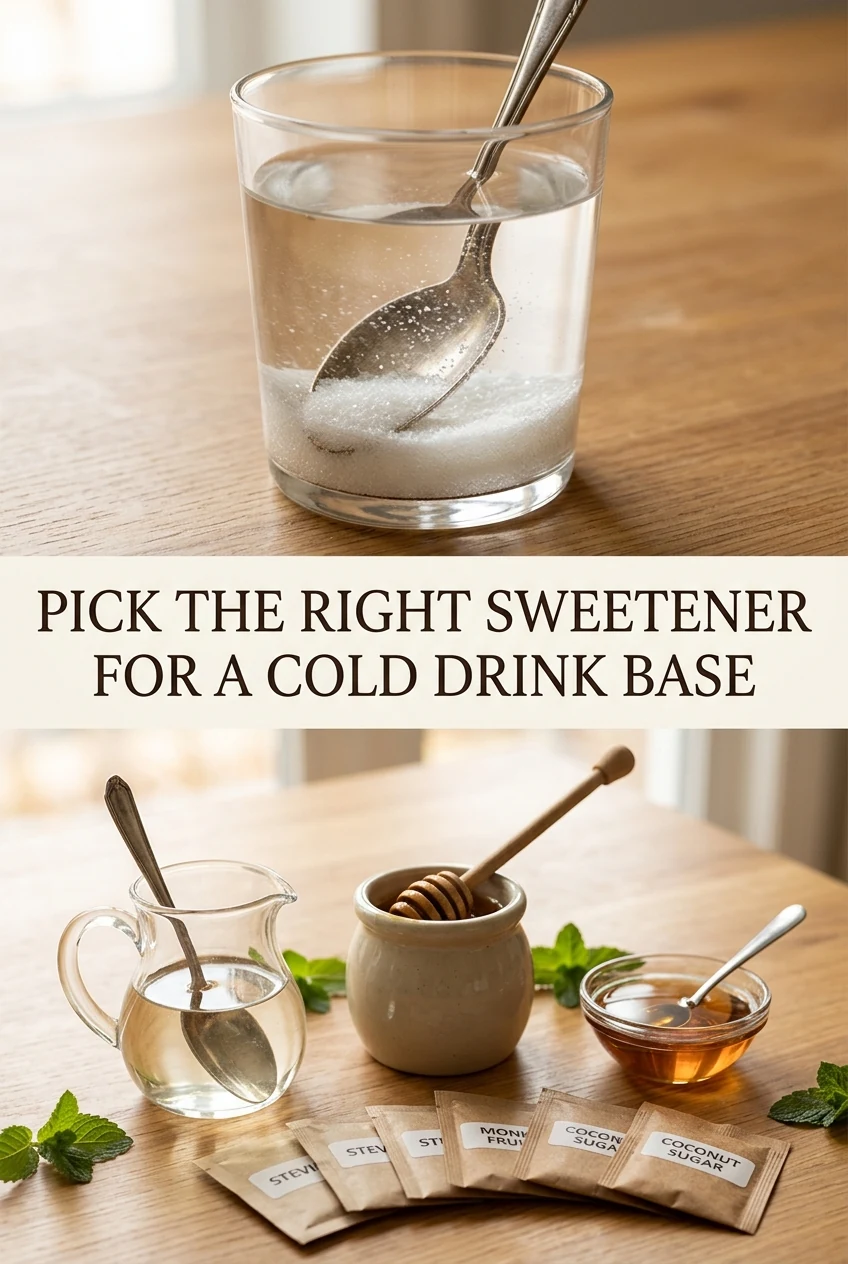
AI-generated editorial concept created for this article. The image is not a technical diagram or a tested result.
How Granulated Sugar Behaves in Cold Liquid
Granulated sugar dissolves slowly in cold water because low temperatures reduce the kinetic energy that breaks sugar crystals apart. Stirring vigorously for thirty to sixty seconds helps, but some crystals often remain suspended and settle once stirring stops. If you prefer granulated sugar, dissolve it in a small amount of warm water first, then add that solution to your cold base. Using it dry in an iced drink almost always leaves residual sweetness unevenly distributed.
Simple Syrup Dissolves Instantly and Measures Predictably
Simple syrup is pre-dissolved sugar in water, typically made at a one to one ratio by weight or volume. Because the sugar is already in solution, it integrates into cold drinks immediately with no stirring lag. A standard starting point for a 350 ml cold drink is 15 to 20 ml of one to one syrup, adjusted to taste. The trade-off is that you are also adding water, which slightly dilutes the base compared to an equivalent dry sugar amount.
Honey Adds Viscosity and Requires More Effort to Incorporate
Honey is denser and more viscous than syrup, and it resists blending into cold liquid without mechanical help. A handheld frother or a vigorous shake in a sealed jar disperses it more reliably than stirring alone. Honey is also sweeter per gram than granulated sugar for many palates, so a smaller quantity may achieve the same perceived sweetness. Start with 10 ml in a 350 ml cold drink and adjust, since over-sweetening with honey is easy to do quickly.
Comparing Sweetness Impact Across the Three Options
Perceived sweetness is not identical across sweeteners even at the same gram weight. Honey contains fructose, which many people perceive as sweeter than sucrose at equivalent masses. Simple syrup made at one to one delivers less sweetness per millilitre than dry sugar because half the volume is water. These are general tendencies rather than fixed ratios, so tasting incrementally as you add any sweetener remains the most reliable calibration method for your specific drink.
Matching Sweetener to Drink Type
For a fruit-forward cold drink where clarity matters, simple syrup keeps the liquid visually clean and integrates without cloudiness. For a thicker smoothie-style base, honey adds body that complements the texture. For a drink you are making in large batches and storing refrigerated at 4 degrees Celsius or below, simple syrup distributes evenly when you pour and stir, whereas granulated sugar may settle again after sitting. Choose based on the drink's texture goal, not just convenience.
A little more
to know.
Can I use powdered sugar instead of granulated to speed up dissolving?
Powdered sugar dissolves faster than granulated in cold liquid because the smaller particle size increases surface area. It also contains a small amount of starch to prevent clumping, which can leave a faintly starchy note in a delicate drink.
Does the type of sweetener affect how long a cold drink base keeps in the refrigerator?
Honey has lower water activity than syrup and may slightly slow microbial growth, but a cold drink base with any perishable ingredient should still be refrigerated promptly and consumed within the same day for best safety and quality.
Original editorial guidance and recipe formulations, not independently kitchen-tested. Times are estimates and depend on equipment and product directions. Cooked bases need additional cooling and refrigeration before cold serving. Images are AI-generated illustrations; appearance and yield may vary. Check actual ingredient labels, allergens, and any certification you require. We do not certify products. Read our approach.
Save to Pinterest ↗ANOTHER IDEA FOR THE COUNTER