Measure Loose Leaf Mint by Volume and by Weight to See Where the Numbers Differ
Many drink recipes call for a tablespoon or a cup of fresh mint, but mint leaves compress unpredictably depending on leaf size, moisture content, and how firmly you pack them. The same tablespoon measurement can hold anywhere from a loosely placed single leaf to a tightly packed cluster several times heavier. Weighing a small portion and comparing it directly to a volume measurement in a spoon makes the gap visible and gives you a more reliable reference for consistent drinks.
Read the note ↓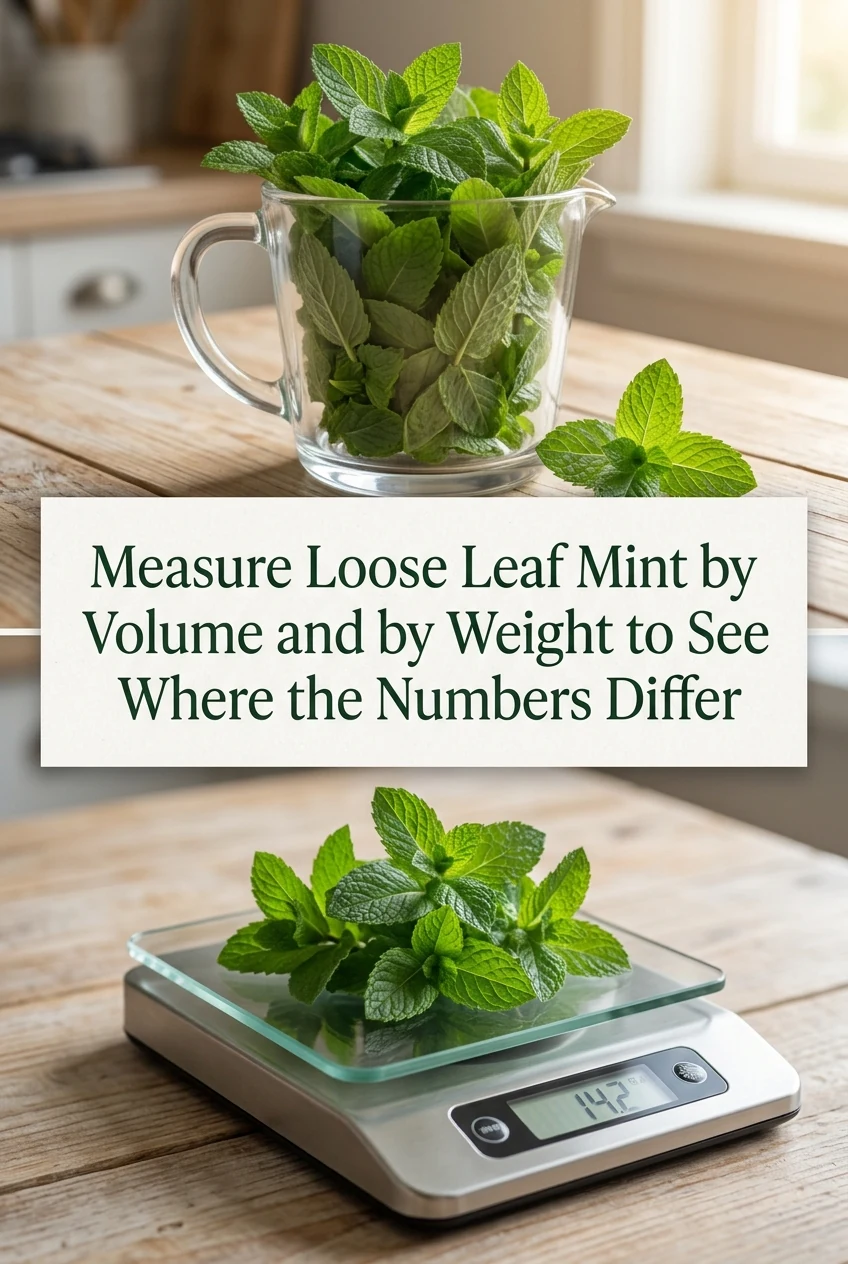
AI-generated editorial concept created for this article. The image is not a technical diagram or a tested result.
Setting Up the Comparison Correctly
You need a kitchen scale that reads in single grams, a standard 15 ml tablespoon measure, and a bunch of fresh mint at room temperature. Tare the scale with a small bowl on it. The goal is not to find a universal conversion but to understand how your specific mint, on this day, behaves under two different measuring approaches. Results will differ with drier or wetter leaves, so treat each comparison as informative for that session rather than a permanent fixed ratio.
The Loosely Filled Spoon
Pick individual mint leaves from the stems and place them into the tablespoon without pressing them down, allowing them to sit naturally. Level the top gently without compressing. Transfer the contents to the tared bowl and read the weight. In a practical example, a loosely filled tablespoon of medium-sized fresh mint leaves weighed approximately 1 gram. This is illustrative; your result will vary. Record your number before moving to the next step.
The Packed Spoon
Refill the same tablespoon, this time pressing the leaves down firmly with a finger until the spoon is compactly full. Transfer to the tared bowl and weigh again. A firmly packed tablespoon of the same mint in the same session often weighs two to three times the loosely filled version, sometimes reaching 3 grams or more. The difference is large enough to noticeably change the intensity of a mint-forward cold drink if the recipe does not specify packing.
What the Gap Means for Drink Consistency
If a recipe says one tablespoon of mint and you packed it tightly last time but loosely today, the drink will taste different even though you followed the same instruction. Switching to weight removes that variable. Once you know that your preferred mint intensity in a drink corresponds to, say, 2 grams, you can reproduce it regardless of leaf size or how the mint sits in the spoon. Weight is the more stable reference for repeatable results.
Applying the Finding at Your Next Session
After running the comparison once, note the weight that matched your preferred drink strength. Write it on the recipe card or in a notes app. At your next session, place the bowl on the scale, tare it, and add mint leaves until you reach that number. You do not need to repeat the volume comparison each time. The volume measure remains useful as a rough guide when a scale is unavailable, but weight is the more reliable tool when consistency matters.
A little more
to know.
Does the moisture level of the mint affect the weight comparison significantly?
Yes. Freshly washed and still-damp mint leaves weigh more than dried-surface leaves of the same volume. Pat mint dry before weighing if you want a consistent baseline, especially if you sometimes wash it immediately before measuring and sometimes do not.
Is there a standard gram-per-tablespoon figure I can use instead of measuring myself?
Published averages exist but vary widely by source and mint variety. Running your own comparison with your actual mint is more reliable than applying a generic figure, because leaf size, stem thickness, and moisture all affect the real number in your kitchen.
Original editorial guidance and recipe formulations, not independently kitchen-tested. Times are estimates and depend on equipment and product directions. Cooked bases need additional cooling and refrigeration before cold serving. Images are AI-generated illustrations; appearance and yield may vary. Check actual ingredient labels, allergens, and any certification you require. We do not certify products. Read our approach.
Save to Pinterest ↗ANOTHER IDEA FOR THE COUNTER