Match Baking Paper Size to a Small Rectangular Tin
Cutting baking paper to fit a small rectangular tin before you mix a single ingredient saves a great deal of frustration later. A liner that is too short leaves bare metal at the corners, while one that is too generous bunches up and creases the sides of a finished cake or slice. This article walks through a straightforward measuring and folding method so the paper sits flat against the base and rises cleanly up each wall. The steps below describe an illustrative plan for a home-cafe setting, not a laboratory-tested result, and you should always check the maximum heat rating printed on your specific roll of baking paper before placing it in any oven.
Read the note ↓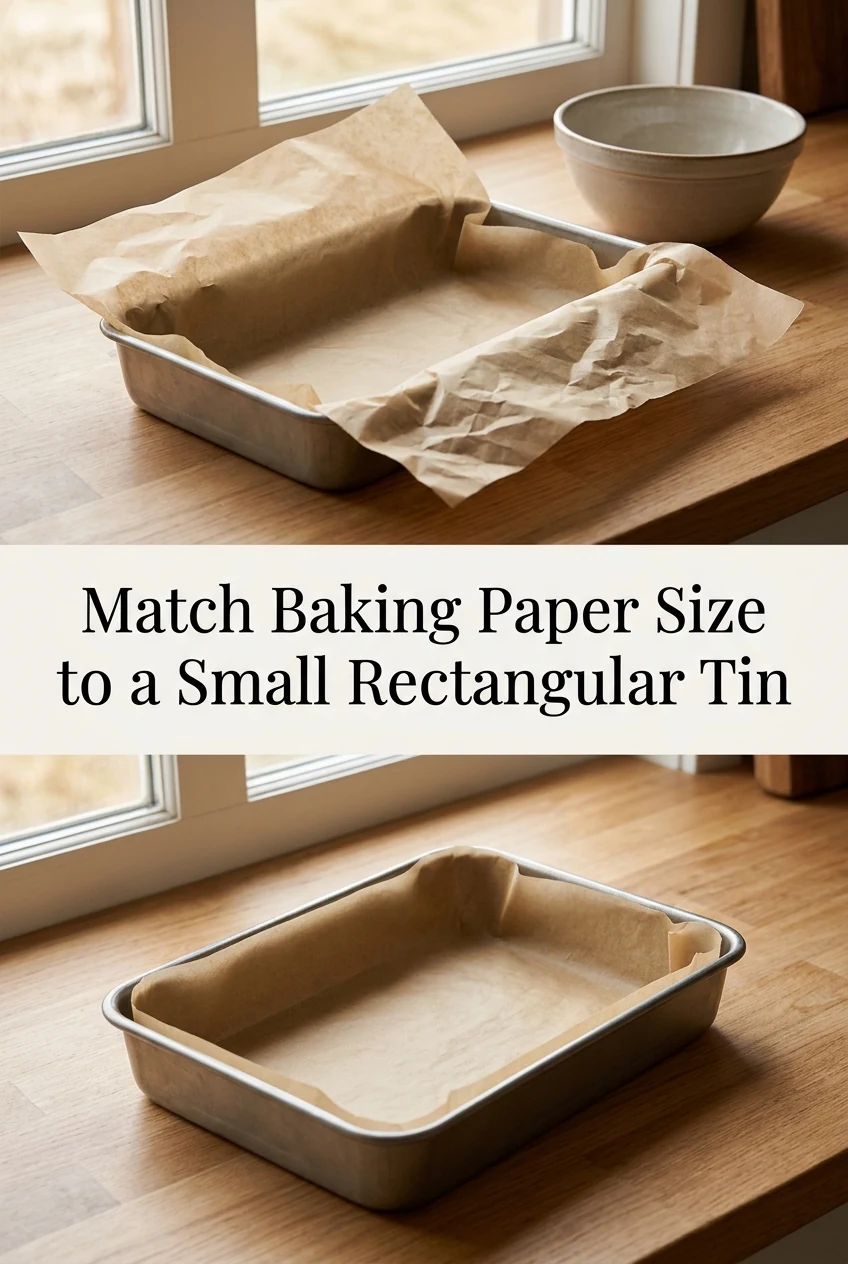
AI-generated editorial concept created for this article. The image is not a technical diagram or a tested result.
Gather What You Need
Before you start, place the tin on a flat surface and collect a roll of baking paper, a ruler or tape measure, a pencil, and a pair of scissors. Check the packaging of your baking paper roll for the manufacturer's stated temperature limit and keep that figure in mind throughout. You will also need the tin itself. For this worked example, imagine a small rectangular loaf tin with an internal base measuring 20 cm long by 10 cm wide, and internal side walls that are 6 cm tall. These are the only three numbers you need to carry forward.
Calculate the Sheet Dimensions
The goal is one sheet of paper that covers the base and folds up all four walls without overlapping excessively. For the length of the sheet, add the base length to twice the wall height: 20 cm plus 6 cm plus 6 cm gives 32 cm. For the width of the sheet, add the base width to twice the wall height: 10 cm plus 6 cm plus 6 cm gives 22 cm. Adding roughly 1 cm to 2 cm on each calculated dimension gives a small allowance for the paper to sit just above the tin rim, making it easier to lift a finished bake. In this example, cutting a sheet approximately 34 cm by 24 cm provides that margin. Mark the dimensions lightly in pencil on the paper, then cut along the lines.
Score and Fold the Corners
Lay the cut sheet flat on a clean, dry surface. Place the tin upright in the centre of the sheet and lightly trace around the base with a pencil. Remove the tin. At each corner point, cut a straight diagonal snip from the outer corner of the paper inward to the corresponding corner of the drawn rectangle. Fold each long side up along the pencil line, then fold each short side up. The diagonal cuts allow the corner flaps to overlap neatly rather than bunch. Press the folds firmly with a fingernail or the back of a spoon so they hold their shape. Drop the folded liner into the tin and adjust it until the base lies flat and the walls stand upright against the tin sides.
Fit Check Before You Fill
Run a finger along each internal corner of the tin after placing the liner. The paper should sit flush against the metal with no large air gaps and no section of bare tin visible at the base. If a wall panel flops inward, the corner snip may have gone too far; trim a fresh sheet and make a shallower cut. If the paper buckles outward at the top, the sheet was cut slightly wide, which is acceptable as long as the base remains flat. A liner that stands a centimetre or so above the rim is useful because it acts as a gentle guide when levelling batter. This fit check is a visual and tactile step only; it is not a performance guarantee for any particular bake.
Use the Liner Safely and Handle Perishables Promptly
Once the liner is in place, prepare your batter or mixture according to your chosen recipe. If the recipe calls for vanilla flavoring, use only a product that is explicitly labeled alcohol-free. Any recipe containing dairy, eggs, or other perishable ingredients should go into the oven promptly after mixing, and the finished bake should be cooled and then refrigerated without delay if it will not be consumed the same day. Do not exceed the heat limit stated on your baking paper packaging. After baking, allow the tin to cool before removing the liner; the paper and any residue on it should be discarded rather than reused, as the paper's surface changes during baking.
A little more
to know.
Can I use the same folded liner for a second bake in the same session?
Baking paper is generally intended for single use. After one bake, the surface of the paper changes and residue from the first bake may affect the next one. Discard the used liner and cut a fresh sheet for any subsequent bake.
What if my tin has sloped rather than straight walls?
Sloped walls mean the base measurement and the top opening measurement differ. Measure both the base and the top opening, then use the larger of the two width and length figures when calculating your sheet size. The extra paper will fold against the slope rather than pulling away from it, though you may need to make slightly longer corner snips to accommodate the angle. Treat this as an adjustment to try on your specific tin rather than a guaranteed outcome.
Original editorial guidance and recipe formulations, not independently kitchen-tested. Times are estimates and depend on equipment and product directions. Cooked bases need additional cooling and refrigeration before cold serving. Images are AI-generated illustrations; appearance and yield may vary. Check actual ingredient labels, allergens, and any certification you require. We do not certify products. Read our approach.
Save to Pinterest ↗ANOTHER IDEA FOR THE COUNTER