Layer Cold Milk Over Espresso Without Premature Mixing
Creating visually separated cafe drinks requires controlling fluid density and kinetic impact. Pouring cold milk straight from a pitcher directly into fresh espresso creates immediate turbulent mixing, turning the drink into an ordinary light-brown blend. To maintain a sharp line of demarcation between dark coffee and opaque white milk, you must manipulate fluid density and reduce the speed of entry using an ordinary bar spoon. Mastering density setup, spoon placement, and liquid deceleration allows home baristas to build clean layered iced drinks without relying on chemical stabilizers or artificial density enhancers.
Read the note ↓
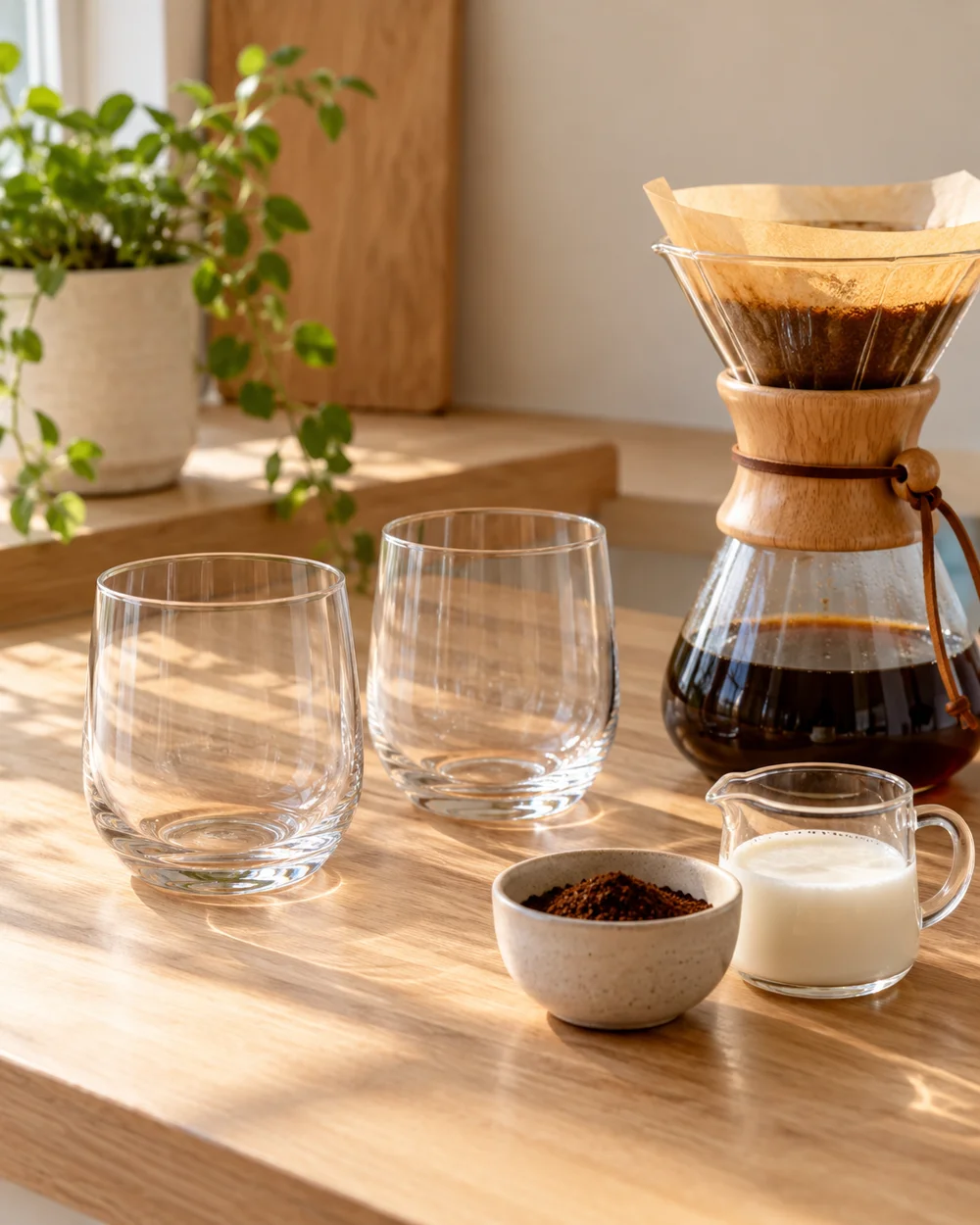
Representative category illustration reused from our editorial library; it does not depict this specific project or a tested result.
Density and Temperature Dynamics
Fluid separation in glassware depends primarily on liquid density differences. Plain chilled whole milk has a higher density (approximately 1.03 g/mL) than hot or warm espresso without sugar (approximately 1.00 to 1.01 g/mL). If cold unsweetened milk is poured on top of plain espresso, the denser milk naturally sinks, while espresso rises. To float milk on top of espresso reliably, the espresso base must be made denser than the milk—typically by dissolving sugar or dense simple syrup directly into it—or chilled milk must serve as the bottom base with espresso layered carefully over it.
The Inverted Spoon Technique
The primary tool for breaking fall velocity is an inverted teardrop bar spoon. Hold the spoon convex side upward, positioning the rounded tip directly against the inside wall of the serving glass. The edge of the spoon bowl should sit approximately 2 to 3 millimeters above the top surface of the initial liquid layer. As liquid hits the back of the spoon, its downward kinetic momentum converts into a gentle, flat cascade that spreads outward across the glass surface rather than plunging into the layer below.
Step-by-Step Layering Sequence
For a two-toned iced beverage where milk sits atop coffee, first dissolve 15 to 20 milliliters of rich simple syrup into 60 milliliters of freshly extracted espresso to increase its specific gravity well above that of dairy milk. Place 80 grams of solid ice cubes into a tall clear glass and pour the sweetened espresso over the ice. Allow the espresso to chill against the ice for thirty seconds so thermal turbulence settles. Rest the convex side of the spoon against the glass interior just above the coffee line. Slowly trickle 120 milliliters of cold pasteurized milk from a narrow-spout pitcher onto the curved back of the spoon.
Managing Pour Speed and Height
Keep the pitcher spout within 1 centimeter of the spoon bowl throughout the pour. Elevating the pitcher increases gravitational acceleration, causing incoming milk to slice through the spoon diversion and pierce the espresso surface. Elevate the spoon gradually as the liquid volume rises, preserving that narrow 2-millimeter gap between the spoon base and the rising surface. The pour should take approximately fifteen continuous seconds; rushing the movement creates localized eddies that blur the clean horizontal boundary line.
Alternative Unsweetened Layering Order
If you prefer an unsweetened beverage, reverse the pouring sequence to respect natural fluid densities. Pour 120 milliliters of cold whole milk over ice cubes first. Because cold unsweetened milk is denser than warm espresso, the milk naturally forms a stable bottom layer. Position the inverted spoon just above the milk surface and slowly pour the 60 milliliters of freshly brewed espresso over the back of the spoon. The lighter coffee will float neatly on top of the dense, chilled milk bed without mixing.
A little more
to know.
Can I layer hot steamed milk over cold espresso?
Hot frothed milk contains trapped air and is less dense than cold espresso, so it floats naturally. Pour the warm milk slowly over the back of a spoon onto chilled espresso; dense microfoam forms a stable, sharply defined cap above the cold coffee base.
Why does my separation line blur after five minutes?
Molecular diffusion naturally occurs over time as dissolved solutes equalize across the liquid boundary. Melting ice also creates fresh convection currents. Layered beverages are designed for immediate visual presentation and should be served promptly after assembly.
Original editorial guidance and recipe formulations, not independently kitchen-tested. Times are estimates and depend on equipment and product directions. Cooked bases need additional cooling and refrigeration before cold serving. Images are AI-generated illustrations; appearance and yield may vary. Check actual ingredient labels, allergens, and any certification you require. We do not certify products. Read our approach.
Save to Pinterest ↗ANOTHER IDEA FOR THE COUNTER