Label Allergens on a Home Drinks Table
At a home gathering, a jug of creamy iced drink gives no visible sign of whether it contains dairy milk, oat milk, soy, nut butter or sesame paste. Guests with allergies or intolerances cannot safely guess, and a shared serving spoon moves ingredients from one jug into another without anyone noticing. A small set of written cards and a few physical boundaries on the table address this directly without requiring professional equipment or making claims you cannot support.
Read the note ↓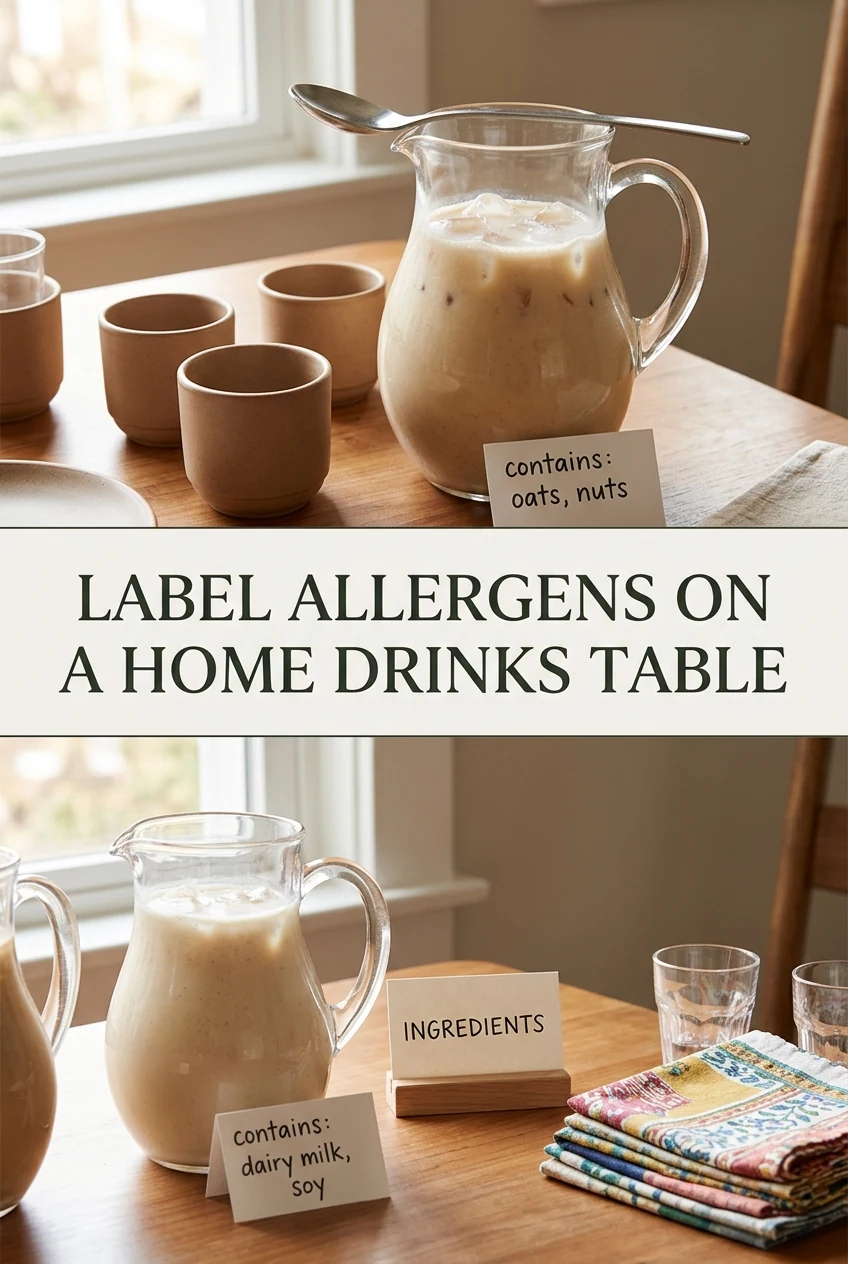
AI-generated editorial concept created for this article. The image is not a technical diagram or a tested result.
Write a Card for Each Pitcher Listing Main Ingredients
Use an index card or folded paper and write the name of the drink and its main ingredients in clear handwriting or printed text. For an oat-milk iced latte, the card reads: oat milk, espresso, sugar. For a tahini cocoa, it reads: tahini, cocoa powder, oat milk, honey. Do not write allergen-free on any card. You cannot guarantee that your ingredients or preparation area are free from cross-contact, and stating otherwise could mislead a guest with a serious allergy.
Give Each Pitcher Its Own Serving Spoon or Ladle
Place a separate spoon directly beside or inside each pitcher before guests arrive. A spoon resting across the top of a jug signals clearly that it belongs to that jug. If a guest uses the wrong spoon, ingredients transfer. This matters most when one pitcher contains a common allergen such as sesame or soy and another does not. Lay the spoons out before you open the refrigerator so the habit is set before the table fills.
Separate Milk and Plant-Milk Jugs Physically and Visually
Place dairy milk and plant milks at opposite ends of the table or on separate trays. Label each jug with its contents, for example whole milk or oat milk, not just milk. A guest who is managing a dairy allergy needs to identify the jug without asking. If space is limited, use two small trays of different colours to create a visible boundary. The physical gap reinforces the written label and reduces the chance of a guest reaching for the wrong jug.
Keep Chilled Jugs Refrigerated Until Needed
Do not set out all pitchers at once if your gathering runs longer than two hours. Keep extras in the refrigerator at 4 degrees Celsius or below and bring them out in rotation. In a warm room above 32 degrees Celsius, the safe window shortens to one hour. Set a phone reminder if you are hosting and likely to be distracted. Discard any chilled drink that has been sitting out beyond its safe window rather than returning it to the refrigerator.
Worked Example: Three Drinks on One Table
Set a tray on the left with an oat-milk iced latte card reading oat milk, espresso, cane sugar, its own long spoon resting across the rim. In the centre, a fruit still-water pitcher with a card reading still water, lemon, strawberries. On the right, a tahini cocoa jug with a card reading oat milk, cocoa powder, tahini, honey, sesame present. Each card faces outward. A small note near the table reads: please ask the host about any allergy before serving yourself. This is an illustrative arrangement, not a certified allergen-management system.
A little more
to know.
What should I do if a guest has a severe allergy to one of the ingredients?
Speak with the guest directly before they approach the table. Describe every ingredient in the relevant drink, including the brand if they ask. The written card supports the conversation but does not replace it for a guest with a serious allergy.
Can I reuse the same pitcher for a different drink during the gathering?
Wash and dry the pitcher fully before refilling it with a different drink, especially if the first drink contained a common allergen. Update the card immediately so the new contents are accurately described before anyone serves themselves.
Original editorial guidance and recipe formulations, not independently kitchen-tested. Times are estimates and depend on equipment and product directions. Cooked bases need additional cooling and refrigeration before cold serving. Images are AI-generated illustrations; appearance and yield may vary. Check actual ingredient labels, allergens, and any certification you require. We do not certify products. Read our approach.
Save to Pinterest ↗ANOTHER IDEA FOR THE COUNTER