Keep a Recipe's Original Units When Using a Different Measuring Set
A recipe written in millilitres does not become more accurate when you scoop it with a decorative tablespoon from the cutlery drawer. Household spoons vary widely in actual capacity, and a vintage dessertspoon is not a calibrated 10 ml tool. The straightforward fix is to work in the units the recipe already uses, which means owning the right measuring set for the job rather than converting on the fly and hoping the result lands close enough.
Read the note ↓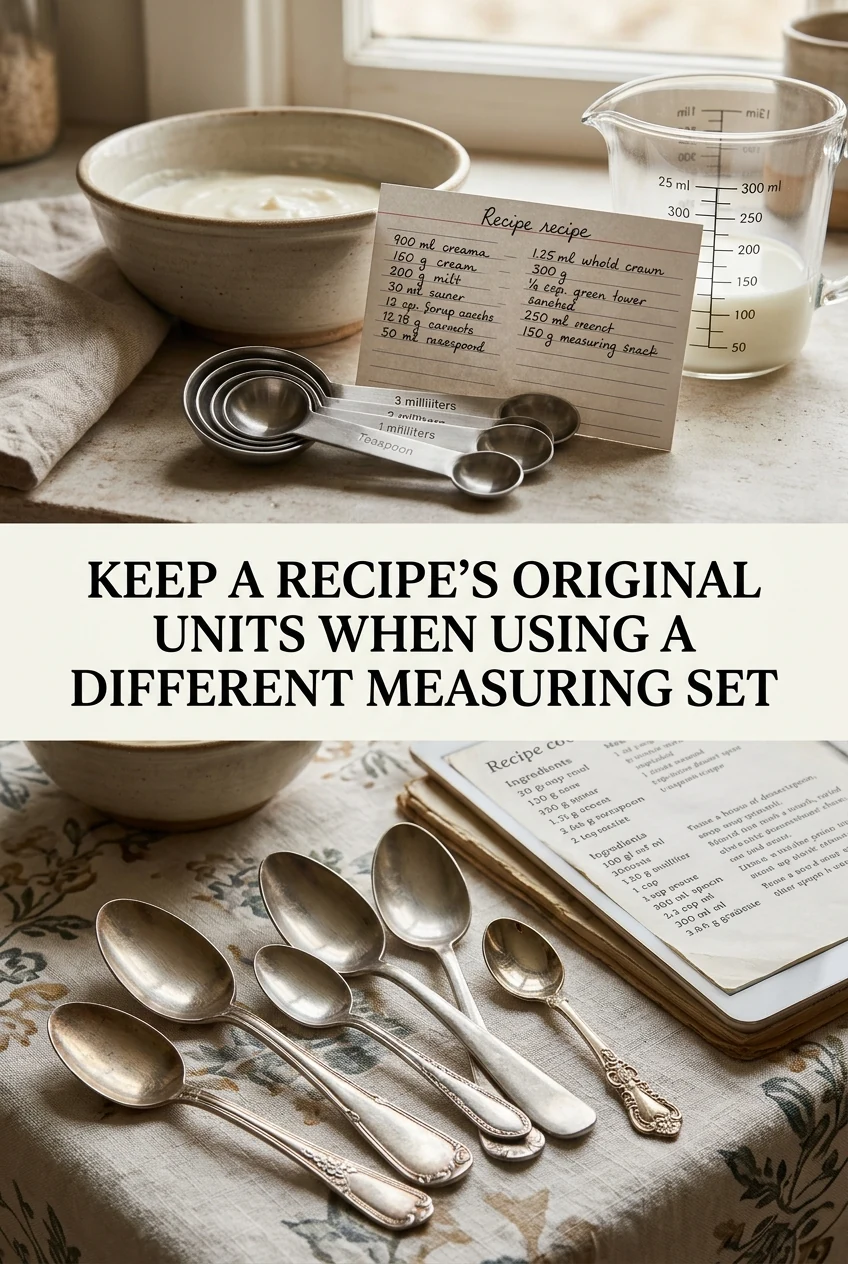
AI-generated editorial concept created for this article. The image is not a technical diagram or a tested result.
Why the Original Units Matter
Recipe developers write quantities in the system they tested with. A barista-style vanilla syrup recipe calling for 15 ml of alcohol-free vanilla flavouring was balanced at that exact volume. If you convert 15 ml to tablespoons in your head and then use a cutlery spoon that actually holds 12 ml, you have introduced two compounding errors: an imprecise mental conversion and an uncalibrated vessel. Keeping the original units removes one of those variables entirely. Your only task becomes finding a measuring tool that reads in the same system the recipe uses.
Spotting the Gap in Your Equipment Drawer
Go through your current measuring set and note which units appear on each piece. A common home situation is owning cup measures marked in cups and fractions, plus a jug marked in both ml and fluid ounces, but nothing that clearly marks individual teaspoon or tablespoon volumes in millilitres. If a recipe lists 5 ml, 15 ml, and 250 ml, check whether each of those values appears as a marked line or a labelled spoon in your set. Any value that is missing is a gap. Write the missing units down before you shop so you buy exactly what is needed rather than a duplicate of something you already have.
Choosing a Suitable Measuring Set
Look for a set that is explicitly labelled in the units your recipes use most. For metric recipes, a set of stainless-steel or food-grade plastic measuring spoons labelled 1.25 ml, 2.5 ml, 5 ml, and 15 ml covers the most common small volumes. A clear-sided measuring jug with ml graduations printed at eye-level handles larger liquids. When buying, confirm the markings are moulded or permanently printed rather than a paper sticker that will peel. If you also use recipes written in US cups, a separate nested cup set avoids the confusion of trying to read a dual-scale jug at an angle. Purchase from a kitchenware retailer that stocks tools described as calibrated measuring spoons, and check that the product listing confirms the capacity of each spoon.
A Worked Example: Scaling a Small Vanilla Syrup Batch
This is an illustrative plan, not a kitchen-tested result. Suppose a home-cafe recipe for a simple syrup yields roughly 335 ml and calls for 200 ml water, 200 g white sugar, and 10 ml alcohol-free vanilla flavouring. You want to make a half-batch, so 100 ml water, 100 g sugar, and 5 ml alcohol-free vanilla flavouring. Your existing equipment includes a kitchen scale for the sugar and a jug marked in ml for the water, so both of those are covered. The 5 ml vanilla is where the gap appears: your cutlery teaspoon is unlabelled. Rather than guessing, you note that 5 ml is the standard capacity of a calibrated measuring teaspoon and you add one to your shopping list. Once the correct spoon arrives, you measure 5 ml of alcohol-free vanilla flavouring directly, combine all ingredients, heat gently on the hob while stirring until the sugar dissolves, then remove from heat. Because the syrup contains water and sugar with no preservatives, it should be cooled and then stored promptly in the refrigerator in a clean, lidded container. Follow any storage guidance provided by the recipe source, as homemade syrups are perishable.
Keeping Your Measuring Set Accurate Over Time
Measuring tools can warp or accumulate residue that affects their capacity. After each use, wash spoons and jugs according to the manufacturer's instructions for that specific product, whether that means hand washing or a particular dishwasher setting. Do not use abrasive pads on printed graduations. Store spoons flat or hanging so they are not bent out of shape. If a plastic jug develops a crack along a graduation line, replace it rather than estimating. Periodically check that ring-style measuring spoons have not been bent by being stored under heavy items, since a deformed bowl holds a different volume than it did when new.
A little more
to know.
Can I use a dual-scale jug that shows both ml and cups instead of buying two separate sets?
A dual-scale jug is useful for larger liquid volumes, but reading it accurately depends on holding it level and viewing the meniscus at eye level, which becomes harder with small amounts. For quantities under about 60 ml, a set of labelled measuring spoons is more practical than trying to read a jug graduation that may only mark every 25 ml or 50 ml. Use the jug for volumes it marks clearly and use labelled spoons for smaller amounts.
Is it acceptable to convert a metric recipe to cups and use my existing cup set?
Converting units introduces rounding, and some metric quantities do not divide neatly into cup fractions. For example, 75 ml is three-tenths of a cup, which no standard cup set marks. If you convert and then round to the nearest marked line, you are no longer measuring the original quantity. The simpler approach is to obtain a measuring tool that reads in the original units, which keeps the recipe as the developer wrote it and avoids accumulated rounding errors across multiple ingredients.
Original editorial guidance and recipe formulations, not independently kitchen-tested. Times are estimates and depend on equipment and product directions. Cooked bases need additional cooling and refrigeration before cold serving. Images are AI-generated illustrations; appearance and yield may vary. Check actual ingredient labels, allergens, and any certification you require. We do not certify products. Read our approach.
Save to Pinterest ↗ANOTHER IDEA FOR THE COUNTER