Keep a Brewed Chamomile Concentrate in a Sealed Jar and Label It With the Brew Date
Brewing a chamomile concentrate ahead of time and storing it in a sealed jar in the refrigerator means you can assemble iced chamomile drinks quickly without waiting for tea to cool each time. The concentrate is simply diluted to order. The critical habit is labelling the jar with the brew date so you can make a straightforward decision about freshness rather than guessing. This guide covers brew ratio, cooling steps, jar choice, labelling, and dilution guidance.
Read the note ↓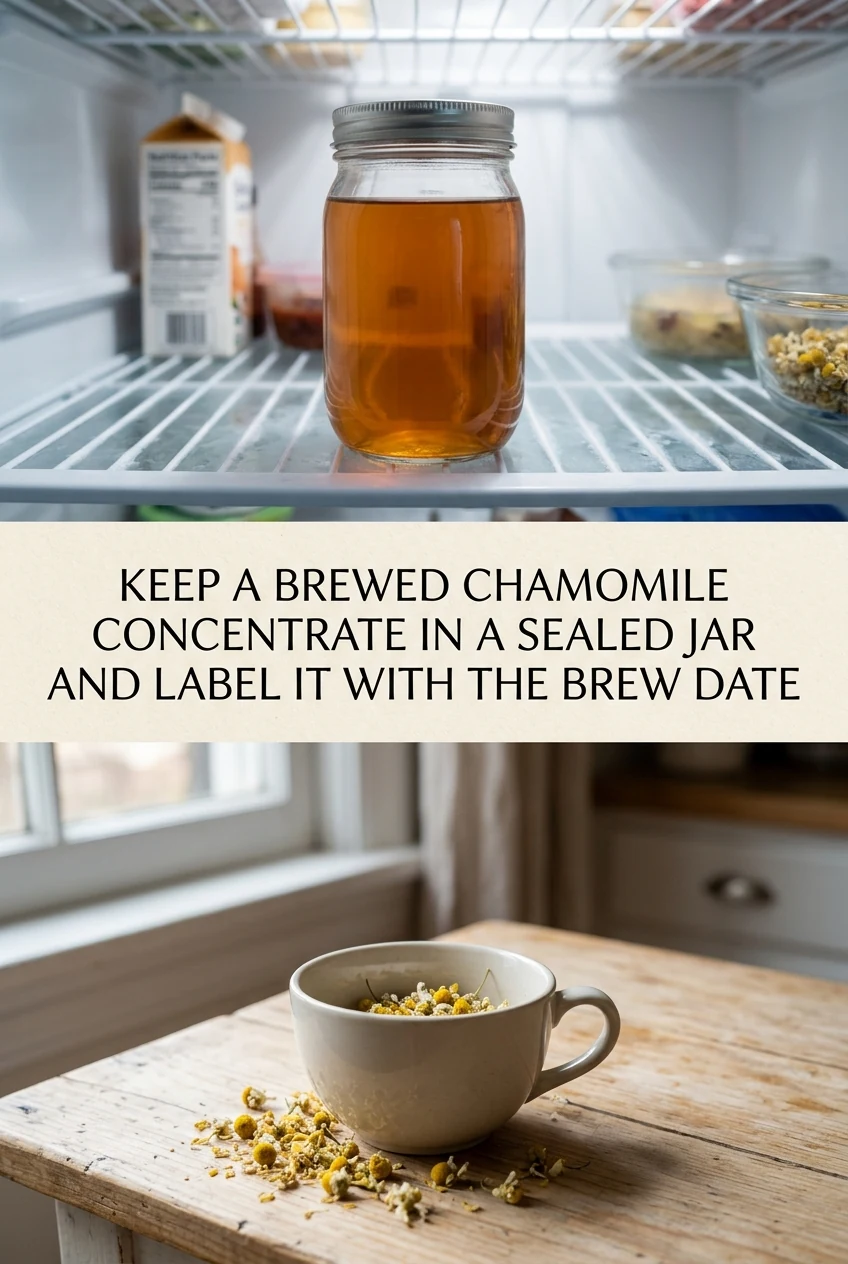
AI-generated editorial concept created for this article. The image is not a technical diagram or a tested result.
Decide on Concentrate Strength
A concentrate brewed at double strength means using two chamomile tea bags per 240 ml of water instead of one. This produces a brew intended to be diluted one-to-one with cold water or poured over ice that will melt and contribute dilution naturally. Chamomile is mild, so doubling the bags rather than extending steep time gives a cleaner flavour. Steeping longer than ten minutes can introduce a slightly bitter, hay-like note that becomes more pronounced when cold.
Brew and Cool the Concentrate Safely
Bring 480 ml of fresh water to just below a full boil, around 90 to 95 degrees Celsius, and pour it over four chamomile tea bags in a heatproof jug. Steep for eight minutes, then remove the bags. Do not squeeze the bags. Allow the concentrate to cool at room temperature for no more than one hour, then transfer it to a clean sealed glass jar and refrigerate at 4 degrees Celsius or below. Do not leave brewed tea at room temperature beyond two hours.
Choose a Suitable Jar and Seal It Properly
A 500 ml glass jar with a screw-top lid is a practical choice for this batch size. Ensure the jar is clean and fully dry before filling, as residual moisture can affect the concentrate. Fill the jar leaving about 2 cm of headspace, which makes it easier to seal without spillage. Tighten the lid firmly. Avoid storing the jar in the refrigerator door where temperature fluctuates each time the door opens; a shelf position is more stable.
Label the Jar With the Brew Date
Write the brew date on a small adhesive label or a piece of masking tape and attach it to the jar before placing it in the refrigerator. A date label removes the need to remember when the batch was made. Use the concentrate within three days of brewing and discard it if it smells off, appears unusually cloudy, or develops any visible surface changes. Freshness decisions based on a visible date are more reliable than relying on appearance alone.
Dilute and Serve to Order
To serve, pour 120 ml of cold concentrate over a glass filled with ice and add 120 ml of cold still water, giving a roughly one-to-one dilution as a starting point. For a lighter drink, increase the water to 150 ml. The concentrate also pairs with cold sparkling water or a small measure of pear syrup. Taste before serving and adjust the ratio. Do not heat the concentrate in its jar; decant the required amount into a separate vessel if a warm drink is needed.
A little more
to know.
Can I use loose-leaf chamomile instead of tea bags?
Yes. Use approximately 4 grams of loose-leaf chamomile per 240 ml of water and strain through a fine mesh strainer before jarring. Steep time and temperature remain the same as for bags.
Is it safe to freeze the concentrate to extend its life?
Freezing is possible in a freezer-safe container with adequate headspace for expansion. Thaw in the refrigerator, not at room temperature, and use the thawed concentrate within one day. Label the container with both the brew date and the freeze date.
Original editorial guidance and recipe formulations, not independently kitchen-tested. Times are estimates and depend on equipment and product directions. Cooked bases need additional cooling and refrigeration before cold serving. Images are AI-generated illustrations; appearance and yield may vary. Check actual ingredient labels, allergens, and any certification you require. We do not certify products. Read our approach.
Save to Pinterest ↗ANOTHER IDEA FOR THE COUNTER