Emulsify Separated Tahini into Cold Oat Milk Beverages
Adding dense sesame paste directly into cold oat milk frequently creates oily separation and chalky sediment. Because the dense paste seizes and resists dispersion upon contact with chilled liquids, it breaks into gritty flecks instead of integrating smoothly. The solution lies in preparing an intermediary warm emulsion. By blending the measured tahini with a warm simple syrup base before introducing cold liquids, the paste loosens and distributes uniformly. This technique produces an even, stable texture throughout iced oat milk drinks while preventing messy cling along the glassware.
Read the note ↓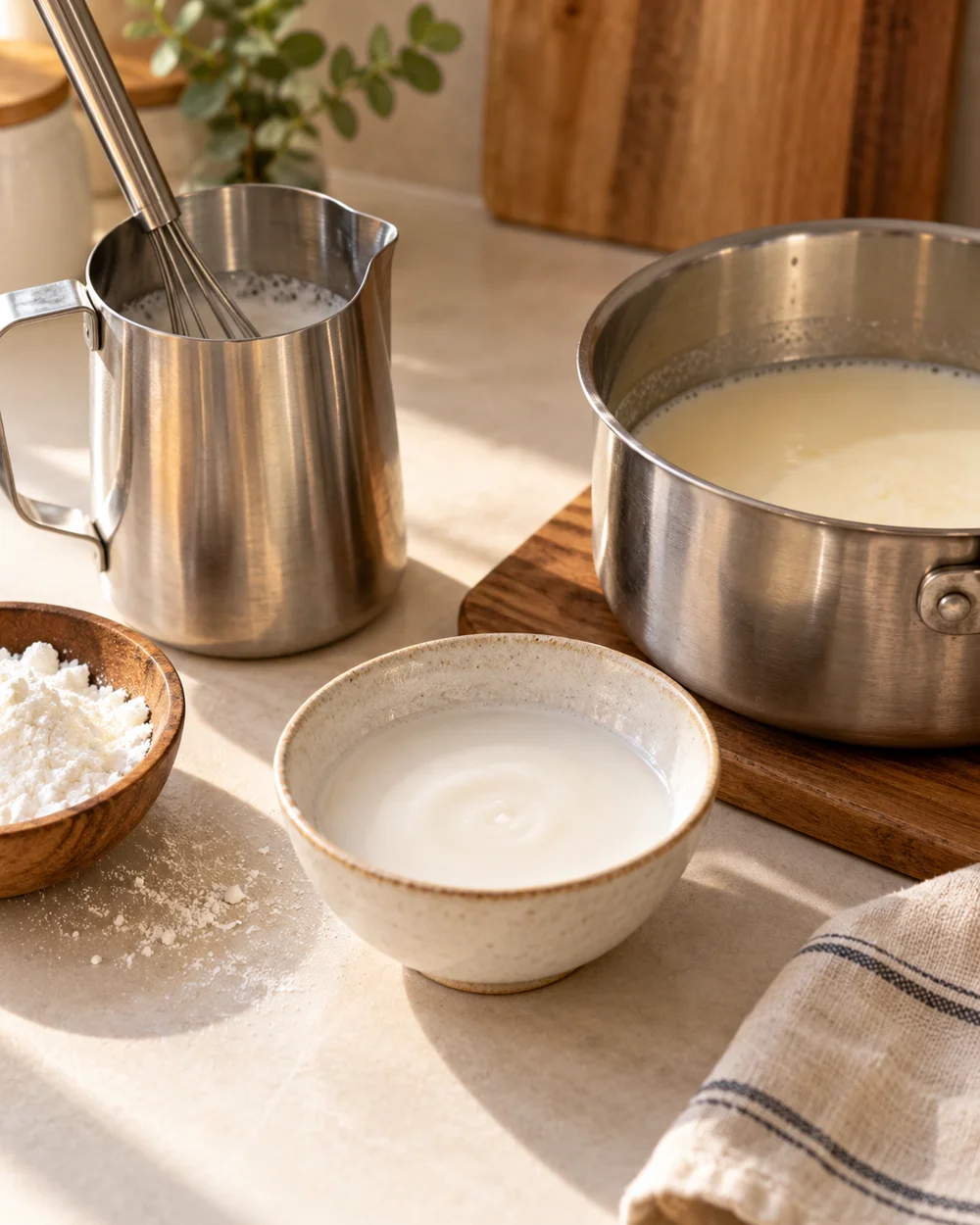
Representative category illustration reused from our editorial library; it does not depict this specific project or a tested result.
Understanding the Cold Liquid Barrier
Sesame paste consists of finely ground seeds suspended within sesame seed oil. When introduced directly to cold liquids without pre-mixing, the seed solids clump together and separate from the free oil instead of dispersing evenly. Shaking or stirring this cold mixture only shears the paste into granular flecks that settle along the base of the glass. Cold commercial oat milk cannot easily incorporate dense, unblended tahini paste without sufficient thinning and intermediate temperature conditioning.
Forming the Warm Syrup Pre-Emulsion
The intermediate step requires equal parts warm liquid syrup and smooth tahini. As a practical single-drink ratio, stir fifteen grams of stirred tahini into fifteen milliliters of warm sugar syrup heated to roughly sixty degrees Celsius. Use a small wire whisk or hand frother inside a small heatproof vessel. The warmth lowers viscosity, while the dissolved syrup helps loosen the dense seed paste into a glossy, homogeneous concentrate ready for cold dilution.
Gradual Dilution Workflow
Never dump the entire volume of cold milk onto the warm concentrate at once. Flooding the concentrate with cold liquid too quickly can cause the loosened paste to seize into stubborn clumps. Pour twenty milliliters of cold pasteurized oat milk into the warm base, whisking vigorously until the liquid accepts the volume. Once this combined mixture thins down smoothly to a pourable cream consistency, stream in the remaining one hundred and fifty milliliters of cold milk while maintaining gentle, steady stirring.
Adding Ice and Final Suspension
Transfer the fully blended oat milk base into a clean serving glass before introducing ice cubes. Adding dense ice beforehand creates localized cold pockets that disrupt the newly established emulsion before mixing completes. Once the liquid sits evenly in the vessel, drop large, solid ice cubes directly through the surface. The viscosity gained from the combined syrup and dispersed sesame solids holds the particles in suspension, delaying separation for ordinary drinking periods.
Chilling Limits and Handling
If mixing larger batches of this sesame syrup concentrate in advance, place the container into prompt refrigeration at four degrees Celsius or below within two hours of preparation, or within one hour if room temperatures exceed thirty-two degrees. Stored concentrate will slowly thicken as the natural oils cool in the refrigerator. Before portioning into cold oat milk, re-warm the measured concentrate slightly in a warm water bath to restore fluidity.
A little more
to know.
Can date syrup replace sugar syrup in the pre-emulsion step?
Yes. Date syrup integrates well if warmed slightly with a few drops of hot water to lower its native viscosity. Ensure the syrup contains no coarse pulp particles that could interfere with the initial whisking process.
Why does the drink settle after thirty minutes on the table?
Sesame paste contains insoluble seed fiber that eventually falls out of suspension under gravity. While the fat remains emulsified, periodic gentle swirling with a straw redistributes the heavier microscopic seed material throughout the liquid.
Original editorial guidance and recipe formulations, not independently kitchen-tested. Times are estimates and depend on equipment and product directions. Cooked bases need additional cooling and refrigeration before cold serving. Images are AI-generated illustrations; appearance and yield may vary. Check actual ingredient labels, allergens, and any certification you require. We do not certify products. Read our approach.
Save to Pinterest ↗ANOTHER IDEA FOR THE COUNTER