Dissolve Honey Into a Cold Drink Without Leaving Sticky Clumps
Honey stirred directly into a cold drink almost always pools at the bottom as a thick, undissolved ribbon that no amount of stirring fully incorporates. The problem is physical: honey's viscosity increases sharply as temperature drops, making it resist mixing with cold liquid. The fix is simple and takes about thirty seconds before you build the drink. Dissolving honey in a small amount of warm water first creates a pourable honey solution that blends evenly into cold milk, iced tea, or any other cold base without leaving sticky residue.
Read the note ↓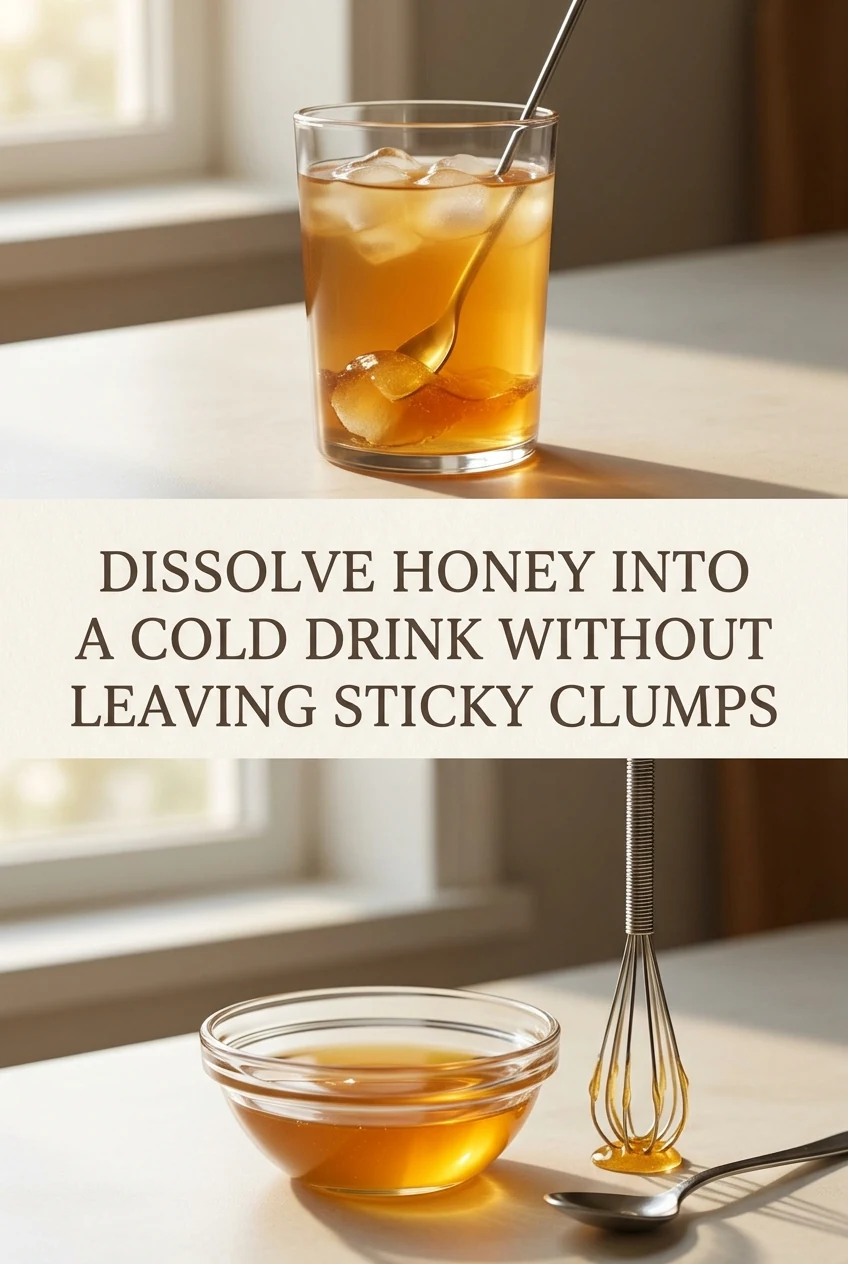
AI-generated editorial concept created for this article. The image is not a technical diagram or a tested result.
Why Honey Clumps in Cold Liquid
Honey is a supersaturated sugar solution with high viscosity at low temperatures. When you add it to a cold drink, the surrounding liquid cools the honey faster than stirring can disperse it, causing it to contract into a dense mass that sticks to the bottom or sides of the glass. The sugar does not crystallize in this scenario, but the honey becomes so thick relative to the cold liquid that mechanical stirring alone cannot create an even distribution before the ice further drops the temperature.
The Warm Water Pre-Dissolve Method
Measure your honey into a small cup or the bottom of your serving glass before adding any cold ingredients. Add two to three times the volume of warm water, not boiling, to the honey. For example, if you are using 15 ml of honey, add 30 to 45 ml of warm water. Stir for 20 to 30 seconds until the honey fully dissolves into a uniform, amber-colored liquid with no visible streaks. The resulting solution pours and mixes like a thin syrup rather than behaving like cold honey.
Building the Drink After Pre-Dissolving
Once your honey is dissolved in warm water, add ice to the glass, then pour the honey solution over the ice. The solution is now dilute enough that the cold temperature does not cause it to re-thicken into clumps. Add your cold milk, tea, or coffee next and stir briefly from the bottom. The sweetness distributes evenly in two or three stirs rather than requiring prolonged mixing. This sequence works for iced matcha lattes, iced tea, and cold milk drinks equally well.
Adjusting Sweetness Without Losing the Method
A common concern is that pre-dissolving in water dilutes the drink. In a 350 ml drink, adding 30 to 45 ml of warm water as the dissolving medium is a real dilution that changes the ratio of other ingredients. Compensate by reducing the cold water or milk by the same volume you added as the dissolving medium. For example, if your recipe calls for 200 ml of milk and you used 40 ml of warm water to dissolve the honey, use 160 ml of milk to keep the total volume consistent.
When the Method Is Not Necessary
If your drink is served warm or at room temperature, honey dissolves readily with simple stirring and no pre-dissolving step is needed. The method described here addresses specifically cold and iced drinks where temperature is the barrier to dissolution. Additionally, if you are using a blender to make a smoothie-style drink, the mechanical action is strong enough to incorporate honey directly without pre-dissolving, though the warm water method still produces a more even result in a standard stirred drink.
A little more
to know.
Does pre-dissolving honey in warm water change its flavor?
Warm water at the temperatures used for dissolving, roughly 40 to 60 degrees Celsius, does not noticeably alter honey's flavor profile in a cold drink. Very high heat can affect delicate floral notes, but brief warm-water dissolving at moderate temperatures is not the same as cooking honey.
Can I make a larger batch of dissolved honey to keep in the refrigerator?
You can dissolve honey in warm water in a larger ratio and store it in a sealed container in the refrigerator for up to two weeks. Use a one-to-one ratio by volume and treat it as you would a simple syrup, checking for any off-smell before use.
Original editorial guidance and recipe formulations, not independently kitchen-tested. Times are estimates and depend on equipment and product directions. Cooked bases need additional cooling and refrigeration before cold serving. Images are AI-generated illustrations; appearance and yield may vary. Check actual ingredient labels, allergens, and any certification you require. We do not certify products. Read our approach.
Save to Pinterest ↗ANOTHER IDEA FOR THE COUNTER