Decide Whether to Use a Scale or a Measuring Cup When Portioning Tahini for a Cold Drink
Tahini settles in its jar over time, forming a dense paste at the bottom and a layer of separated oil on top. Scooping a tablespoon from an unstirred jar can deliver mostly oil one time and mostly dense paste the next, making the flavour and texture of a cold drink inconsistent. Deciding between a volume measure and a weight measure comes down to whether you can stir the jar fully before each use and how much precision the drink recipe requires.
Read the note ↓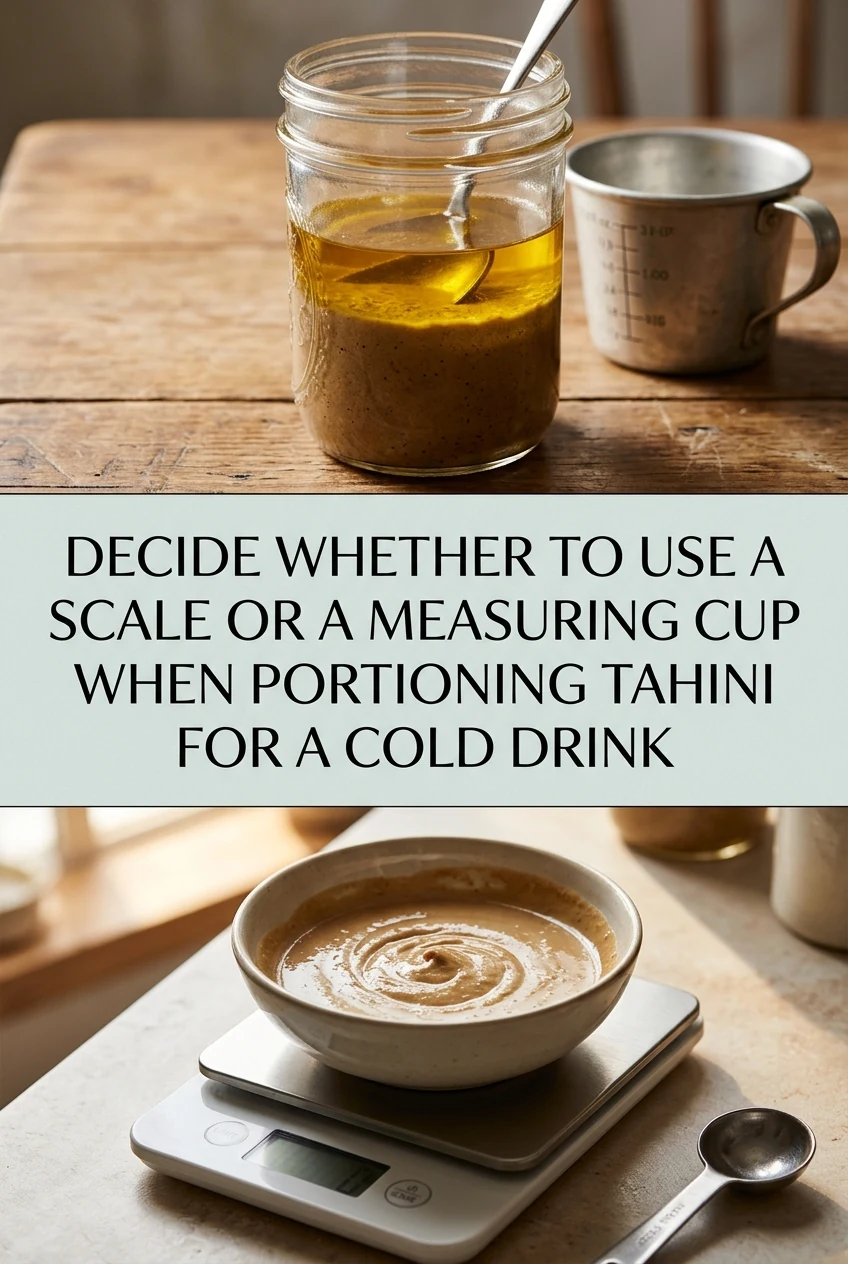
AI-generated editorial concept created for this article. The image is not a technical diagram or a tested result.
Why Tahini Behaves Differently From Other Liquid Ingredients
Tahini is a suspension of ground sesame solids in sesame oil. Unlike a homogeneous liquid, it does not stay evenly mixed after sitting. The oil rises and the solids compact downward, sometimes forming a nearly solid plug at the base of the jar. A tablespoon scooped from the oil layer weighs significantly less and delivers far less sesame flavour than one scooped from the dense lower layer. This inconsistency is the core problem that measuring method must address.
Weighing by Mass Is the More Reliable Default
Taring your mixing container directly on a kitchen scale and spooning stirred tahini until you reach your target gram amount provides far greater precision than volume tools. Tahini is thick and viscous, meaning a significant amount sticks to measuring spoons and cups rather than releasing into the drink. While the jar must still be stirred thoroughly to recombine the separated oil and paste, weighing avoids clinging loss, requires fewer utensils, and delivers the exact intended quantity each time.
When Volume Measurement Is Acceptable
Volume measurement is acceptable if you stir the entire jar of tahini thoroughly before portioning. Use a long-handled spoon or butter knife to fold the oil back into the paste from the bottom of the jar until the texture is uniform throughout. This takes one to two minutes for a full jar. Once stirred, a tablespoon measure becomes reasonably consistent. The limitation is that tahini begins to separate again within hours, so the jar must be stirred at each use session rather than once in advance.
Worked Example With Bounded Inputs
Consider a cold sesame and date drink calling for two tablespoons (roughly 30 g) of tahini. If you scoop from a well-stirred jar into measuring spoons, scraping the paste out cleanly is difficult, and several grams typically remain stuck to the spoon. In contrast, placing the blender cup directly on a digital scale, taring it to zero, and spooning stirred tahini straight from the jar until the display reads 30 g delivers the exact amount required without waste or extra cleanup.
Practical Setup for a Home Café Workflow
If you make tahini drinks regularly, keep the jar stored upside down between uses. This slows separation by keeping the oil near the base when the jar is flipped upright for use. Before opening, turn the jar right-side up and allow it to rest for a minute, then stir before portioning. A scale with a tare function and a capacity of at least 500 g handles tahini portioning cleanly. Wipe the spoon and bowl immediately after use, as tahini residue thickens quickly when exposed to air.
A little more
to know.
Does refrigerating tahini affect how it measures?
Refrigerated tahini becomes significantly thicker and harder to stir. Cold tahini measured by volume will pack more densely into a spoon, increasing the actual mass delivered. Bring it to room temperature before portioning for more consistent results with either method.
Is there a point where the tahini in a jar is too separated to rescue by stirring?
Very old or repeatedly temperature-shocked tahini can develop a hardened paste that resists stirring. If the solid layer does not soften after several minutes of folding, the product is past its best quality and portioning accuracy will be unreliable regardless of method.
Original editorial guidance and recipe formulations, not independently kitchen-tested. Times are estimates and depend on equipment and product directions. Cooked bases need additional cooling and refrigeration before cold serving. Images are AI-generated illustrations; appearance and yield may vary. Check actual ingredient labels, allergens, and any certification you require. We do not certify products. Read our approach.
Save to Pinterest ↗ANOTHER IDEA FOR THE COUNTER