Decide Whether to Use a Scale or a Measuring Cup When Portioning Rice Flour for a Warm Drink
Rice flour behaves differently from wheat flour when scooped because its fine, dense particles compact under pressure. A cup measure filled by scooping directly from the bag can hold noticeably more flour than one filled by spooning gently. For a warm milk drink where texture depends on a small amount of flour, this difference matters. Comparing both methods once before you commit to a recipe quantity helps you understand which tool gives you a reliable result.
Read the note ↓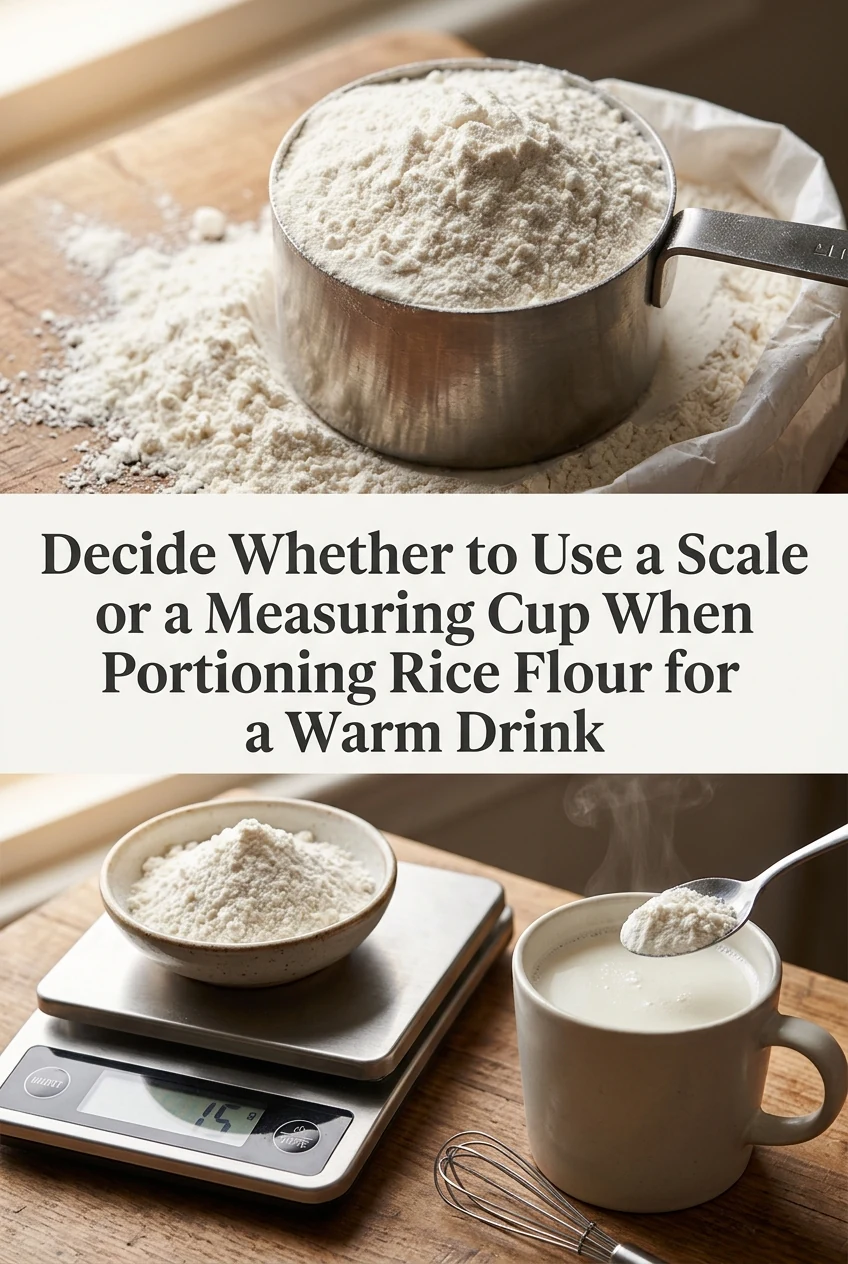
AI-generated editorial concept created for this article. The image is not a technical diagram or a tested result.
Understand why the same cup can give different weights
Rice flour particles are small and settle quickly. If you press the measuring cup into the flour bag and scoop, you pack the particles together and get a denser fill. If you spoon flour lightly into the cup and level it off, you get a looser fill. As an illustrative example, a 60 ml cup scooped directly might hold 38 g, while the same cup spooned and leveled might hold only 28 g. That 10 g difference in a single-serve drink changes the final texture noticeably.
Run a quick comparison before your first batch
Place a bowl on your scale and tare it. Scoop a full 60 ml cup of rice flour directly from the bag and tip it into the bowl. Record the weight. Empty and tare the bowl again. This time, spoon flour into the same cup until it mounds slightly, level it with a straight edge, and tip it in. Record that weight too. The difference between your two readings tells you how much variation your specific scooping habit introduces.
Choose the scale for repeatable results
Once you know the weight that produces the texture you want in your warm drink, a scale removes the variable entirely. Weigh the flour directly into the saucepan or mixing bowl every time, regardless of how the bag has settled or who is making the drink. For a single-serve warm rice flour drink using 200 ml of milk, a typical starting point is 12 to 18 g of flour, but your preferred texture determines the exact number.
When a measuring cup is the only option
If you are working without a scale, commit to one consistent scooping method and use it every time. Spooning into the cup and leveling is generally more consistent than scooping directly because it is less affected by how tightly the flour has settled in the bag. Mark your chosen method on the recipe card so anyone else making the drink follows the same technique and gets the same result.
Adjust for thickness after the first test batch
Make the drink with your measured flour, whisk it into a small amount of cold milk first to prevent lumps, then add the remaining warm milk and heat gently while stirring. Taste and assess the texture before adding sweetener. If the drink is too thick, reduce the flour by 2 g next time. If it is too thin, increase by 2 g. Small adjustments are easier to track by weight than by fractions of a cup.
A little more
to know.
Does the brand or grind of rice flour affect how much a cup holds?
Yes. Finely milled rice flour packs more densely than coarser grinds, so the same cup volume can yield different weights across brands. This is another reason a scale gives more consistent results when switching between products.
Should I sift rice flour before measuring it by cup?
Sifting loosens compacted flour and makes a spooned cup measure more consistent, but it adds a step. If you are using a scale, sifting is unnecessary for portioning purposes, though it can help the flour incorporate more smoothly into liquid.
Original editorial guidance and recipe formulations, not independently kitchen-tested. Times are estimates and depend on equipment and product directions. Cooked bases need additional cooling and refrigeration before cold serving. Images are AI-generated illustrations; appearance and yield may vary. Check actual ingredient labels, allergens, and any certification you require. We do not certify products. Read our approach.
Save to Pinterest ↗ANOTHER IDEA FOR THE COUNTER