Decide Whether to Use a Saucepan or a Milk Jug for a Small Warm Spiced Drink
Choosing between a small saucepan and a microwave-safe jug for a warm spiced milk drink comes down to what you are adding to the milk. Whole spices and ground powders need gentle, even heat and regular stirring to dissolve and infuse properly, which a saucepan handles better. A jug suits a plain warm milk portion where speed matters more than extraction. Understanding this difference saves you from scorched milk or under-infused spice.
Read the note ↓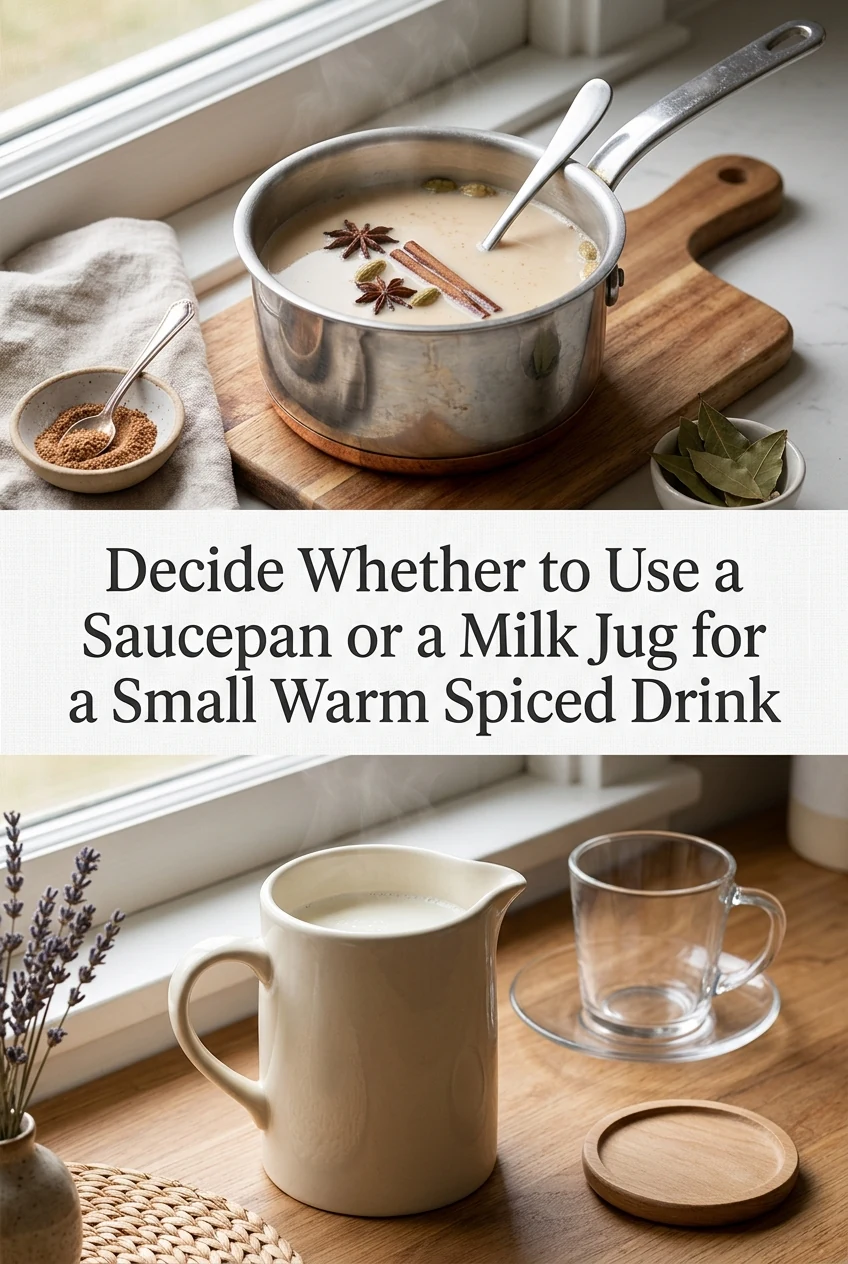
AI-generated editorial concept created for this article. The image is not a technical diagram or a tested result.
Why the vessel affects spice infusion
A saucepan distributes heat across a wide base, letting you stir continuously and keep the milk just below a simmer. Ground cinnamon or cardamom needs that sustained gentle agitation to disperse evenly rather than clumping on the surface. A microwave heats unevenly through electromagnetic radiation with localized hot spots, which does not provide the steady stirring and dwell time spice particles need to hydrate and release flavour before reaching serving temperature.
When a microwave-safe jug is the right choice
If you are warming 150 to 200 millilitres of plain pasteurised whole milk to add to an already-flavoured drink, a microwave-safe jug is practical. Heat in 30-second intervals, stirring between each, and stop when the milk feels warm to the back of your hand but has not begun to form a skin. This approach works for topping a pre-made cocoa concentrate or a pre-brewed spiced tea where the flavour is already built.
Setting up the saucepan for a spiced drink
Use a small saucepan, roughly 600 to 700 millilitre capacity, for a single 250 millilitre serving. Measure your milk cold, add ground spice directly to the cold milk before turning on the heat, then stir with a silicone spatula as the temperature rises. Starting with cold milk and cold spice together gives the powder a longer window to hydrate before the milk becomes too hot to keep stirring safely.
Recognising the right heat level without a thermometer
For a spiced milk drink, you want the milk steaming steadily but not boiling. Watch for small bubbles forming around the edge of the pan and a visible rise of steam. At that point, reduce the heat immediately and continue stirring for another 30 seconds before pouring. Boiling drives off aromatic compounds in spices and creates a skin that traps flavour in the pan rather than in your cup.
Transferring and serving safely
Pour the finished drink through a small fine-mesh strainer into your cup to catch any undissolved spice particles or milk skin. If you made more than one serving and have leftover warm spiced milk, refrigerate it in a sealed container within two hours of preparation, or within one hour if your kitchen is above 32 degrees Celsius. Reheat only once using the saucepan method, stirring throughout.
A little more
to know.
Can I use a non-stick saucepan for warming spiced milk?
Yes, a non-stick interior makes cleanup easier and reduces the chance of milk solids sticking to the base. Use a silicone or wooden spatula rather than metal to protect the coating while stirring.
Does the fat content of the milk change how I use the saucepan?
Skimmed milk scorches faster than whole milk because it has less fat to buffer the heat. Keep the flame lower and stir more frequently if you are using a reduced-fat pasteurised milk in the saucepan.
Original editorial guidance and recipe formulations, not independently kitchen-tested. Times are estimates and depend on equipment and product directions. Cooked bases need additional cooling and refrigeration before cold serving. Images are AI-generated illustrations; appearance and yield may vary. Check actual ingredient labels, allergens, and any certification you require. We do not certify products. Read our approach.
Save to Pinterest ↗ANOTHER IDEA FOR THE COUNTER