Decide Whether to Use a Jigger or a Small Ladle When Portioning Warm Syrup Into Cups
Pouring warm syrup free-hand from a saucepan into individual cups produces uneven sweetness across a small batch. The first cup often receives more than intended and the last cup less. Choosing a portioning tool before service, rather than improvising, solves this without requiring expensive equipment. The choice between a jigger and a small ladle depends on the syrup volume per cup, the number of cups, and how quickly service needs to move.
Read the note ↓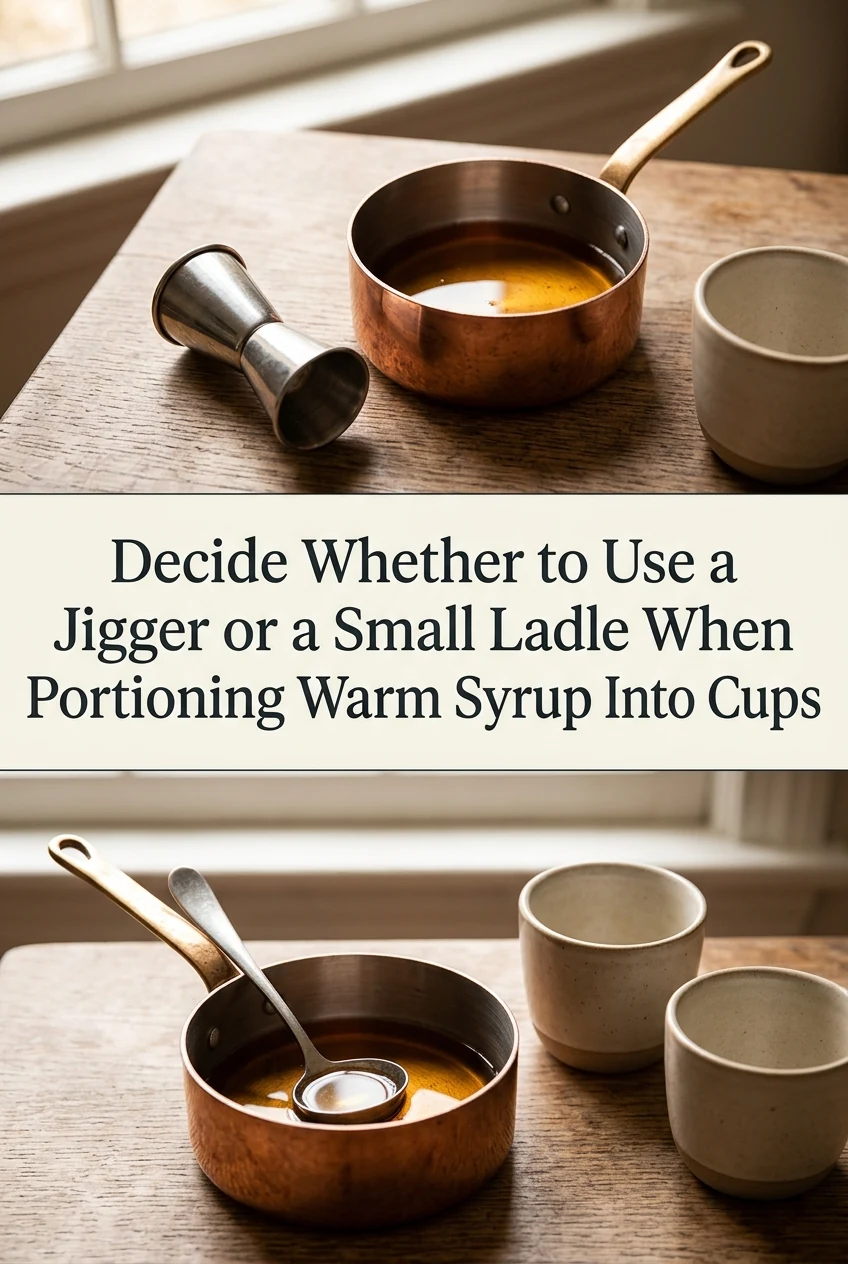
AI-generated editorial concept created for this article. The image is not a technical diagram or a tested result.
What a jigger controls precisely
A double-sided jigger with marked capacities, commonly 15 and 30 millilitres, fills to a fixed volume each time. For recipes calling for 15 to 30 millilitres of syrup per cup, a jigger gives the most repeatable result. Fill it level, not heaped, and pour directly into the cup before adding the beverage. The limitation is speed: filling and emptying a jigger for six cups takes longer than ladling, and warm syrup cools slightly with each transfer.
What a small ladle suits better
A small ladle with a known capacity, often 30 or 60 millilitres stamped on the handle, works well when syrup portions are larger or when you are serving four or more cups in sequence. The wider bowl moves syrup faster than a jigger. The key is confirming the ladle capacity before service, not assuming it. Fill the ladle with water and pour into a measuring jug once to verify the actual volume. Record that number and use it as your reference.
Matching the tool to the syrup volume per cup
As an illustrative example: if a recipe calls for 20 millilitres of syrup per cup and you are serving five cups, you need 100 millilitres total. A 30-millilitre jigger filled two-thirds of the way each time gives a consistent 20-millilitre portion. A ladle holding 60 millilitres filled one-third of the way is harder to judge accurately by eye. In this case the jigger is the better tool. For portions of 45 millilitres or more, the ladle becomes more practical.
Keeping syrup at a usable temperature during service
Warm syrup thickens as it cools, which changes how it pours and makes portions less consistent toward the end of a batch. Keep the syrup in a small heatproof jug placed in a shallow pan of warm water during service. Do not reheat repeatedly on the stove between cups. If syrup has thickened noticeably before all cups are filled, stir it gently; do not add water to thin it, as this changes the concentration and alters sweetness in the remaining cups.
Setting up before guests arrive
Line the cups in a row before portioning begins. Pour syrup into all cups first, then add the beverage. This sequence keeps the portioning tool in continuous use rather than alternating between syrup and liquid, which slows service and increases the chance of cross-contaminating flavours. Rinse the jigger or ladle between different syrups if you are offering more than one flavour. Dry it briefly before the next syrup to avoid diluting the portion.
A little more
to know.
Can I use a measuring spoon instead of a jigger for very small syrup portions?
A measuring spoon works for portions of five to fifteen millilitres and is more precise than a jigger at that scale. Use a tablespoon for 15 millilitres. The narrow bowl makes pouring into a cup without dripping slightly more difficult than a jigger.
How do I store leftover warm syrup safely after service?
Transfer cooled syrup to a clean, sealed container and refrigerate at 4 degrees Celsius or below within two hours of preparation. Do not return used syrup from cups to the storage container. Discard any syrup left in the portioning vessel after service.
Original editorial guidance and recipe formulations, not independently kitchen-tested. Times are estimates and depend on equipment and product directions. Cooked bases need additional cooling and refrigeration before cold serving. Images are AI-generated illustrations; appearance and yield may vary. Check actual ingredient labels, allergens, and any certification you require. We do not certify products. Read our approach.
Save to Pinterest ↗ANOTHER IDEA FOR THE COUNTER