Decide Whether to Use a Fine Sieve or a Cloth Bag When Straining a Warm Spiced Milk
Straining warm spiced milk sounds straightforward until fine cinnamon powder clouds the cup or a coarse cardamom husk slips through a cloth weave. The choice between a fine-mesh sieve and a cloth bag depends on two practical factors: the physical size of the spice particles you used and how visually clear you want the finished drink to be. Getting this decision right before you pour saves a second straining pass and keeps the milk at serving temperature.
Read the note ↓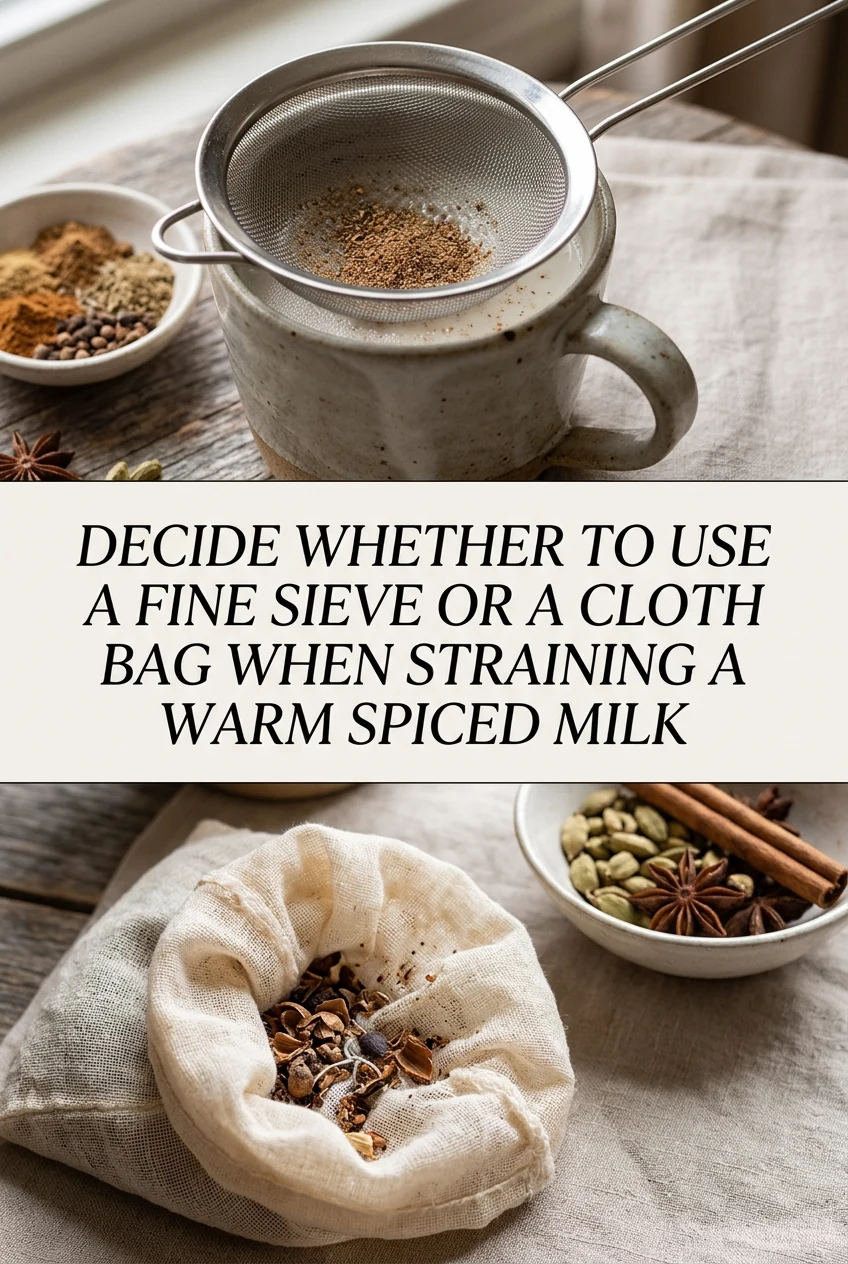
AI-generated editorial concept created for this article. The image is not a technical diagram or a tested result.
Identify the Particle Size of Your Spices First
Whole spices simmered in milk, such as a cinnamon stick, star anise, or cracked cardamom pods, leave large fragments that any standard fine-mesh sieve catches easily. Ground spices behave differently. A quarter teaspoon of ground cinnamon disperses into particles small enough to pass through many sieve meshes, leaving visible sediment in the cup. Before choosing your straining tool, note whether you used whole, cracked, or ground spices, because that single fact drives the rest of the decision.
When a Fine-Mesh Sieve Is the Right Choice
A fine-mesh sieve works well when you have used whole or coarsely cracked spices and want a quick, hands-free pour. Hold the sieve over the serving cup, pour steadily, and the fragments collect in the bowl of the sieve. For an illustrative example, a batch made with one cinnamon stick and four lightly cracked green cardamom pods in 250 millilitres of milk strains cleanly through a standard fine-mesh sieve in a single slow pour with no residue reaching the cup.
When a Cloth Bag Produces a Cleaner Result
A dampened muslin or fine cotton cloth bag traps ground spice particles that pass through metal mesh. Dampen the cloth before use so it does not absorb the first pour of milk. Place the bag over a heat-safe jug, pour the hot milk through slowly, and allow gravity to do the work rather than pressing or squeezing, which forces fine sediment through the weave. This method takes longer but produces a noticeably clearer, smoother drink when ground spices were used.
Combining Both Tools for a Two-Stage Strain
If you used a mix of whole and ground spices, a two-stage approach is practical. Pour first through the fine-mesh sieve to remove large pieces, then pass the milk through a dampened cloth bag. This sequence keeps the cloth from clogging with large fragments. The total extra time is roughly one to two minutes, and the result is a drink with neither floating husks nor a gritty base, which matters most when serving in a clear glass.
Temperature and Timing Considerations
Warm spiced milk cools during straining, particularly through a cloth bag, which slows the pour. If serving temperature matters, heat the milk a few degrees above your target before straining, or warm the serving cup with hot water first. For food safety, any strained milk not served immediately should be transferred to a clean container and refrigerated at 4 degrees Celsius or below within two hours of preparation, or within one hour if your kitchen is above 32 degrees Celsius.
A little more
to know.
Can I reuse a muslin cloth bag for straining milk on the same day?
Yes, rinse it thoroughly with hot water between uses and wring it out. Do not leave a milk-damp cloth sitting at room temperature between sessions; rinse it immediately after each use and store it refrigerated if there is a gap of more than an hour.
Does straining remove the flavour along with the particles?
Straining removes solid matter, not dissolved flavour compounds already infused into the milk. A well-simmered batch retains its spice character after straining. If the flavour seems weak, the issue is steeping time or spice quantity rather than the straining method itself.
Original editorial guidance and recipe formulations, not independently kitchen-tested. Times are estimates and depend on equipment and product directions. Cooked bases need additional cooling and refrigeration before cold serving. Images are AI-generated illustrations; appearance and yield may vary. Check actual ingredient labels, allergens, and any certification you require. We do not certify products. Read our approach.
Save to Pinterest ↗ANOTHER IDEA FOR THE COUNTER