Control Bloom Expansion in Fresh Dark Roast Pour-Overs
Freshly roasted dark coffee beans trap immense volumes of carbon dioxide within brittle, porous cell structures. Pouring hot water onto dark grounds in a conical dripper often triggers violent off-gassing, generating an unruly foaming dome that crawls up paper walls and leaves dry internal pockets. Uneven foaming channels extraction water along outer edges, causing bitter dryness and hollow flavor. By splitting initial bloom saturation into two measured wetting phases and applying low-impact concentric pours, you tame degassing turbulence and establish an evenly saturated coffee bed.
Read the note ↓
Representative category illustration reused from our editorial library; it does not depict this specific project or a tested result.
Gas Release Dynamics
During deep roasting, cellular walls inside coffee beans fracture, creating extensive micro-porosity while accumulating high concentrations of carbon dioxide gas. When hot water hits these grounds, internal pressure vents furiously, pushing grounds upward into a buoyant, expanding froth. If wet grounds climb the filter walls too rapidly, water runs through porous perimeter channels instead of percolating through the compacted central bed, resulting in localized over-extraction and sour center voids.
Dripper Bed Geometry
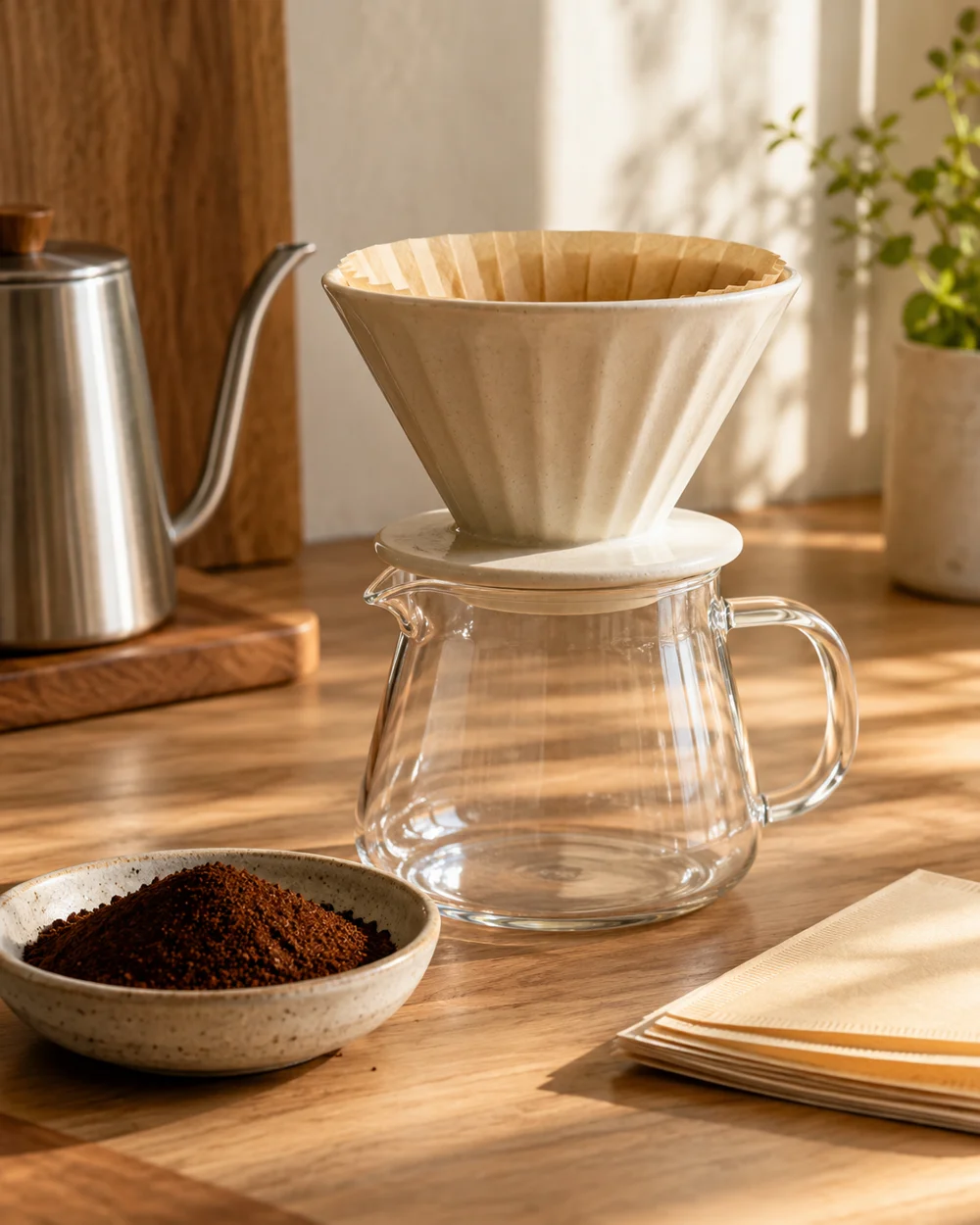
Dose twenty grams of medium-coarse dark roast coffee into a rinsed conical paper filter seated inside a standard sixty-degree dripper. Tap the dripper walls gently to settle the dry grounds into a level plane. Use a clean wooden skewer to press a shallow three-millimeter indentation into the exact center of the bed, creating a guided basin that prevents water from spilling immediately to the outer paper perimeter.
Divided Wetting Phase
Heat filtered water to eighty-eight degrees Celsius rather than boiling to temper aggressive gas release. Pour thirty grams of water directly into the center indentation over five seconds, keeping the kettle spout three centimeters above the bed to minimize agitation. Allow the slurry to expand for twenty seconds, venting the initial rush of carbon dioxide without letting the foam spill outward to the dry edges.
Secondary Saturation Sweep
At twenty seconds, execute the second bloom stage by pouring another thirty grams of water in slow, tight concentric circles from the center toward the mid-radius. Avoid pouring within one centimeter of the paper wall. The gentle secondary stream collapses large gas blisters, submerges floating grounds, and thoroughly saturates the lower bed layers without lifting the foam dome up the dripper walls.
Illustrative Pour Timeline
In an illustrative setup with twenty grams of coffee roasted five days prior, this sixty-gram dual bloom contained the expansion dome safely within the lower third of the dripper within forty seconds. Main pours totaling two hundred forty grams drained smoothly with a flat, even final bed. Grounds roasted several weeks earlier release substantially less gas and settle faster.
A little more
to know.
Should I stir the dark roast bloom with a spoon to break clumps?
Vigorous spoon agitation often pushes fine coffee silt into filter pores, stalling liquid drainage and causing slurry overflow. Gentle circular water momentum provides sufficient wetting without clogging the delicate paper fibers below.
Why avoid pouring water against the outer paper filter during bloom?
Pouring against the paper allows water to bypass the ground bed completely via capillary action along the filter ribs. Bypassed water dilutes the cup while leaving the adjacent coffee grounds under-saturated and under-extracted.
Original editorial guidance and recipe formulations, not independently kitchen-tested. Times are estimates and depend on equipment and product directions. Cooked bases need additional cooling and refrigeration before cold serving. Images are AI-generated illustrations; appearance and yield may vary. Check actual ingredient labels, allergens, and any certification you require. We do not certify products. Read our approach.
Save to Pinterest ↗ANOTHER IDEA FOR THE COUNTER