Compare a Small Offset Spatula and a Straight Scraper for Smoothing Batter in a Loaf Tin
Levelling loaf batter before baking is a small step with a visible effect on the finished crust. An uneven surface bakes unevenly, leaving one end higher or producing a lopsided dome. Two common tools handle this task differently: a small offset spatula and a straight bench scraper. Understanding how each one interacts with the tin walls and the batter surface helps you choose the right tool for your tin size and batter consistency.
Read the note ↓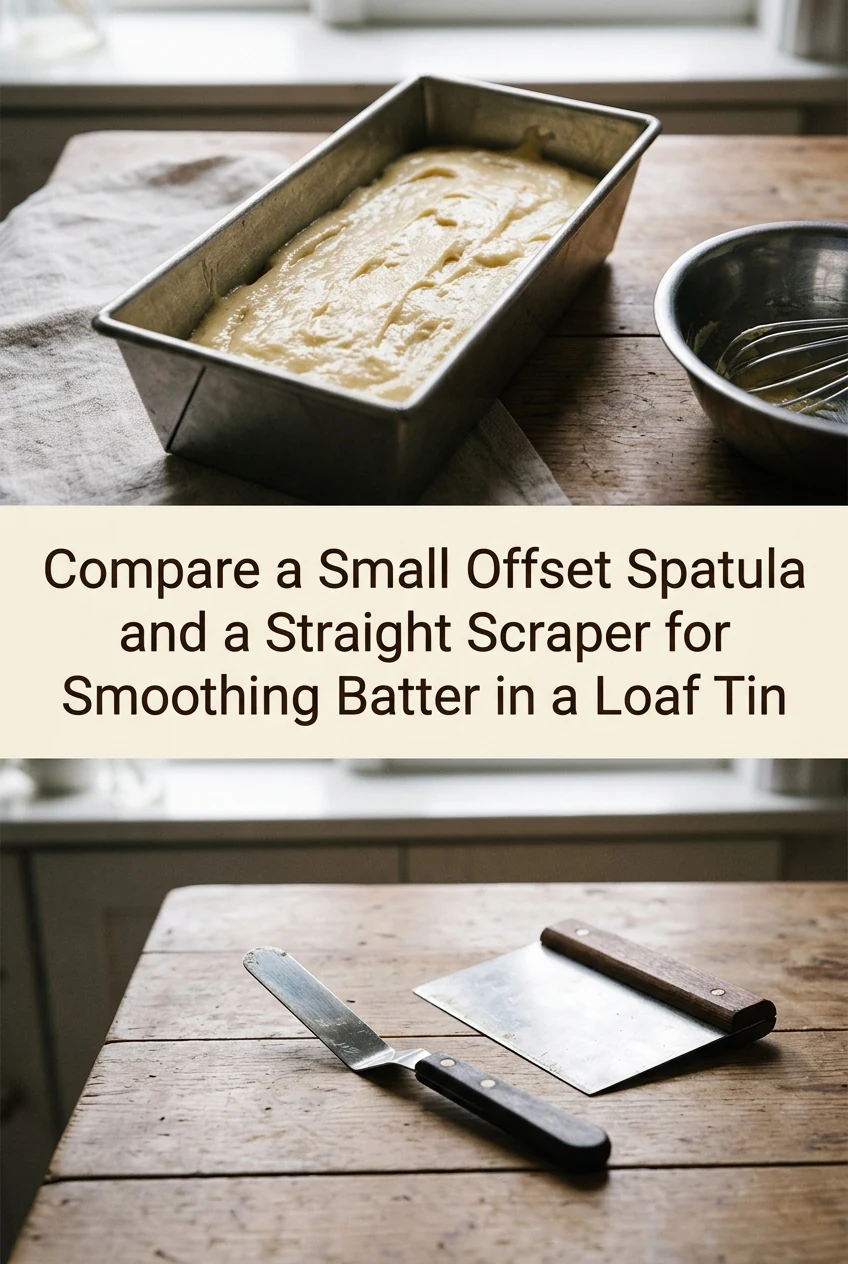
AI-generated editorial concept created for this article. The image is not a technical diagram or a tested result.
How the Offset Spatula Works in a Loaf Tin
A small offset spatula, typically with a blade of around 15 centimetres, has a bent handle that raises your knuckles above the rim of the tin. This clearance lets you sweep the blade flat across the batter surface without your hand hitting the tin sides mid-stroke. The flexible blade conforms slightly to the batter, making it easier to smooth dense batters like banana bread or a compact tea loaf. The angled handle is the primary functional advantage over a straight tool in this context.
How the Straight Scraper Works in a Loaf Tin
A straight bench scraper has a rigid rectangular blade, usually 10 to 15 centimetres wide, with a handle running along the top edge. Dragging it across a loaf tin requires tilting the blade at an angle because the handle sits directly above the blade and collides with the tin rim on a level pass. For a standard 900-gram loaf tin measuring roughly 23 by 13 centimetres, a straight scraper works adequately if held at a shallow angle, though the contact is less controlled than with an offset tool.
Batter Consistency Changes the Comparison
For a pourable batter, such as a lemon drizzle loaf, the surface self-levels to a reasonable degree and either tool finishes the job quickly. For a stiffer batter, such as a fruit-loaded loaf, the offset spatula holds an advantage because its flexibility lets you push and redistribute batter without dragging the tin across the counter. A rigid straight scraper on stiff batter can shift the tin rather than move the batter, particularly on a smooth worktop. This is an illustrative distinction, not a guaranteed outcome for every recipe.
Tin Depth and Tool Length
A deeper tin, such as a 1-kilogram capacity tin with walls of around 7 centimetres, amplifies the knuckle-clearance problem for a straight scraper. The offset spatula blade can reach the centre of the tin without the handle obstructing the motion. For a shallower tin with walls under 5 centimetres, the straight scraper's angle limitation is less pronounced and the tool becomes more competitive. Matching tool length to tin width matters too; a blade narrower than the tin interior requires multiple passes.
Practical Decision Summary
If you bake loaves regularly, a small offset spatula earns its place specifically for tin work. The straight scraper remains useful for bench tasks like portioning dough or cleaning a flat surface. Using the straight scraper inside a deep loaf tin is workable but requires a deliberate tilted grip and an awareness that the blade is not lying flat. Neither tool guarantees a perfectly level bake on its own; oven hot spots and batter distribution when pouring also affect the final dome shape.
A little more
to know.
Can a regular dinner knife substitute for an offset spatula in a loaf tin?
A dinner knife can spread batter but lacks the flexible blade needed to sweep smoothly across the full surface. The handle also sits in line with the blade, recreating the same knuckle-clearance problem as a straight scraper.
Does smoothing the batter surface affect baking time?
Smoothing does not directly change baking time, but a more even surface promotes a more uniform dome and consistent crust browning. An uneven surface can cause one section to overbrown before the rest of the loaf is fully baked through.
Original editorial guidance and recipe formulations, not independently kitchen-tested. Times are estimates and depend on equipment and product directions. Cooked bases need additional cooling and refrigeration before cold serving. Images are AI-generated illustrations; appearance and yield may vary. Check actual ingredient labels, allergens, and any certification you require. We do not certify products. Read our approach.
Save to Pinterest ↗ANOTHER IDEA FOR THE COUNTER