Compare a Small Offset Spatula and a Straight Palette Knife for Spreading Cream on Café Cakes
Spreading a thin, even layer of cream on a small café cake sounds straightforward, but the tool you choose directly affects whether the surface stays smooth or drags and tears the sponge underneath. An offset spatula and a straight palette knife behave differently in the hand and against the cake surface. Understanding what each tool does physically helps you choose the right one for the job before you start, rather than switching mid-spread when the damage is already done.
Read the note ↓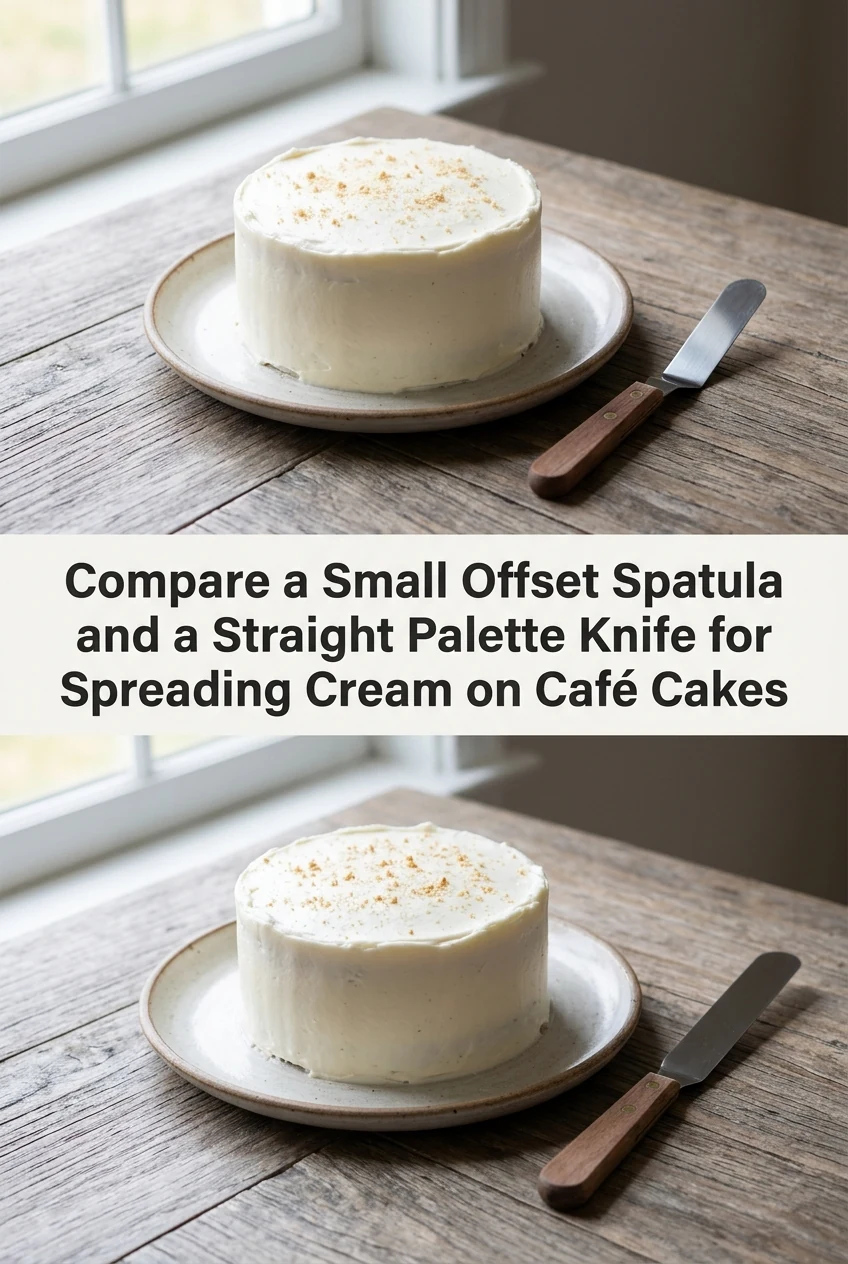
AI-generated editorial concept created for this article. The image is not a technical diagram or a tested result.
How the offset spatula sits against the surface
A small offset spatula has a blade that drops below the handle line at a bend near the bolster. When you rest the blade flat on a cake surface, your hand and wrist sit above the cake rather than at the same level. This angle lets you apply light, even downward pressure across the full blade length without your knuckles dragging through the cream. For a 15-centimetre round cake, a blade of around 10 to 12 centimetres works well without overhanging the edges excessively.
How the straight palette knife sits against the surface
A straight palette knife has a blade that runs in line with the handle, so your hand is at the same height as the blade tip when the knife is held flat. On a small cake, this forces your wrist to angle downward awkwardly, which makes it harder to maintain consistent pressure across the full blade. The straight knife is better suited to vertical work, such as smoothing the sides of a cake or spreading cream on a flat board where your hand does not need to clear the surface.
What happens to the sponge under each tool
A soft sponge tears when the spreading tool drags rather than glides. The offset spatula, held at its natural angle, tends to glide because the blade approaches the surface at a shallow, consistent angle. The straight palette knife, forced flat by an awkward wrist position, often catches and drags, especially near the centre of the cake where the blade tip can dig in. If your cream layer is thin, around 3 to 5 millimetres, the offset spatula is significantly less likely to disturb the sponge beneath.
Practical workflow for a thin cream layer
Place a generous spoonful of cream, roughly 60 to 80 grams for a 15-centimetre cake top, in the centre of the cooled cake. Use the offset spatula to push the cream outward from the centre in short, confident strokes rather than long sweeping passes. Rotate the cake stand or board a quarter turn between strokes. This approach distributes the cream before you refine the surface. Trying to spread too little cream in one long stroke is the most common reason the sponge tears.
When the straight knife is actually the better choice
Use the straight palette knife when smoothing the sides of a layered cake or when working on a flat, low-sided tray bake where your hand does not need to clear a raised edge. The in-line blade gives better control for vertical strokes against a cake side held on a turntable. Switching to the straight knife for side work after using the offset spatula for the top is a practical two-tool workflow that suits most small café cake formats without requiring specialist equipment.
A little more
to know.
Does blade flexibility matter when choosing between these tools?
Yes. A more flexible blade conforms to slight surface irregularities and is forgiving on uneven sponge. A stiffer blade gives more control for a very flat finish but requires a more consistent hand. Most small offset spatulas sold for home use have moderate flexibility, which suits general café cake work.
Can you use the back of a regular dinner knife instead?
A dinner knife is shorter, thicker, and less flexible than either palette tool, so it covers less surface per stroke and tends to leave ridges. It can work for a very rough crumb coat but is not well suited to a clean, thin finished layer on a small cake.
Original editorial guidance and recipe formulations, not independently kitchen-tested. Times are estimates and depend on equipment and product directions. Cooked bases need additional cooling and refrigeration before cold serving. Images are AI-generated illustrations; appearance and yield may vary. Check actual ingredient labels, allergens, and any certification you require. We do not certify products. Read our approach.
Save to Pinterest ↗ANOTHER IDEA FOR THE COUNTER