Choose Between a Tall Glass and a Wide Cup for a Layered Matcha Drink
Vessel shape directly affects how long layers stay distinct in a matcha drink built over a fruit or milk base. The physics are straightforward: a narrower cross-section means less surface area where two liquids of different densities meet, so mixing happens more slowly. Choosing the right vessel before you pour is a practical decision that determines whether you serve a visually distinct layered drink or a blended one, and both outcomes are valid depending on what you want.
Read the note ↓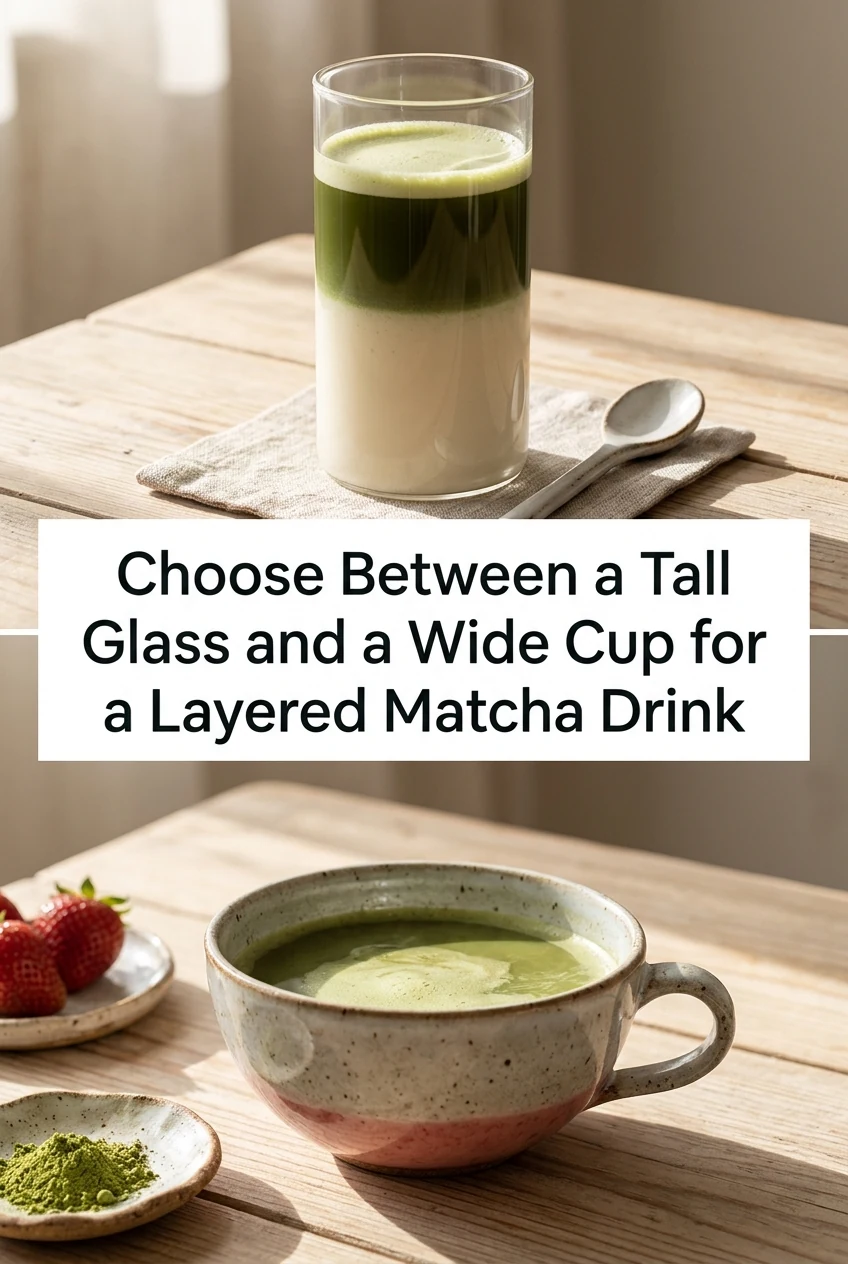
AI-generated editorial concept created for this article. The image is not a technical diagram or a tested result.
Why Surface Area at the Interface Matters
When you pour matcha over a denser base such as a fruit syrup or sweetened milk, the two liquids meet at a horizontal boundary. In a tall 300-millilitre glass with a 6-centimetre diameter opening, that interface is roughly 28 square centimetres. In a wide 300-millilitre cup with a 9-centimetre diameter, the interface is roughly 64 square centimetres. The wider interface allows more mixing per second through convection and diffusion. This is an illustrative comparison, not a laboratory measurement, but the principle holds in practice.
How to Pour Into a Tall Glass to Preserve Layers
Add your base first, whether that is a fruit concentrate, sweetened condensed milk or a thin syrup, to the bottom of the tall glass. Add ice if using. Then pour prepared matcha slowly over the back of a spoon held just above the ice surface. The spoon disperses the pour and slows the matcha as it contacts the base layer. Work slowly and do not pour from height. Even with good technique, layers in a home setting begin to blend within three to five minutes, so serve promptly.
When a Wide Cup Is the Better Choice
A wide cup suits a stirred matcha drink where you want the flavours fully integrated before the first sip. It also suits hot matcha preparations where you whisk directly in the cup, because the wider base gives a chasen room to move. If you are making a matcha latte with steamed or frothed milk that you plan to stir anyway, vessel width is irrelevant to layering, so choose based on volume, comfortable handling, and your preferred drinking style.
Ice Placement Affects Layer Stability Too
In a tall glass, placing ice above the base layer acts as a physical buffer that slows mixing when you pour. The ice breaks the downward momentum of the incoming matcha, dispersing the stream gently across the top rather than letting it plunge directly into the base beneath. In a wide cup, ice spreads out across a broader area, offering less resistance in any single spot. If clear layer definition is your priority, stack ice in a tall glass and pour slowly over the cubes. Without ice, liquids in either vessel mix much more readily on contact.
Practical Decision Summary Before You Pour
Ask two questions before choosing your vessel. First, do you want distinct layers visible through the glass, or a blended drink? Second, are you serving hot or cold? Tall glass with ice suits cold layered drinks. Wide ceramic cup suits hot stirred drinks or any preparation you plan to blend. If you are serving guests and want a visual effect, use the tall glass and serve within two minutes of assembly. If you are making a quick personal drink, vessel shape matters far less than your pour technique.
A little more
to know.
Does the density of the matcha preparation affect how long layers hold?
Yes. Layering relies on the matcha being less dense than the liquid beneath it. Dense bases containing dissolved sugars—such as fruit syrups, condensed milk, or sweetened dairy—support a lighter layer of water-whisked matcha on top. If the matcha is sweetened or made denser than the base liquid, it will sink through rather than float.
Can I use a mason jar instead of a purpose-made tall glass?
A mason jar works well for layered cold drinks because its straight sides and narrow diameter behave similarly to a tall glass. The wide mouth can make slow pouring slightly harder, so use a spoon to diffuse the pour as usual.
Original editorial guidance and recipe formulations, not independently kitchen-tested. Times are estimates and depend on equipment and product directions. Cooked bases need additional cooling and refrigeration before cold serving. Images are AI-generated illustrations; appearance and yield may vary. Check actual ingredient labels, allergens, and any certification you require. We do not certify products. Read our approach.
Save to Pinterest ↗ANOTHER IDEA FOR THE COUNTER