Choose Between a Silicone and a Wooden Spoon for Stirring a Warm Syrup on the Stovetop
When you make a small flavoured syrup on the stovetop, the spoon you reach for affects both the result and your cleanup. Wooden spoons are familiar and give good tactile feedback, but they hold onto previous flavours in their grain. Silicone spoons rinse clean quickly and do not absorb anything. Understanding exactly where each tool succeeds and where it causes problems helps you make a deliberate choice rather than grabbing whatever is nearest.
Read the note ↓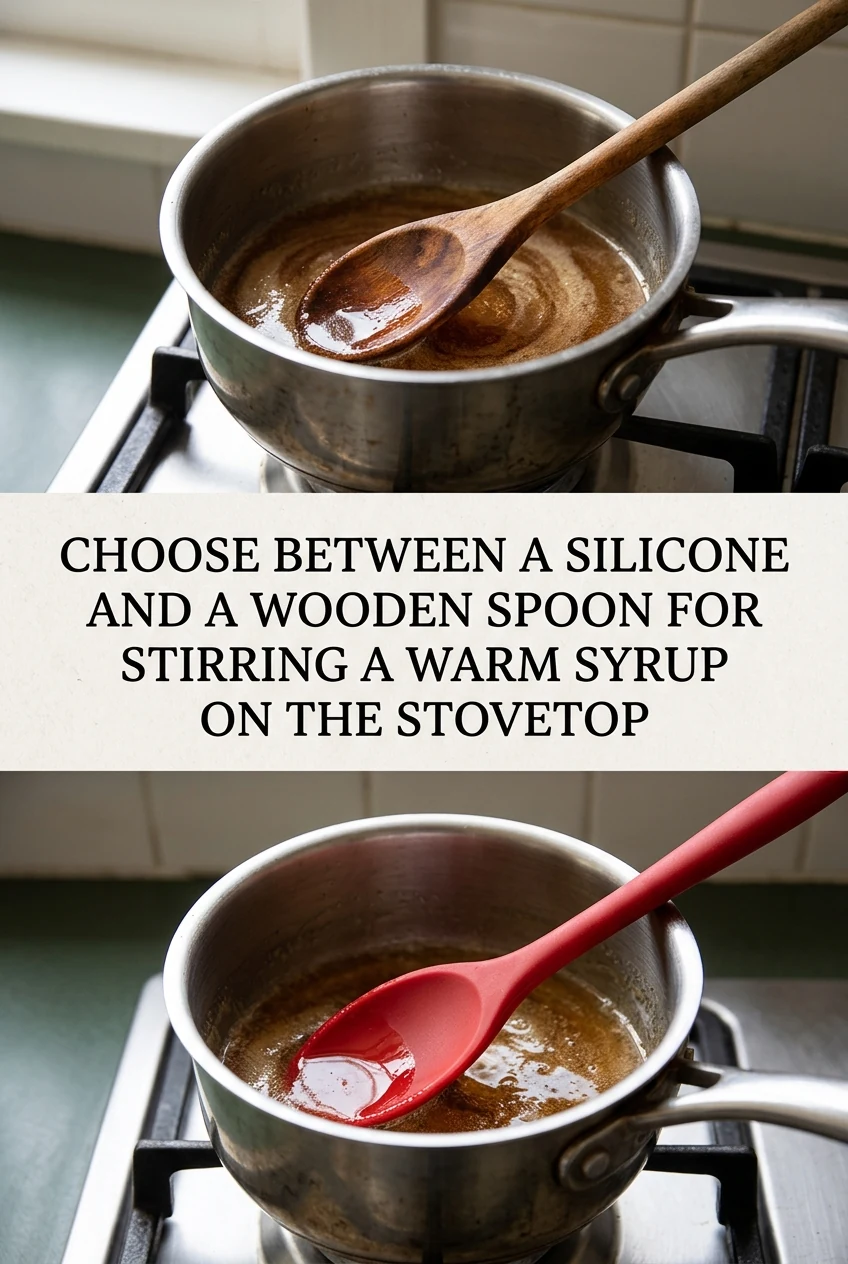
AI-generated editorial concept created for this article. The image is not a technical diagram or a tested result.
Why wooden spoons carry residual flavour
Wood is porous. Even after washing, a wooden spoon used repeatedly for alcohol-free vanilla-flavoured syrups, spiced preparations or anything with a strong aromatic will retain trace compounds in its grain. When you stir a plain sugar syrup intended for a delicate jasmine or light citrus drink, those residual notes can transfer subtly into the batch. This is not a hygiene failure; it is simply how the material behaves. Dedicated wooden spoons kept for one flavour category can reduce this problem.
Where silicone has a practical edge
A silicone spoon has a non-porous surface, so rinsing under warm running water removes syrup residue without soaking. It also tolerates the temperature range of a stovetop syrup, typically between 100 and 115 degrees Celsius for a simple sugar-and-water mixture, without warping or splitting. Because it does not absorb colour or scent, you can move between a rose syrup and a plain simple syrup in the same session without flavour crossover, provided you wash it between uses.
Where a wooden spoon still works well
If you make only one flavour of syrup consistently, a dedicated wooden spoon performs reliably. The handle stays cooler than metal and gives a secure grip when you are stirring continuously to dissolve sugar. For a home cook making, for example, a single recurring batch of a lightly spiced cardamom syrup, a wooden spoon reserved solely for that purpose introduces no crossover risk and remains a practical choice without any disadvantage.
Checking your spoon before you start
Before heating anything, smell the spoon. Hold it close and inhale near the bowl of the utensil. A wooden spoon that smells of a previous batch is a clear signal to use silicone instead for this particular syrup. A silicone spoon should be checked for any cracks or tears in the surface, since damaged silicone can trap residue in the same way wood does. Replace a cracked silicone spoon rather than continuing to use it.
A worked example to illustrate the decision
Suppose you are making 250 millilitres of a plain sugar syrup using equal parts water and white sugar, heated gently until the sugar dissolves. You plan to use this syrup in a lightly floral iced tea the same afternoon. Your wooden spoon was last used for a cinnamon batch two days ago and still carries a faint spice scent. In this illustrative scenario, switching to a clean silicone spoon is the straightforward choice to avoid any unintended spice note in the finished drink.
A little more
to know.
Can I use a metal spoon instead of either option?
A metal spoon conducts heat quickly and the handle can become uncomfortably hot during continuous stirring. It does not absorb flavour, but the handle temperature makes it less comfortable for the sustained stirring a dissolving syrup requires.
Does soaking a wooden spoon in hot water remove absorbed flavours before use?
Soaking softens the wood and can cause swelling and cracking over time without reliably removing embedded aromatic compounds. It is not a dependable method for clearing residual flavour before making a delicate syrup.
Original editorial guidance and recipe formulations, not independently kitchen-tested. Times are estimates and depend on equipment and product directions. Cooked bases need additional cooling and refrigeration before cold serving. Images are AI-generated illustrations; appearance and yield may vary. Check actual ingredient labels, allergens, and any certification you require. We do not certify products. Read our approach.
Save to Pinterest ↗ANOTHER IDEA FOR THE COUNTER