Choose Between a Shallow Saucepan and a Small Milk Jug for Warming Spiced Oat Milk
Warming spiced oat milk sounds straightforward until you consider that the vessel shapes how well you can stir in ground spices, how evenly heat distributes, and how cleanly you can pour into a cup. A shallow saucepan and a small stovetop-safe milk jug each solve different parts of the problem. Understanding what each vessel does well helps you choose based on portion size and how much stirring control matters for your particular spice blend.
Read the note ↓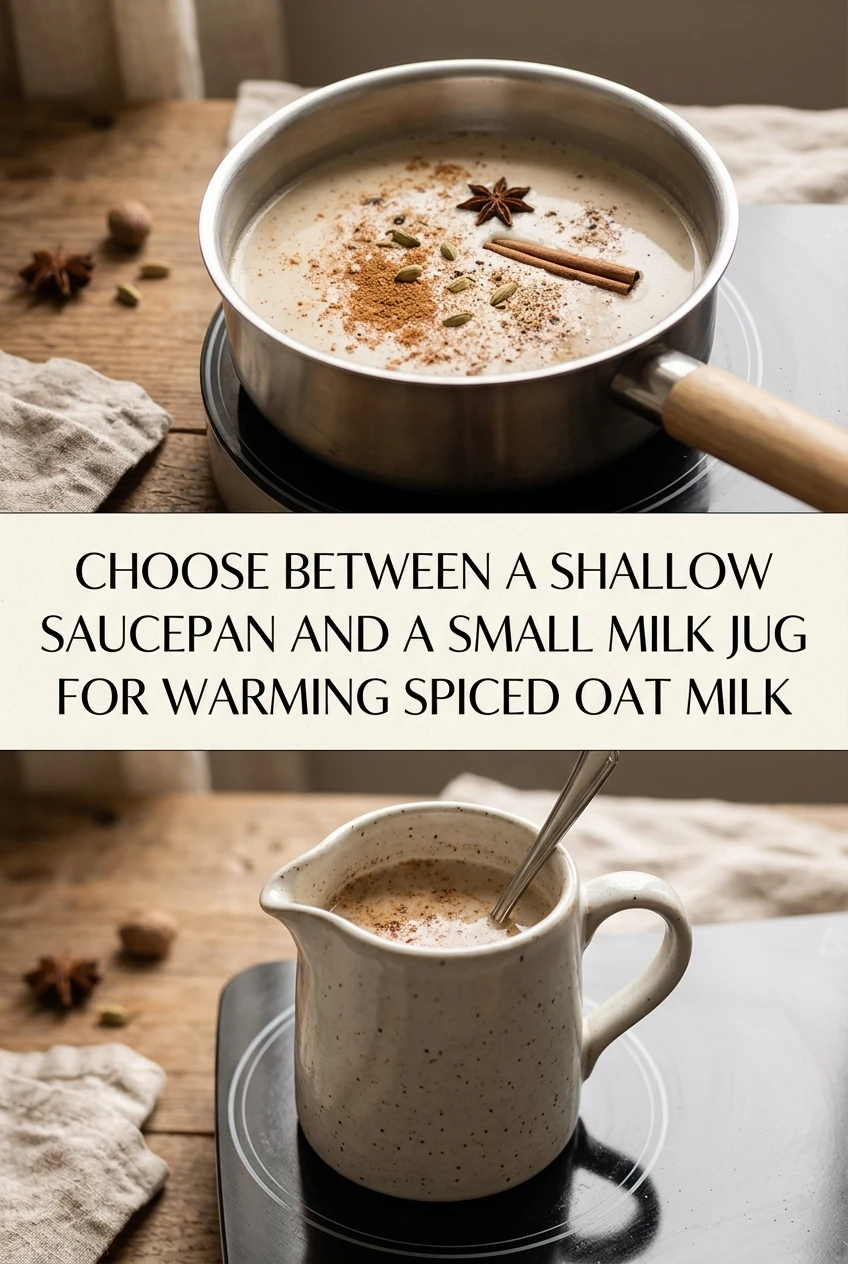
AI-generated editorial concept created for this article. The image is not a technical diagram or a tested result.
What a shallow saucepan does well for larger portions
A shallow saucepan with a wide base distributes heat across a larger surface area, which reduces the chance of scorching oat milk at the bottom before the rest of the liquid is warm. The wide opening also gives a whisk or spoon room to move freely, which matters when you are incorporating ground cinnamon or cardamom that tends to clump on contact with liquid. For portions of 300 millilitres or more, the saucepan offers better stirring leverage than a narrow jug.
What a small milk jug does well for single servings
A stovetop-safe milk jug with a spout and handle concentrates heat around a smaller volume, warming a single 180 to 240 millilitre portion quickly and with less cleanup. The spout gives you a controlled, drip-free pour directly into a cup, which is useful when you want to layer spiced oat milk over a cold brew or tea concentrate without splashing. The narrower base does require more frequent stirring to prevent the bottom from overheating before the surface warms.
How spice type affects the vessel choice
Finely ground spices like cinnamon and ginger disperse more readily in a wide pan where you have room to whisk vigorously. Whole spices such as a cinnamon stick or crushed cardamom pods steep rather than dissolve, making vessel width less critical since you are not trying to break up clumps. If your recipe calls for a spice paste or a dense blend like chai masala, the saucepan gives you the surface area to work it in evenly before the milk reaches serving temperature.
Worked example comparing two portion sizes
As an illustrative comparison: warming 200 millilitres of oat milk with a quarter teaspoon of ground cinnamon in a small jug on medium-low heat may require stirring every 30 seconds to prevent settling. The same quantity in a shallow saucepan warms more evenly with one stir per minute. For 400 millilitres serving two cups, the saucepan becomes the more practical choice because the jug would be too full to stir without risk of spilling. These are practical observations, not timed guarantees.
Pouring accuracy and serving decisions
If you are serving directly from the vessel, the jug wins on accuracy because the spout directs flow. A saucepan requires a steady hand or a ladle to avoid drips. For cafe-style presentation where you want a clean pour over a prepared drink, transferring from a saucepan into a small jug before serving adds one extra step but improves control. Decide whether the extra vessel is worth washing based on how often you make the drink and how much the pour quality matters to you.
A little more
to know.
Can I use a small saucepan as both the warming and pouring vessel without a separate jug?
Yes, a saucepan with a pour lip works for both steps. If yours lacks a lip, use a ladle to transfer into the cup. The main trade-off is slightly less precision compared to a spouted jug, which matters more for layered drinks than for a simple mug of spiced oat milk.
How hot should spiced oat milk get before I remove it from the heat?
Use a kitchen thermometer to target roughly 60 to 70 degrees Celsius, or remove the vessel from the heat once gentle steam rises and small bubbles form at the rim, well before a simmer. Oat milk can develop a starchy texture or scorch if held at high heat or boiled, so remove it promptly.
Original editorial guidance and recipe formulations, not independently kitchen-tested. Times are estimates and depend on equipment and product directions. Cooked bases need additional cooling and refrigeration before cold serving. Images are AI-generated illustrations; appearance and yield may vary. Check actual ingredient labels, allergens, and any certification you require. We do not certify products. Read our approach.
Save to Pinterest ↗ANOTHER IDEA FOR THE COUNTER