Choose Between a Reusable Silicone Mat and Baking Paper for a Small Cookie Batch
Silicone mats and baking paper are not interchangeable liners. Each changes how heat reaches the base of a cookie and how easily the baked piece releases. For a small batch of eight to twelve cookies, the difference in base colour and texture is noticeable. Understanding what each surface does lets you pick the right one for the dough you are working with rather than defaulting to whichever is closest to hand.
Read the note ↓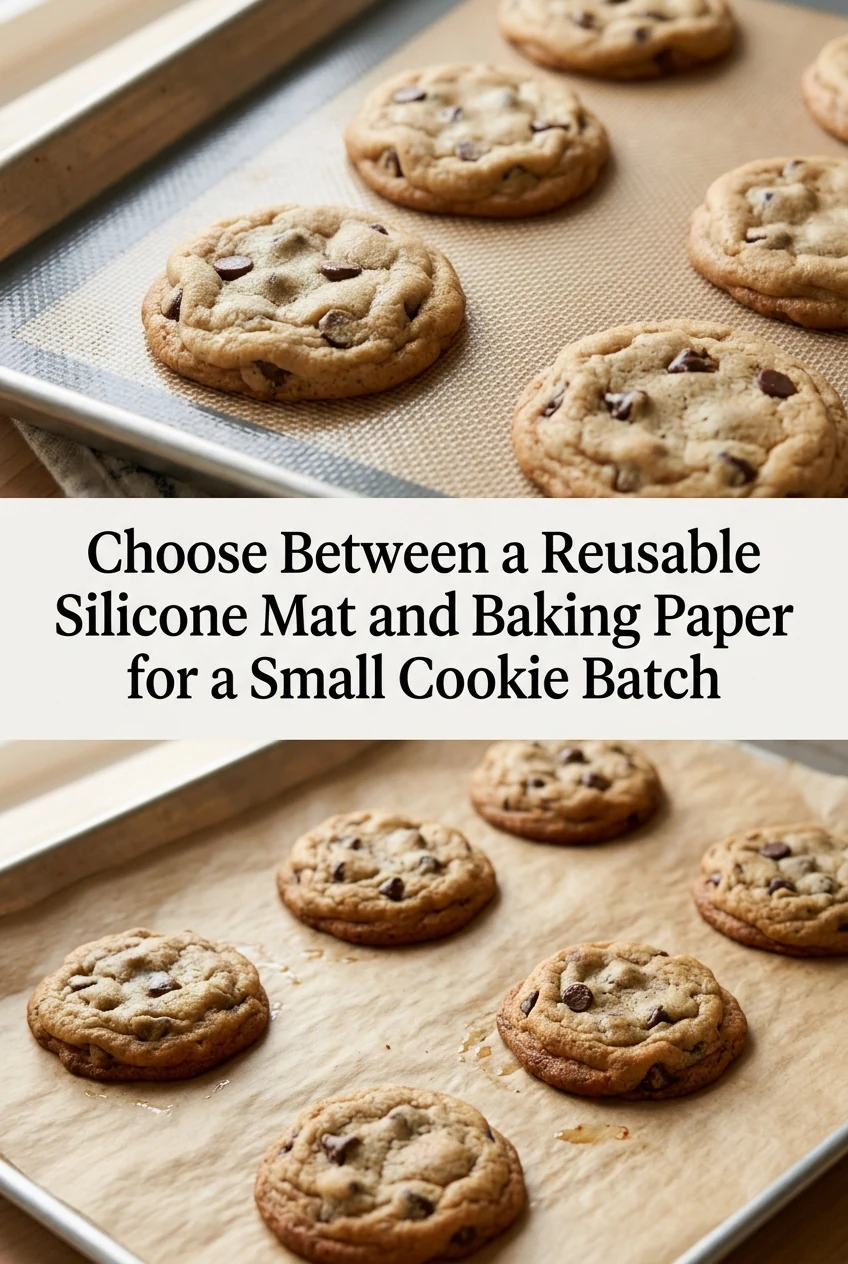
AI-generated editorial concept created for this article. The image is not a technical diagram or a tested result.
How a silicone mat slows base browning
A silicone mat sits between the metal tray and the dough, acting as a mild insulator. Heat from the tray conducts through the mat more slowly than through bare metal or thin paper, so the base of each cookie sets before it deepens in colour. This suits pale shortbread or sugar cookies where a golden base is acceptable but a dark one is not. Expect the base to be slightly softer and more uniform in colour compared with the same dough baked on paper.
How baking paper allows faster base colour
Baking paper is thin enough that tray heat reaches the dough base with little delay. Cookies baked on paper tend to develop a more defined, slightly crisper base and a deeper golden colour in the same oven time. For a chocolate chip or oat cookie where a firm, browned base is desirable, paper often gives a better result. The trade-off is that paper is single-use and can shift on the tray if the dough is placed carelessly.
Release and cleanup differences
Both surfaces release most cookies cleanly once the batch has rested for two to three minutes off the oven. A silicone mat releases very sticky or high-sugar doughs more reliably because the flexible surface lets you peel away gently. Baking paper can be lifted with the cookies still on it, which is useful when moving fragile pieces. Silicone mats require washing after each use; paper is discarded. Neither surface eliminates the need to let cookies cool slightly before lifting.
Matching the liner to your tray size
A silicone mat must lie flat without overlapping the tray edges, otherwise the raised edge traps steam and softens the cookie base unevenly. Measure your tray interior before buying a mat. A common home tray interior measures roughly 30 by 40 centimetres; a mat cut for that size should sit flush. Baking paper can be trimmed with scissors to fit any tray exactly, making it more adaptable when you use more than one tray size.
Making the decision for a small batch
For eight to twelve cookies, the practical question is what result the dough needs. If you want a pale, soft base and plan to bake this dough regularly, a silicone mat earns its cost over time. If you want a crisper, more browned base or are baking a one-off batch, baking paper is simpler. Avoid switching liners mid-batch; changing the surface partway through produces inconsistent results across the tray.
A little more
to know.
Can I use a silicone mat and baking paper together on the same tray?
Layering both adds insulation and can significantly under-brown the base. It also raises the dough further from the tray surface. Use one liner at a time and adjust baking time if you notice the base is not setting at the expected point.
Does a silicone mat affect baking time compared with paper?
It can add one to three minutes to the time needed for the base to set, depending on your oven and dough thickness. Check the base colour rather than relying solely on the clock, especially the first time you use a new mat.
Original editorial guidance and recipe formulations, not independently kitchen-tested. Times are estimates and depend on equipment and product directions. Cooked bases need additional cooling and refrigeration before cold serving. Images are AI-generated illustrations; appearance and yield may vary. Check actual ingredient labels, allergens, and any certification you require. We do not certify products. Read our approach.
Save to Pinterest ↗ANOTHER IDEA FOR THE COUNTER