Choose Between a Gooseneck and a Standard Kettle Spout for Pour-Over
The spout shape on a kettle determines how much control you have over water flow during brewing. For pour-over methods that rely on slow, targeted pouring, a gooseneck spout makes a measurable difference. For immersion methods like French press, a standard spout is entirely adequate. Understanding what each spout actually does in practice helps you decide whether a second kettle is a genuine upgrade or an unnecessary purchase.
Read the note ↓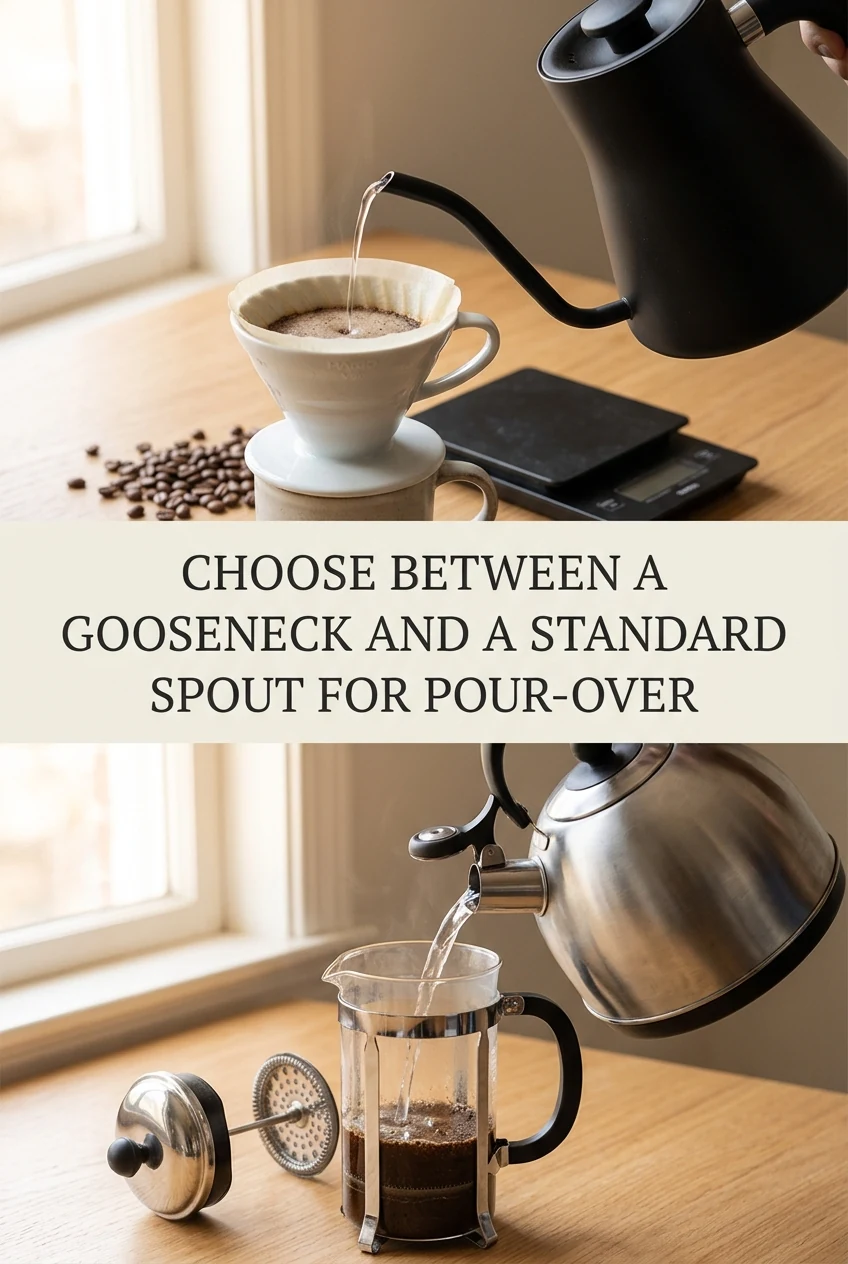
AI-generated editorial concept created for this article. The image is not a technical diagram or a tested result.
What a Gooseneck Spout Does Differently
A gooseneck spout curves upward from the kettle body and narrows toward the tip, typically to around 8 to 10 mm in diameter. This geometry slows the water as it exits and lets you tilt the kettle at a low angle without triggering a surge. The result is a thin, steady stream you can direct precisely onto a specific area of the coffee bed. That control matters when a pour-over recipe calls for a slow bloom pour or a spiral pattern across the grounds.
Where a Standard Spout Falls Short for Pour-Over
A standard kettle spout is wide and positioned at a steep angle, designed for speed rather than precision. When you tilt it gently, little water flows; tilt it further and flow increases sharply with little middle ground. For pour-over brewing, this makes it difficult to deliver a consistent 30 to 40 gram bloom pour without accidentally flooding the grounds. The inconsistency affects extraction evenness, though the degree of impact varies by brewer experience and the specific dripper used.
Where a Standard Spout Works Fine
French press brewing requires pouring a full volume of water over coarse grounds quickly and evenly, then waiting. A standard spout handles this without difficulty. The same applies to moka pot filling, cold brew concentrate preparation, and any method where precise flow rate is not a variable in the recipe. If your home brewing is limited to these methods, a gooseneck spout offers no practical advantage and buying one solely for these uses is not necessary.
Testing Your Current Kettle Before Buying
Before purchasing a gooseneck kettle, test your existing spout over a scale. Fill the kettle to a typical brewing level, then practice pouring 35 grams of water in approximately 10 seconds into a cup placed on the scale. If you consistently overshoot or the stream surges unpredictably, your spout is limiting your control. If you can hit the target range with reasonable consistency, your current kettle may be sufficient for the pour-over style you are practicing.
Practical Decision Points Before You Buy
A gooseneck kettle is worth the investment if you brew pour-over daily and find flow control genuinely difficult with your current equipment. If you brew pour-over occasionally alongside French press, consider whether a single gooseneck kettle can replace both rather than adding a second. Temperature-variable gooseneck kettles add cost but eliminate a separate thermometer. A basic gooseneck without temperature control is a meaningful upgrade for flow alone and costs less than a variable model.
A little more
to know.
Can I use a gooseneck kettle for French press without any problem?
Yes. A gooseneck kettle pours more slowly, so filling a French press takes slightly longer, but it works without issue. The slower pour does not harm the brew. Many home brewers use one gooseneck kettle for all manual methods without difficulty.
Does kettle material affect how well a gooseneck spout performs?
Material affects heat retention and durability rather than flow control. The spout geometry determines pour precision regardless of whether the kettle body is stainless steel or another material. Focus on spout design and capacity when comparing gooseneck models.
Original editorial guidance and recipe formulations, not independently kitchen-tested. Times are estimates and depend on equipment and product directions. Cooked bases need additional cooling and refrigeration before cold serving. Images are AI-generated illustrations; appearance and yield may vary. Check actual ingredient labels, allergens, and any certification you require. We do not certify products. Read our approach.
Save to Pinterest ↗ANOTHER IDEA FOR THE COUNTER