Choose Between a Ceramic and a Glass Server for Keeping Pour-Over Coffee Warm
After finishing a pour-over, you need somewhere to hold the coffee while you prepare cups or wait for a second person to sit down. A ceramic server and a glass server behave differently once the brew is inside. The choice affects how quickly the coffee cools, how easy it is to judge the volume remaining, and how the vessel handles contact with a kitchen counter. Understanding the practical difference helps you pick the right server for your actual serving window.
Read the note ↓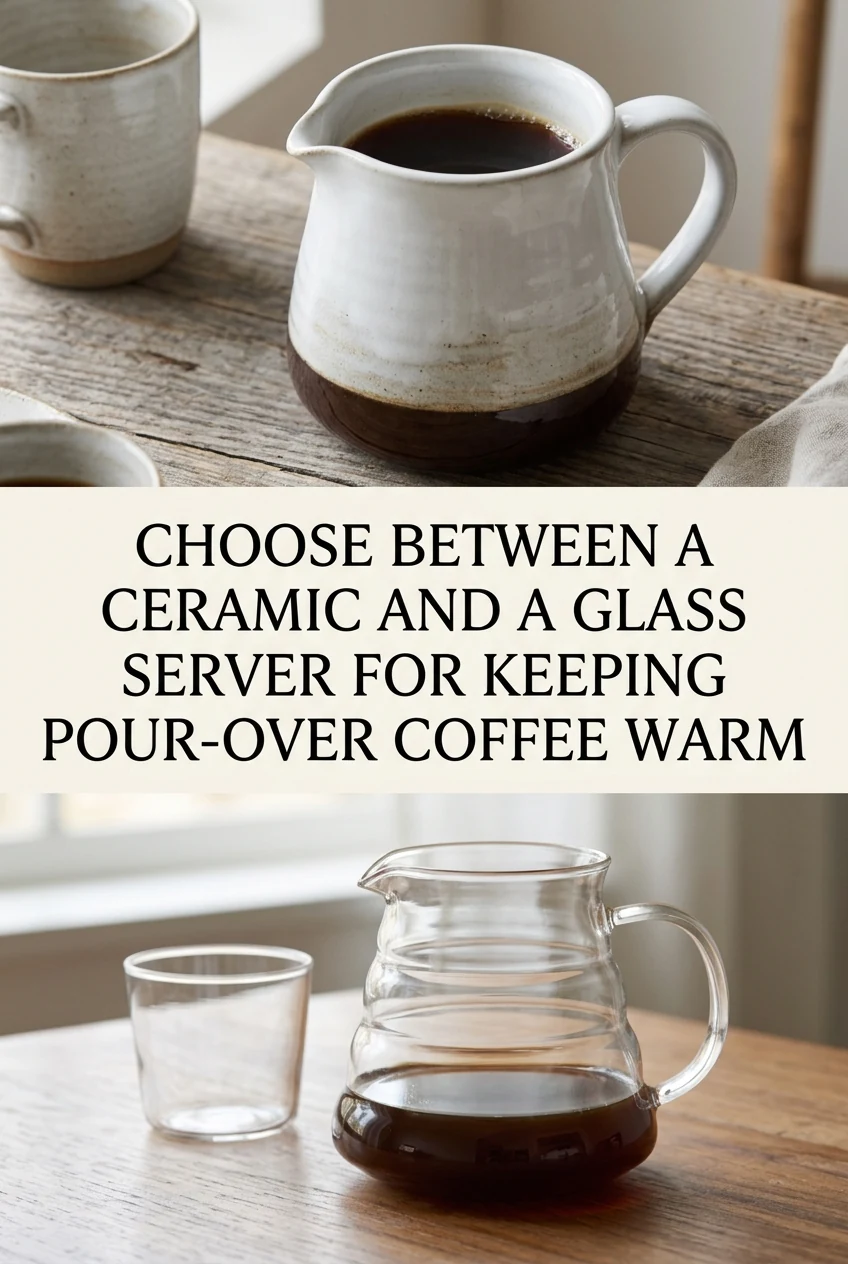
AI-generated editorial concept created for this article. The image is not a technical diagram or a tested result.
How Each Material Handles Heat Retention Differently
Ceramic servers retain heat longer than thin borosilicate glass primarily because of their greater wall thickness and thermal mass rather than lower conductivity. Borosilicate glass actually conducts heat at a rate similar to or lower than dense ceramics, but glass servers are built with much thinner walls. When thoroughly pre-warmed, the substantial mass of a ceramic server absorbs thermal energy from the rinse water and acts as a reservoir, radiating heat slowly back into the brewed coffee over a ten to fifteen minute serving window. By contrast, a lightweight glass server possesses minimal mass to store heat, allowing the brew to cool down more quickly once pouring finishes.
Pre-Warming Makes a Measurable Difference for Both Materials
Filling either server with hot water before brewing and emptying it just before the coffee drips through prevents a cold vessel from quenching your brew. This pre-warming routine is far more critical for ceramic than for glass. Because ceramic is dense and heavy, a cold server acts as a rapid heat sink, drawing several degrees of temperature out of the fresh coffee on first contact. Thin borosilicate glass absorbs very little initial heat due to its low mass, though it starts releasing heat to the room shortly afterward. Rinsing either vessel with hot kettle water prepares the material without adding complicated steps to your morning brew.
Glass Lets You Monitor Volume Without Lifting the Server
A clear glass server lets you see exactly how much coffee remains without picking it up or tilting it. This is useful when you are serving two or three cups and want to judge whether there is enough for a refill before committing to pouring. Ceramic servers require you to lift and tilt or use a marked scale on the side if one is present. For a single-person session, this difference is minor, but for two or more people it affects serving flow.
Counter Material and Kitchen Temperature Affect the Decision
A ceramic server placed on a cold stone or tile counter loses heat rapidly through its base unless insulated by a wooden trivet, silicone mat, or folded cloth. The same principle applies to glass. Dense countertop materials like granite or quartz pull heat away by conduction much faster than surrounding air. In a warm kitchen, both vessels maintain their temperature longer than in a cool, drafty space, which narrows the practical retention gap between thick ceramic and thin glass. Protecting the base of either server helps preserve the temperature of the finished coffee.
Match the Server to Your Actual Serving Window
If you typically pour and serve within five minutes of finishing the brew, either material works adequately with pre-warming. If you regularly wait ten minutes or more before serving, a pre-warmed ceramic server is the more practical choice for maintaining temperature. If visual volume monitoring matters more to you than maximum heat retention, a glass server suits your workflow better. Neither choice requires a coaster warmer or any electrical accessory to function well within a normal home serving window.
A little more
to know.
Does the lid on a server make a bigger difference than the material it is made from?
A well-fitting lid reduces heat loss from the top surface significantly, regardless of material. If your glass server has a lid and your ceramic server does not, the lidded glass server may outperform the open ceramic one during the same serving window.
Can I place either server directly on an electric warming plate designed for carafes?
Only if the server is explicitly rated by its manufacturer for use on a warming plate. Check the product documentation for your specific server before placing it on any heat source, as not all ceramic or glass servers are designed for base heating.
Original editorial guidance and recipe formulations, not independently kitchen-tested. Times are estimates and depend on equipment and product directions. Cooked bases need additional cooling and refrigeration before cold serving. Images are AI-generated illustrations; appearance and yield may vary. Check actual ingredient labels, allergens, and any certification you require. We do not certify products. Read our approach.
Save to Pinterest ↗ANOTHER IDEA FOR THE COUNTER