Choose a Small Spatula That Reaches a Jar's Bottom Corners
A jar of tahini, date paste, or thick fruit preserve hides a surprising amount of usable product in its bottom corners. The right small spatula lets you reach that material cleanly without tilting the jar or scraping blindly with a spoon. This article walks through how to compare blade width, flexibility, and neck clearance using the actual empty jars you own, so you can choose a spatula that genuinely fits before you commit to a technique.
Read the note ↓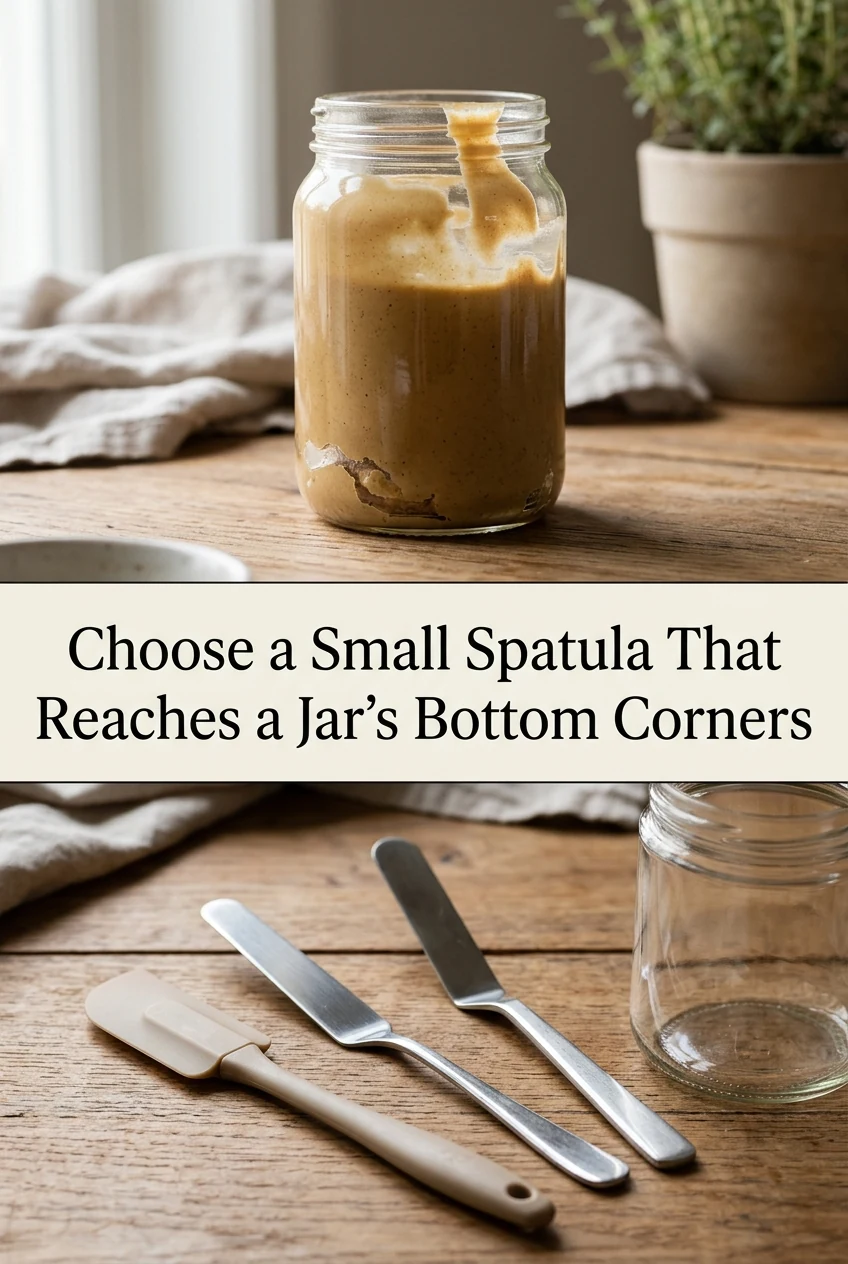
AI-generated editorial concept created for this article. The image is not a technical diagram or a tested result.
Why Jar Geometry Matters Before You Buy
Jars are not uniform. A 300 g tahini jar might have a neck opening of 48 mm while a 250 g date-paste jar opens to only 38 mm. The bottom corners of both jars curve inward at different radii. If a spatula blade is wider than the neck, it cannot enter the jar at all. If the blade is narrower than the neck but stiffer than the corner curve, it presses flat against the side wall and misses the corner entirely. Measuring your actual jars with a simple ruler before shopping removes guesswork. Write down the neck diameter and the approximate corner radius of each jar you use regularly. Those two numbers become your shopping filter.
Blade Width and Neck Clearance: A Practical Check
Hold a clean, empty jar up to the light and drop a ruler across the opening to read the inner neck diameter. Subtract roughly 6 mm to allow the blade to enter and pivot without jamming against the glass. That result is your maximum usable blade width. For example, a jar with a 44 mm inner neck diameter suggests a blade no wider than about 38 mm. At a kitchen-supply counter, lay candidate spatulas across the jar opening before purchasing. A blade that clears the neck with a few millimetres to spare on each side will pivot freely inside. One that fits too snugly will wedge and make controlled scraping difficult. This comparison using your own containers is more reliable than any printed size chart.
Flexibility and Corner Contact
Blade flexibility determines whether the tip can bend to follow the curved corner at the base of the jar. A completely rigid blade touches only the flat centre of the bottom and skips the corners. A blade that is too floppy collapses under the pressure needed to move thick paste. The useful middle ground is a blade that holds its shape under light hand pressure but deflects noticeably when you press the tip against a hard surface with moderate force. To compare two candidate spatulas without purchasing both, press each tip against the edge of a countertop at roughly a 30-degree angle. The blade that bends smoothly without kinking and springs back flat is likely to conform to a jar corner without tearing or folding. This is an illustrative check, not a calibrated test, but it gives you a practical sense of relative stiffness before you choose.
A Worked Example: Scraping a Tahini Jar
Suppose you have a 300 g tahini jar with a 48 mm inner neck opening and gently curved bottom corners. Using the arithmetic above, you look for a blade no wider than about 42 mm. You find a silicone jar spatula at a kitchen shop with a 35 mm blade width and a medium-flex rating on the packaging. You drop it into the empty jar at home: it enters the neck cleanly, pivots left and right without touching the glass walls, and when you press the tip into a bottom corner the blade curves just enough to make contact across the curve. You then spoon the remaining tahini from a nearly finished jar, use this spatula to collect what clings to the bottom and sides, and transfer it to a clean bowl for immediate use in a sauce. Because tahini is a perishable once the jar is opened and mixed with other ingredients, any prepared sauce goes into the refrigerator promptly and is used within the timeframe your recipe source recommends. The spatula is rinsed and washed after each use according to normal dishwashing practice.
Keeping the Technique Honest
A small spatula that fits your jar well is a practical convenience, not a precision instrument. The neck-clearance arithmetic gives you a reasonable starting point, and the flexibility check gives you a rough comparison between options, but neither guarantees a perfect outcome for every jar shape. Jars with pronounced shoulder curves or very narrow necks may still limit access regardless of blade width. Treat each new jar as a fresh fit check using the same empty-container method. Clean the spatula between uses, store it where it stays dry, and replace it if the blade develops tears or permanent bends that prevent flat contact with a surface. Following the maker's care instructions for the specific spatula you choose will keep it in working condition longer than any general rule.
A little more
to know.
Can I use the same small spatula for both narrow-neck spice jars and wide-mouth preserve jars?
A blade narrow enough to enter a spice jar will usually also fit a wide-mouth jar, but it may be shorter than ideal for reaching the bottom of a tall wide jar. Check the blade length against the jar depth as well as the blade width against the neck opening. You may find that two spatulas of different widths serve different jar types better than one spatula trying to cover both.
Does blade material affect how well it reaches jar corners?
Silicone blades are common for this task because they flex without scratching glass and are easy to wash. The specific flexibility of any silicone blade varies by thickness and formulation, so two spatulas both described as silicone may feel noticeably different. The countertop press check described in this article gives you a way to compare stiffness between specific products rather than relying on material labels alone.
Original editorial guidance and recipe formulations, not independently kitchen-tested. Times are estimates and depend on equipment and product directions. Cooked bases need additional cooling and refrigeration before cold serving. Images are AI-generated illustrations; appearance and yield may vary. Check actual ingredient labels, allergens, and any certification you require. We do not certify products. Read our approach.
Save to Pinterest ↗ANOTHER IDEA FOR THE COUNTER