Choose a Covered Dish for Transporting Plain Biscuits Across the House
A home cafe setup often means carrying a small plate of plain biscuits from the kitchen to a side table near the espresso machine or cocoa station. The walk is short, but an uncovered plate lets crumbs scatter and exposes the biscuits to steam or splashes near brewing equipment. Choosing a covered dish that actually fits your biscuits, sits flat in your hands, and has a lid that stays on during the short trip makes the routine tidier and more deliberate. This article walks through a practical selection approach, illustrated with one worked example, so you can apply the same thinking to whatever dish you already own or plan to buy.
Read the note ↓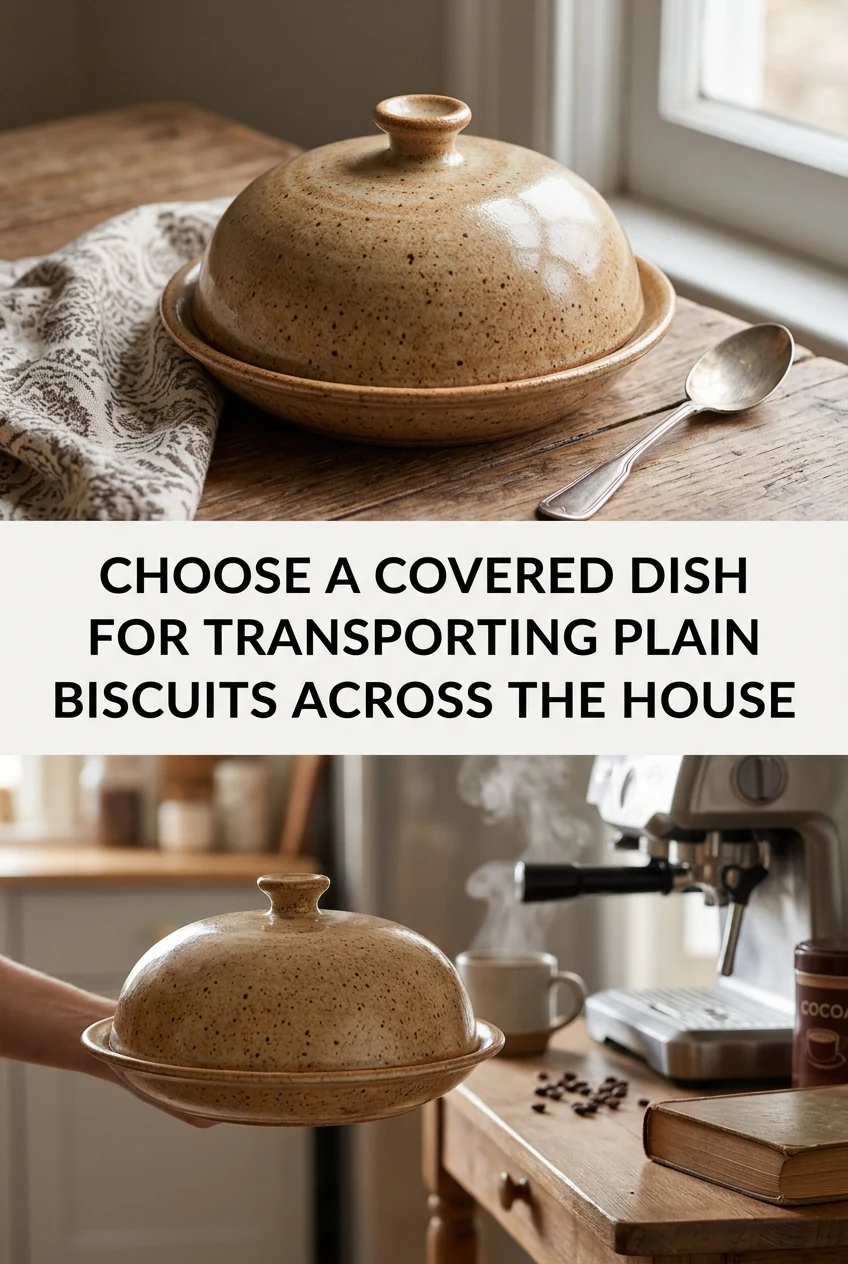
AI-generated editorial concept created for this article. The image is not a technical diagram or a tested result.
Measure Your Biscuits Before You Measure Anything Else
Plain biscuits vary in diameter and height depending on the recipe or brand. Before looking at any dish, place three or four biscuits in a single layer on a flat surface and measure the footprint they occupy together. Note the height of one biscuit standing upright, then decide whether you want them lying flat or standing on edge. Lying flat is more stable for transport. In the worked example used throughout this article, four round plain biscuits each measure 7 cm across and 1 cm thick. Arranged in a two-by-two grid, they occupy roughly 15 cm by 15 cm and stand 1 cm tall. These numbers become the minimum interior dimensions the dish must meet.
Match Interior Dish Dimensions to the Biscuit Footprint
A dish that is too wide lets biscuits slide into each other on every step. A dish that is too narrow forces you to stack biscuits, which can crush delicate edges. Aim for an interior floor area that fits your biscuit arrangement with no more than 1 to 2 cm of clearance on each side. For the worked example, a dish with an interior floor of 17 cm by 17 cm gives roughly 1 cm of clearance on each side of the two-by-two arrangement, which keeps the biscuits from sliding significantly without cramping them. Check the interior measurement, not the exterior, because dish walls take up space. A ceramic serving dish with 4 mm walls on each side means the exterior reads about 18 cm across while the interior is the usable 17 cm.
Evaluate the Lid for Clearance and Grip
The lid must clear the tallest point of the biscuits without pressing down on them. In the worked example, the biscuits are 1 cm tall, so a lid with at least 1.5 cm of interior clearance from the rim to the underside of the dome or flat surface is sufficient. Check this by placing the lid over the biscuits before committing to the dish. A lid that rests on the biscuits will crack or compress them when you pick up the dish. Also check that the lid has a handle or a raised edge you can grip with one hand while the other hand supports the base. A lid that requires two hands to remove is awkward when you are standing at a small table next to brewing equipment. Fit and stability should be confirmed with the actual dish and lid together, not assumed from the product description alone.
Consider Material, Weight, and Surface Stability
Ceramic and stoneware dishes are heavier but sit flat and do not flex. A lightweight plastic container with a snap lid is easier to carry one-handed but may slide on smooth surfaces when set down. Whichever material you choose, place the loaded dish on the surface where you plan to set it down and check that it does not rock. A dish with a flat, unglazed foot ring tends to grip a wooden or tiled surface better than a fully glazed base. For the worked example, a shallow ceramic dish with a flat foot ring and a domed ceramic lid with a small knob handle was selected. The combined weight when loaded with four biscuits is manageable with one hand under the base, and the foot ring sits without rocking on the wooden side table used in this plan.
Carry the Dish Safely Away From Brewing Equipment
Once you have confirmed fit and stability at home, establish a carrying path that does not pass directly over an active espresso machine, kettle, or cocoa warmer. Steam and heat from brewing equipment can affect both the biscuits and your grip. In the worked example, the route goes from the kitchen counter, around the side of the espresso station rather than over it, and directly to the side table. The dish is carried with one hand flat under the base and the other hand lightly steadying the lid knob. This is an illustrative plan based on the layout described, not a universally tested result. Your own space may require a different path. The goal is a deliberate, short route that keeps the covered dish level and away from heat sources and steam.
A little more
to know.
Can I use a dish with a glass lid instead of a ceramic one?
Yes, provided the glass lid fits the dish securely, has adequate interior clearance above the biscuits, and includes a handle you can grip comfortably. Check that the glass lid does not wobble on the rim of the dish before using it for transport. A loose-fitting glass lid is more likely to slide off during the walk than a snug ceramic one.
Do plain biscuits need to be refrigerated after being placed in the covered dish?
Plain biscuits made without cream, custard, or other perishable fillings or toppings do not typically require refrigeration for a short serving period, but follow the specific guidance that came with your recipe or the product packaging. If your biscuits include any perishable ingredient, refrigerate them promptly according to those instructions and do not leave them at room temperature for extended periods.
Original editorial guidance and recipe formulations, not independently kitchen-tested. Times are estimates and depend on equipment and product directions. Cooked bases need additional cooling and refrigeration before cold serving. Images are AI-generated illustrations; appearance and yield may vary. Check actual ingredient labels, allergens, and any certification you require. We do not certify products. Read our approach.
Save to Pinterest ↗ANOTHER IDEA FOR THE COUNTER