Build a Layered Iced Rooibos and Apricot Drink Using Two Separate Pours
Pouring chilled rooibos concentrate and apricot nectar into the same glass without stirring them first produces a visible two-tone layer that holds long enough to set in front of a guest. The effect depends on density difference between the two liquids and on keeping both cold before assembly. This guide covers concentrate strength, ice quantity, pour order, and the small adjustments that keep the boundary clear from counter to table.
Read the note ↓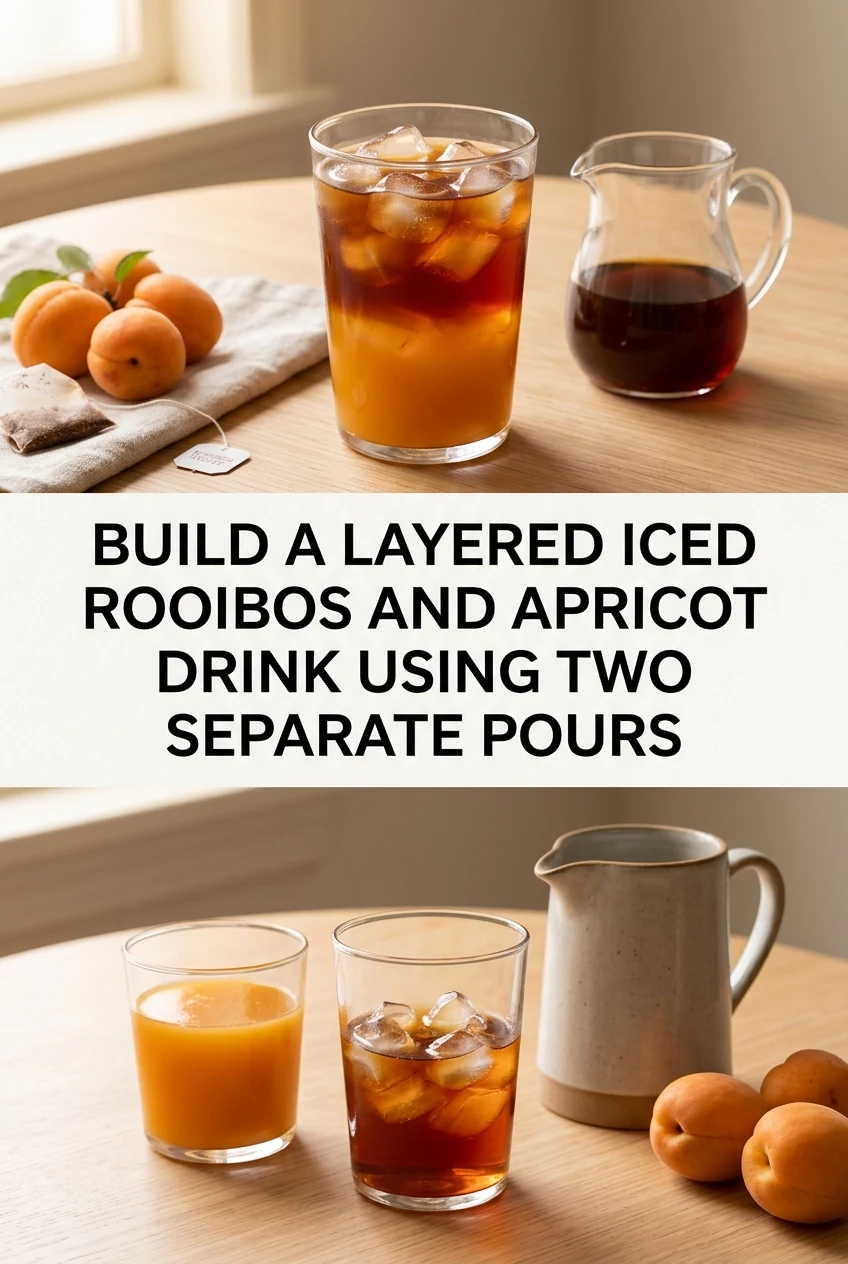
AI-generated editorial concept created for this article. The image is not a technical diagram or a tested result.
Brew the Rooibos Concentrate
Use three rooibos tea bags per 240 ml of just-boiled water and steep for eight minutes. Remove the bags without squeezing them to keep the concentrate clear and free of cloudy sediment. Let the concentrate cool to room temperature, then refrigerate it until fully cold, at least two hours. Cold concentrate is essential because a warm pour melts ice quickly and disrupts the density boundary before the drink reaches the table.
Choose and Measure Your Apricot Nectar
Use a commercially bottled apricot nectar rather than a thin juice. Nectar carries more dissolved fruit solids, which gives it a slightly higher density than the rooibos concentrate. For a 350 ml serving glass, measure 90 ml of cold nectar. Chill the bottle in the refrigerator before assembly. Pouring warm nectar over ice collapses the layer because the temperature difference causes rapid mixing currents inside the glass.
Fill the Glass With Ice and Pour the First Layer
Fill a tall 350 ml glass to within 3 cm of the rim with ice cubes, not crushed ice. Crushed ice compacts and melts unevenly, which blurs the boundary. Pour the 90 ml of chilled apricot nectar into the glass first. Because the nectar is dense with fruit solids and natural sugars, it settles easily at the bottom of the glass around the ice cubes. Pause for ten seconds before the second pour so the liquid settles and the ice stops shifting.
Add the Rooibos Concentrate as the Second Pour
Hold a spoon bowl-side down just above the surface of the nectar, touching an ice cube, and pour roughly 120 ml of chilled rooibos concentrate slowly over the back of the spoon. The spoon breaks the stream's momentum so the lighter rooibos floats atop the denser nectar rather than plunging into it. The rooibos forms a clear reddish-amber layer above the opaque golden nectar. This is an illustrative example of the technique; actual layer sharpness varies with nectar brand and ice fill.
Serve Promptly and Manage Guest Expectations
The layer begins to diffuse within four to six minutes as the ice melts and temperatures equalise. Serve the drink immediately after assembly and let the guest stir it themselves when ready to drink. Offering a long spoon or reusable straw alongside the glass signals that mixing is the next step. Do not attempt to rebuild the layer once it has diffused; simply stir and enjoy the blended result.
A little more
to know.
Can I use a rooibos tea bag blend that includes fruit flavouring?
Yes, flavoured rooibos blends work, but check that any added flavouring is alcohol-free. The layering behaviour depends on brew strength and temperature, not on whether the rooibos is plain or blended.
Does the type of glass affect how well the layer holds?
A straight-sided tall glass shows the separation line more clearly than a wide or flared one. Straight walls keep the boundary surface area consistent as you build the drink, whereas flared walls allow the incoming rooibos pour to spread unevenly and increase mixing at the edge.
Original editorial guidance and recipe formulations, not independently kitchen-tested. Times are estimates and depend on equipment and product directions. Cooked bases need additional cooling and refrigeration before cold serving. Images are AI-generated illustrations; appearance and yield may vary. Check actual ingredient labels, allergens, and any certification you require. We do not certify products. Read our approach.
Save to Pinterest ↗ANOTHER IDEA FOR THE COUNTER